
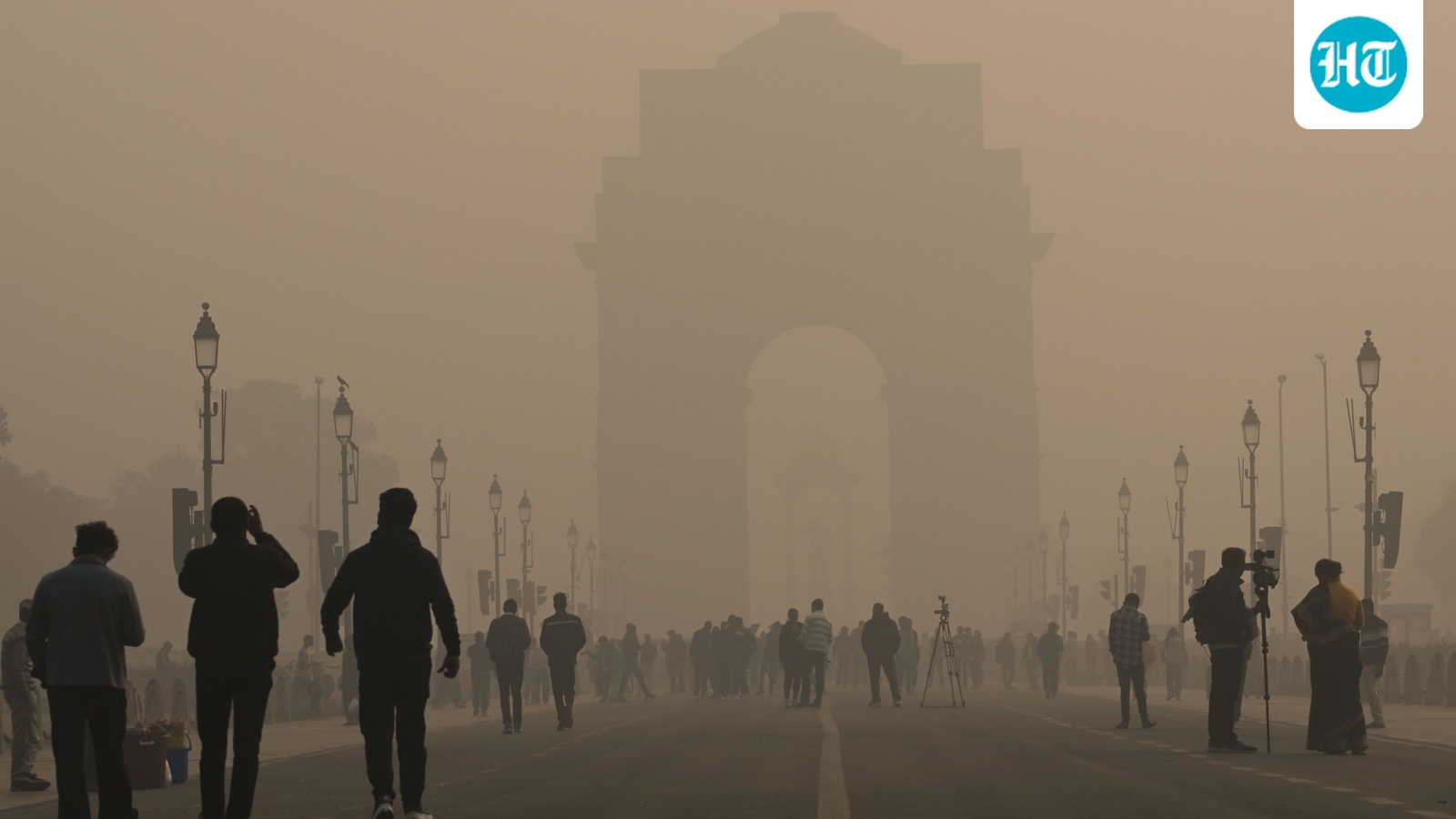
Delhi's air quality remained in the 'very poor' category for the fourth consecutive day on Thursday. The air quality index was recorded at 368 at 7.05 am. Many areas across the city showed severe pollution levels, as a thick haze continued to cover the skyline throughout the morning hours.
Delhi's air quality remained in the 'very poor' category for the fourth consecutive day on Thursday, as a thick haze continued to engulf the Capital's skyline.
Delhi's air quality index (AQI) was recorded at 368 at 7.05 am. The 24-hour average AQI on Wednesday was 377, compared with 350 on Tuesday and 324 on Monday. Last Friday, the city recorded an AQI of 60, in the "satisfactory" category, making it the cleanest October day in four years.
Eighteen of the city's 59 reporting stations recorded AQI readings in the severe category, 36 in the very poor category, and 5 in the poor category.
Jahangirpuri recorded the worst AQI at 459, followed by IIT-Delhi and Punjabi Bagh at 447 and 446, respectively. Okhla Phase II (399), Burari Crossing (397), ITO (397), Dwarka Sector 8 (396), Mandir Marg (393) and Jawaharlal Nehru Stadium (391) recorded readings close to the severe category.
The Central Pollution Control Board (CPCB) classifies AQI readings of 0-50 as "good", 51-100 as "satisfactory", 101-200 as "moderate", 201-300 as "poor", 301-400 as "very poor" and 401-500 as "severe".
At 7 am, CPCB listed PM2.5 as the main pollutant at 53 of Delhi's 59 reporting stations and PM10 at the remaining six. At the same time a day earlier, the corresponding counts were 54 and five.
NASA's satellite detected 2,251 farm fires in Punjab and Haryana between October 1 and November 4 (2,025 in Punjab and 226 in Haryana), including 246 on November 4. During the corresponding period last season, it detected 2,579 fires.
However, the comparison needs to be read with caution as stubble burning has shifted to later hours over the years. Nearly 98% of the fire heat recorded by Meteosat in 2025 came after 3 pm, compared with 94% in 2024. The difference in the two seasonal counts could partly be explained by this shift. Both figures are also underestimates, as much of the burning now takes place after the satellite passes over the region at around 1.45 pm.