
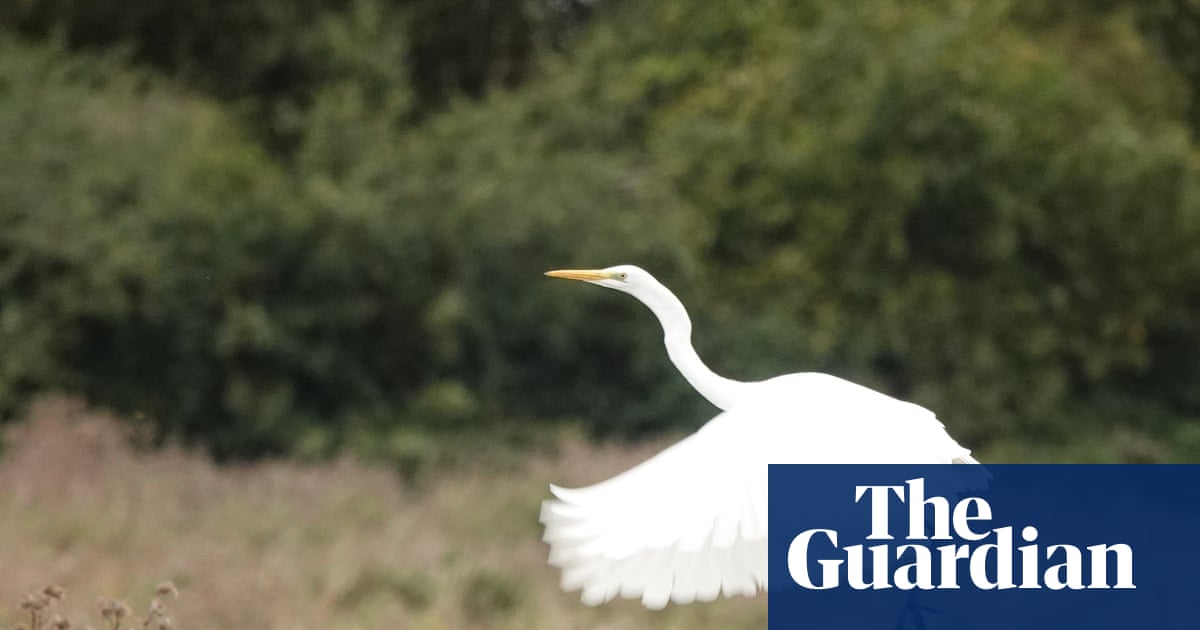
Thirteen great egrets appeared in a dry Cambridgeshire field at Ouse Fen. Once pushed to the edge of extinction by the feather trade, the species started to breed in 2010. Now, this former agricultural land is a rich wetland where many birds and animals thrive in a large, restored habitat.
Ouse Fen, Cambridgeshire: The great egret's story is remarkable, as is the conversion of this low-grade agricultural land into one of the richest wetlands in Britain
In keeping with this region's summer of torrid heat and drought, the field by the path was an expanse of burnt, dead thistles. What was totally unexpected were the 13 great egrets among it. Ironically, the birds may well be here as a consequence of the climate crisis, but their appearance in a parched brown expanse felt strange.
First, they are creatures of freshwater marsh and routinely hunt fish. Second, great egrets are the size of grey herons, but pure white, aside from lemon eyes and dagger-like beaks of pale autumnal orange. What was weirdest of all was the gestalt whole; the way they threaded through that horizon of brown, long necks extending and retracting like winding snakes, and all this gleaming intensity focused on catching voles. Then a bird would fly, the white rope of its neck rising, followed by a ragged cloak of wings, turning eventually to the stolid beat of heavy flight.
What is perhaps strangest of all - although birdwatchers have long since normalised those developments - is that here's a species that was brought to the edge of extinction by the Victorian trade in feathers for haute couture. The species slowly recovered and expanded massively in Europe until it colonised our shores at the beginning of the century. It started to breed in 2010, and by 2019 there were 24 nesting pairs. But the winter total may reach four figures.
Great egrets hunting in a Cambridgeshire field of dead vegetation might be a good news story. Yet the wider tale of Ouse Fen is astonishing. In an innovative partnership between a gravel-extraction business and the RSPB, the whole floodplain has been gradually converted from low-quality agricultural land into one of the richest, most dynamic wetlands in Britain, whose total area will be 3,000 hectares (7,410 acres).
It is already hoaching with wetland wildlife such as water voles and bitterns, spined loaches and marsh harriers. Extensive archaeological work on the other parts of the site has revealed that its most abundant bone material from the Neolithic is remains of beavers and dalmatian pelicans. Given this evidence of its past, who would dare predict what its future might be?
Under the Changing Skies: The Best of the Guardian's Country Diary, 2018-2024 is published by Guardian Faber; order at guardianbookshop.com and get a 15% discount