
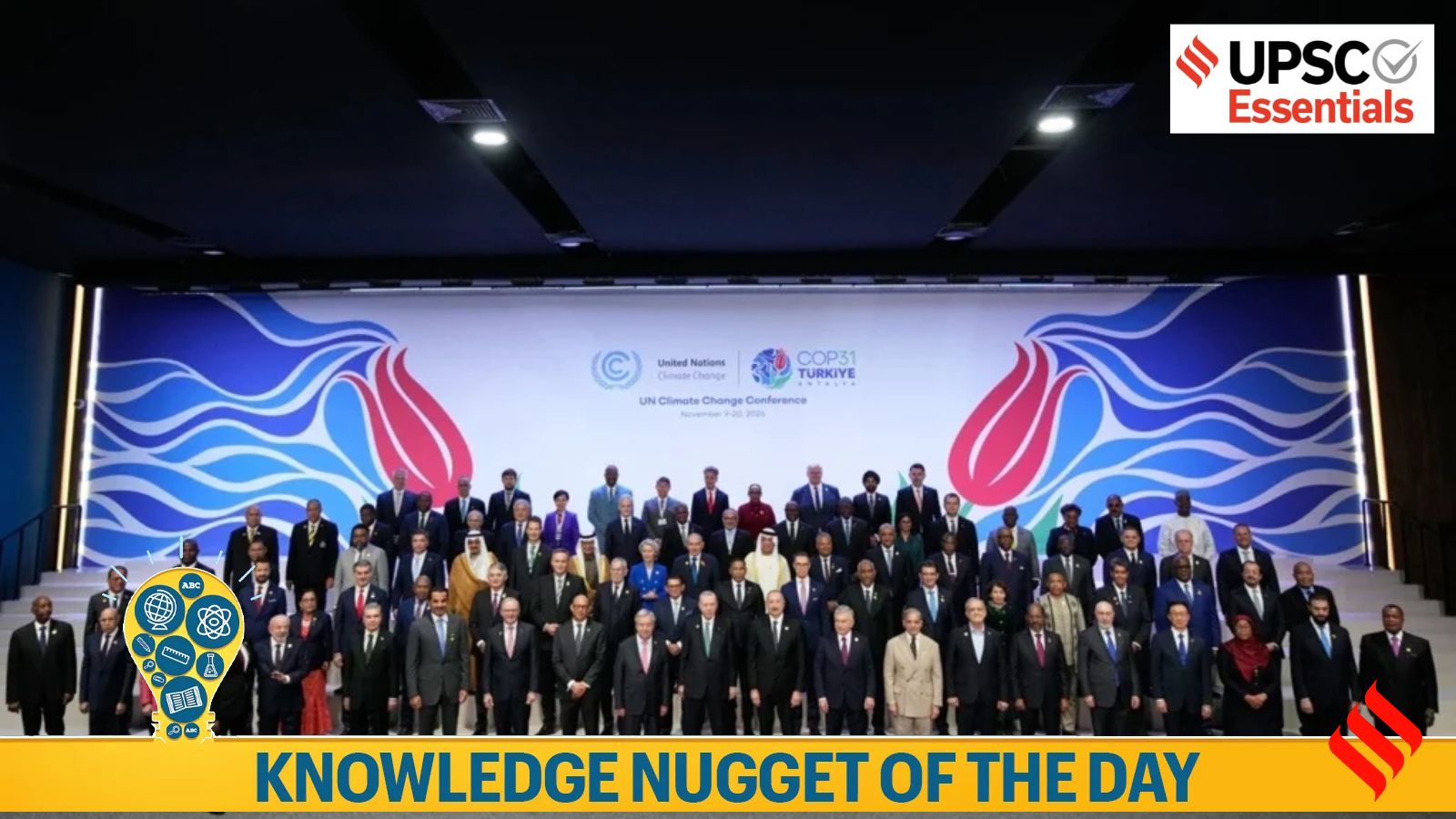
The revised COP31 draft circulated on November 19 dropped references to phasing out fossil fuels. Climate finance remains a major point of contention, as a proposed $120 billion adaptation target was removed. Environment Minister Bhupender Yadav said India wants climate justice and equitable access to the remaining global carbon budget.
To understand what is at stake in the global climate negotiations, let’s examine COP31’s key developments, the fault lines over climate finance, and India’s approach to climate justice and equitable development.
Key Takeaways:
1. The revised draft agreement circulated on November 19 dropped references to phasing out fossil fuels that had appeared in an earlier version. The draft retained the commitment to pursue the 1.5°C temperature goal and limit the duration and magnitude of any overshoot. However, a proposed work programme on pathways to return to 1.5°C after overshooting the threshold was dropped.
2. Türkiye proposed increasing electricity’s share in global final energy consumption from approximately 23% to 35% by 2035. The proposal was initially voluntary but subsequently appeared in the negotiated draft text.
3. Adaptation and climate resilience:
— The Global Goal on Adaptation (GGA), established under the Paris Agreement, seeks to enhance adaptive capacity, strengthen resilience and reduce vulnerability to climate change. COP31 discussions included indicators to measure progress on adaptation, building on the work initiated at COP30 in Belém.
— A proposed specific adaptation-finance target of $120 billion was dropped from the revised draft, highlighting continuing disagreements over financial support.
4. Climate finance:
— At COP31, climate finance remained a major point of contention, particularly over the scale, accessibility and nature of funding for developing countries. The New Collective Quantified Goal (NCQG), calls on developed countries to lead the mobilisation of $300 billion annually by 2035. The broader Baku-to-Belém Roadmap aims to scale up finance from public and private sources to $1.3 trillion annually by 2035.
— On loss and damage, COP31 discussions continued on the Fund for Responding to Loss and Damage, which supports countries particularly vulnerable to climate change. These negotiations carried forward the efforts initiated at COP30 in Belém.
5. India’s position and priorities at COP31:
— Environment Minister Bhupender Yadav emphasised climate justice, equity and Common but Differentiated Responsibilities and Respective Capabilities (CBDR-RC). India called for equitable access to the remaining global carbon budget and argued that developing countries should not bear an unjustified burden for historical emissions.
— India urged developed countries to fulfil their obligations under Article 9.1 of the Paris Agreement, stressing predictable and accessible public finance. It advocated a Party-guided, country-driven Just Transition Mechanism (JTM) that accounts for national circumstances, employment, social protection, poverty eradication and energy access.
— Transboundary river cooperation: Responding to Pakistan Prime Minister’s remarks on water-sharing agreements, Yadav said transboundary water cooperation could promote shared prosperity but could not rely on “archaic mechanisms” or be separated from broader bilateral relations. The remarks came after India placed the 1960 Indus Waters Treaty (IWT) in abeyance following the April 2025 Pahalgam terror attack. India has cited demographic and developmental pressures, climate change and technological advances as reasons for seeking renegotiation of the Treaty.
— Small Island Developing States (SIDS): India offered technical and scientific support in areas such as renewable energy, disaster preparedness and resilient infrastructure. Its Infrastructure for Resilient Island States (IRIS) initiative, launched in 2021 under the Coalition for Disaster Resilient Infrastructure (CDRI), supports small island countries through disaster-resilient infrastructure and preparedness measures.
— Electrification target: India did not commit to Türkiye’s proposed 35-by-2035 target, which seeks to raise electricity’s share in global final energy consumption from 23% to 35%. India maintained that voluntary Presidency Action Agenda initiatives should remain separate from formal negotiations and that global targets must respect national circumstances.
BEYOND THE NUGGET: Understanding the concept of climate finance and global climate governance
1. What is Climate Finance?
— Climate finance refers to funding from public, private and alternative sources at local, national or international levels to support climate action. It covers mitigation (reducing greenhouse gas emissions through renewable energy and energy efficiency) and adaptation (preparing for climate impacts through resilient infrastructure, flood protection and early-warning systems).
— Adaptation often requires public or grant-based finance because its benefits may not generate direct commercial returns.
2. New Collective Quantified Goal (NCQG):
— Agreed at COP29 in Baku (2024), the NCQG calls on developed countries to take the lead in mobilising at least $300 billion annually by 2035 for developing countries.
— The broader ambition is to scale up finance from all sources to at least $1.3 trillion annually by 2035.
— The Baku-to-Belém Roadmap outlines pathways towards this larger goal, including grants, concessional and other non-debt-creating finance.
3. Climate finance principles and governance:
— International climate finance is guided by equity and Common but Differentiated Responsibilities and Respective Capabilities (CBDR-RC).
— Under Article 9.1 of the Paris Agreement, developed countries must provide financial resources to developing countries for mitigation and adaptation.
— Articles 9.3 and 9.4 address the mobilisation of finance and the balance between mitigation and adaptation, recognising the importance of public and grant-based resources.
— Green Climate Fund (GCF): Established in 2010 under the UNFCCC financial mechanism, it supports low-emission and climate-resilient development in developing countries.
— Adaptation Fund: Established under the Kyoto Protocol framework, it finances concrete, country-driven adaptation projects in developing countries.
— Fund for Responding to Loss and Damage (FRLD): Established at COP27 and operationalised at COP28, it supports particularly vulnerable developing countries in responding to climate-related loss and damage.
— Multilateral Development Banks (MDBs): Institutions such as the World Bank provide climate finance, concessional lending, guarantees and technical assistance.
— The United Nations Framework Convention on Climate Change (UNFCCC) Secretariat supports climate negotiations and implementation, while the Intergovernmental Panel on Climate Change (IPCC) assesses scientific evidence and does not negotiate climate agreements.