
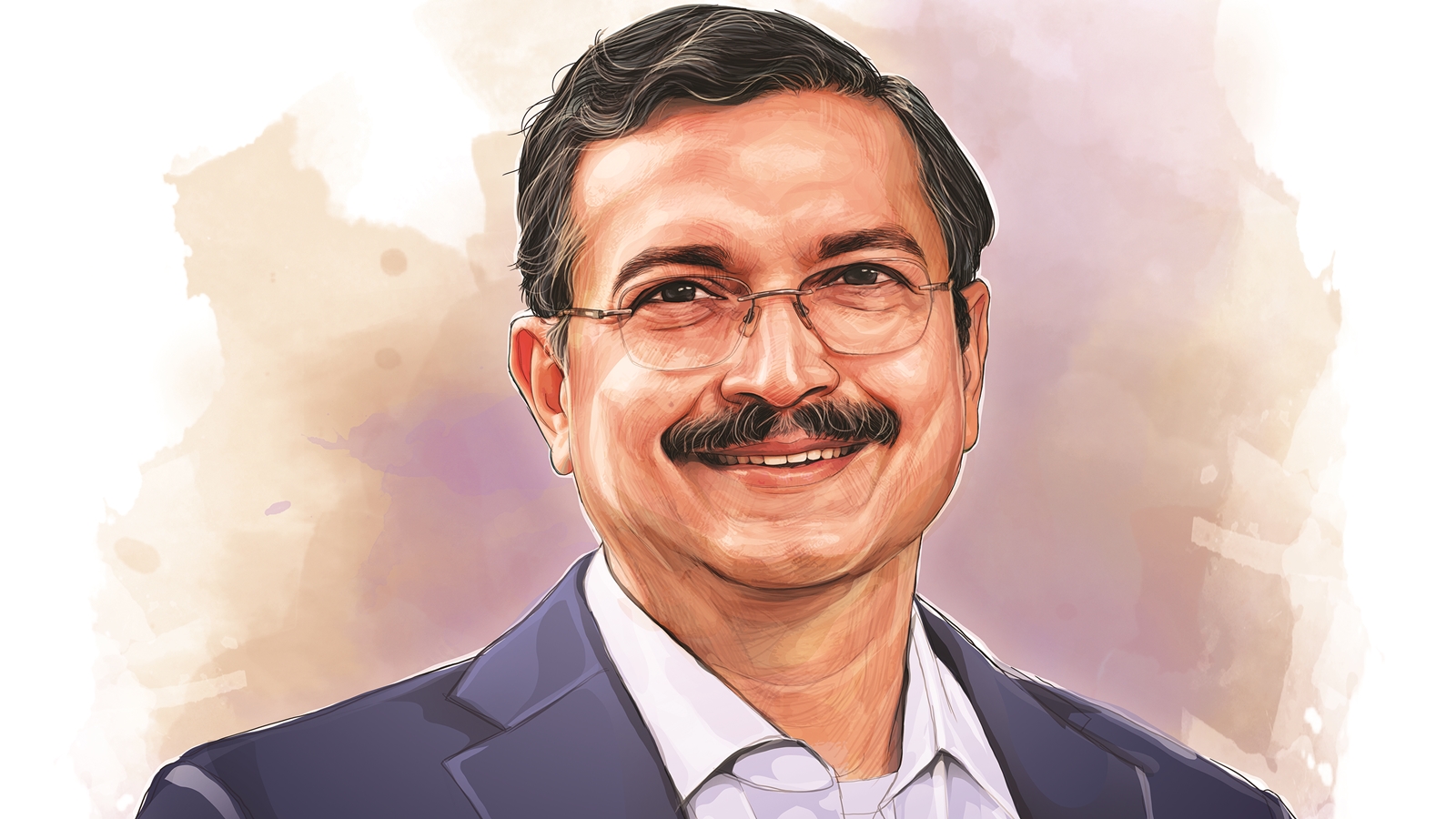
IIT Kanpur professor Sachchida Nand Tripathi said India needs to cross a threshold in clean energy and transport to improve air quality. While farm fires in Punjab, Haryana and Uttar Pradesh fell compared to 2025, he noted that many people still use solid fuel, which keeps pollution levels high.
Sachchida Nand Tripathi is a professor at IIT Kanpur. Known for his expertise in air pollution, he advises the government in various capacities and is part of different committees related to air pollution in Central and State governments.
IIT Kanpur professor Sachchida Nand Tripathi on the gaps in India's air pollution response, the need to link health impacts to different pollution levels and why we can't see clouds in Delhi. He was in conversation with Amitabh Sinha, Deputy Editor, and Nikhil Ghanekar, Assistant Editor, of The Indian Express
Amitabh Sinha: It has been more than a decade since we have been taking concrete measures to fight air pollution. But despite the monitoring issue being addressed adequately, there hasn't been even marginal improvement in air quality. If anything, the situation gets worse every year. Where is the gap?
Monitoring has helped address several issues. In the three major states known to have farm fires -- Punjab, Haryana and Uttar Pradesh -- there has been a marginal decrease in fire counts compared to 2025.
We have possibly not seen the improvements we would like because there is a threshold that needs to be crossed in transitioning to cleaner sources of energy and transportation. A large fraction of the population still uses solid fuel for cooking. Delhi's particulate loading is also contributed by traffic exhaust. To see significant difference, we need major changes in these two sectors and bring farm fires down to a much lower level.
Nikhil Ghanekar: The Central Pollution Control Board (CPCB) recently clarified why readings went blank on Diwali night when pollution levels crossed a certain threshold. Should we continue with this kind of cap? How can it affect our response, given that short periods of high exposure can affect vulnerable populations?
Every machine is calibrated for a particular range. Beyond that, its accuracy starts going down. So, I would not worry much if readings cross the range for which the machine is calibrated. There are other ways of monitoring pollution in Delhi, including sensors and satellites, which provide reasonably accurate information. If the government monitoring network is unable to provide information momentarily, multimodal data from other sources should still give us the complete picture.
On linking health with AQI levels | Even at 200 and 300, clear health outcomes have to be specified so that citizens know what is happening to them. This could give policymakers a better understanding to speed up measures
Nikhil Ghanekar: Do we need to move beyond generalising AQI above 500 as hazardous for all and specify how severe the health impact can be at different levels?
Health outcomes have to be precisely linked to different AQI levels. Even at 200 and 300, clear health outcomes have to be specified so that citizens know what is happening to their health. This could also give policymakers a much better understanding and help speed up measures.
Sarwat Fatima: How do you control pollution practically when every solution -- be it for firecrackers, cars, factories and construction -- is met with an argument?
A study we conducted across the NCR and the Gangetic plain states between October 8 and February 8, looked at the primary emission sources: informal-sector burning, stubble burning and industries. If these three sources are reduced by 80 per cent, Delhi's AQI, which was around 290 last year, could come down to 120-130.
There are win-win solutions. If every household has access to LPG and electricity for space and water heating, burning can be eliminated. If waste burning on roads is completely stopped, AQI can reach 120-130. Similarly, if we increase the number of buses, all electric, AQI could come down to 70-80 or even 60.
Nikhil Ghanekar: If you were an administrator rather than a scientist, what are the issues you would immediately address to reduce pollution? And what is the silver lining in the measures taken so far?
The Delhi-NCR region now has a fairly dense monitoring network. We are also working with agencies to create a hybrid monitoring network, undertake hyperlocal monitoring and identify gaps where interventions can be designed in time.
Many emissions blind spots need attention -- waste that is not properly managed and gets burned, or construction sites that are not adequately protected. These are places where real-time interventions can help avoid or reduce pollution spikes.
On cloud seeding | Studies have highlighted a limitation during winter: the lack of clouds. In their absence, you cannot seed anything. Optimising it would require much more effort before we can succeed
The second issue requires high-level policy intervention. The LPG network expanded over the last seven to eight years, but for various reasons people have dropped out. We need to address this. The Commission for Air Quality Management covers Delhi-NCR districts and Rajasthan. We can design an instrument to connect every household to LPG.
We also need to address public transport. While we have the metro, for last-mile connectivity, people still rely on other polluting modes. We should ensure that vehicles ferrying people for public and private sector units and schools are EVs.
This year, Delhi's atmospheric ventilation coefficient was 8 per cent weaker than last year. The atmosphere's ability to push out pollutants has weakened. If we make changes of only 7-8 per cent, they will be offset. We have to plan for weather conditions that are beyond our control.
Anuradha Mascarenhas: Do air quality issues in cities like Pune, Mumbai and Nashik affect rainfall patterns?
There is a whole body of research globally and in India on a phenomenon called the aerosols' indirect effect. Aerosols can suppress or, depending on the threshold, increase rainfall. This is called the cloud microphysical effect.
Aerosols act as nuclei to form cloud droplets. A large amount of aerosols competes for the same amount of water vapour, modifying cloud microphysics and consequently altering rainfall frequency and rates. This is a well-studied phenomenon, including its consequences for the Indian monsoon.
Nikhil Ghanekar: Why doesn't the AQI worsen as much in Punjab as it does in Delhi when paddy straw is burnt?
We don't know, partly because Punjab does not have as dense a monitoring network as Delhi. Fire counts started increasing around October 27-28, peaked around November 4-5, subsided a little and have started increasing again. This is exactly the period when winds blow from the Northwest. The source is in Punjab but the emissions are carried towards Delhi.
Delhi also has a much larger vehicle fleet and more industries surrounding it. The five or six districts in Punjab prone to stubble burning do not have the same population density as Delhi-NCR. These compounded factors make Delhi far more polluted.
Western UP also has some burning but pollution does not reach Delhi's levels. Delhi has peculiar meteorological conditions and is a tabletop city at an altitude of 220 metres. These factors make its air more polluted than that of surrounding regions.
Abhimanyu Hazarika: What is the efficacy of anti-smog guns used by the government? Have there been impact studies? What kind of water is used, and can it lead to secondary particles?
I understand that IIT Delhi has assessed the efficacy of anti-smog guns. If I recall correctly, they are effective only over a small volume around where they are operating. As for the water used, I am not aware whether it is fresh or treated water.
Alok Singh: Cloud seeding is back in the news, with government authorities trying to determine whether they can induce rain. Should we continue with this experiment?
Several studies have highlighted a serious limitation during winter: the lack of clouds. In their absence, you cannot seed anything.
Cloud seeding is both art and science. You need a reasonable amount of experimentation because several parameters can affect the outcome. Optimising it would require much more effort before we can succeed in getting winter rains through it.
Nirbhay Thakur: Do we need awareness campaigns to encourage public transport?
The AI centre at IIT Kanpur is working with the Delhi Transport Corporation on route optimisation. The existing buses in Delhi are not catering to everyone who needs them. When more buses come, we have to redesign the routes.
A massive public awareness campaign is also needed. It has to be a twin approach: Make people aware while also discouraging private transport. Once adequate public transport is available, policy interventions should ensure that those who continue to bring their own vehicles, pay more.
Shiny Varghese: EVs have heavy batteries, which means that when their tyres hit the road, PM2.5 particles could increase. Are EVs really a solution then?
We conducted a study in Delhi in 2018-19 to estimate the contribution of brake and tyre wear to PM2.5 and found that it was non-negligible but also not very high -- around 5-6 per cent.
For heavy EVs, I would imagine that they might have different kinds of tyres that can sustain friction without significantly increasing particulate matter from road wear. But we need data. But prima facie, I would say it is prudent to go for EVs because cutting tailpipe emissions will outweigh emissions from tyre wear.
Sophiya Mathew: IITM has added real-time source apportionment data that accounts for firecracker emissions. But there is a huge standard deviation. How accurate is this data, given that aerosols are chemically complex and mix with other emissions?
We have measured the contribution of firecrackers to particulate matter by looking at elemental composition. You use a range of mass spectrometers, including a metal monitor, which can measure a set of elements. Some of these clearly point to emissions originating from firecrackers. These elements do not easily combine with other organics and, even if they do, they can still be measured in their elemental form.
Sophiya Mathew: How are anthropogenic sources like road dust and construction dust differentiated in source apportionment studies, given that their chemical nature can be similar?
One thing that differentiates anthropogenic combustion sources from mechanical sources is particle size. Industry and combustion emissions generally come in PM2.5, while road and construction dust generally comes in PM10.
We also look at elemental composition and compare the ratios with those found in pristine dust or earth's crustal material. This helps identify whether emissions are coming from dust or firecrackers.
Nikhil Ghanekar: What is the life cycle of the dust particle coming from different sources, including the Thar desert and man-made dust?
If green cover decreases, it leads to greater erosion and dust can be lifted by wind more easily. Once airborne, it can be transported. We need to plant more trees and arrest desertification.
Dust particles are generally larger in size, often above 2.5 micrometres, and heavier than other particles like soot and therefore settle faster.
However, if strong vertical winds lift them, particularly before the monsoon during convection, they can form elevated layers of dust. If coated, they can act as cloud condensation nuclei or ice nuclei.
Even without coating, dust is a good ice nucleus. It can become a seed for ice-particle formation in clouds, at altitudes of six or seven kilometres. At that point, the time it stays in the atmosphere increases.
Close to the surface, however, dust generally settles much sooner than anthropogenic particles such as soot, organics, sulphate and nitrate, which tend to remain in the atmosphere longer.
Nikhil Ghanekar: There has been considerable debate over retrofitting thermal power plants with devices to reduce sulphur emissions. Three institutions -- IIT Delhi, National Institute of Advanced Studies (NIAS) and National Environmental Engineering Research Institute (NEERI) -- reportedly recommended that these devices were not necessary because ground-level SO2 concentrations were not high. Instead, they recommended electrostatic precipitators to cut particulate emissions. Have we established that power plants do not lead to significant transboundary secondary pollutants?
Power plants emit ash particles and soot, which are primary particles. Electrostatic precipitators can be installed to address these. Then, there are gases such as sulphur dioxide, which can transform into sulphate and become secondary pollutants.
Some sulphur dioxide quickly transitions into sulphate because particles in India are slightly alkaline in nature. Sulphur dioxide is acidic and can quickly react to form sulphate in those particles. That may explain why we see low sulphur dioxide in the atmosphere.
One could look at plants with Flue-gas Desulfurisation (FGD) installed and study their effect on sulphur dioxide emissions and the formation of secondary pollutants nearby.
Nikhil Ghanekar: What are the short- and medium-term prescriptions you would offer before we sign off?
Effective waste disposal would dramatically reduce waste combustion and burning on roads. This requires a waste management strategy and greater capacity in municipal corporations across the Indo-Gangetic plain.
We also need to almost eradicate farm fires through incentives and crop diversification. We are working with several municipal corporations and the Delhi government to bring intelligence into the system and create standard operating procedures that officials can implement in real time. The system can help them assess what works and what doesn't. It is time to start implementing these SOPs using the information and decision-making support available.
Delhi also has a much larger vehicle fleet and more industries surrounding it. The five or six districts in Punjab prone to stubble burning do not have the same population density as Delhi-NCR. These compounded factors make Delhi far more polluted.
Western UP also has some burning, but pollution does not reach Delhi's levels. Delhi has peculiar meteorological conditions and is a tabletop city at an altitude of 220 metres. These factors make its air more polluted than that of surrounding regions. One could look at plants with Flue-gas Desulfurisation (FGD) installed and study their effect on sulphur dioxide emissions and the formation of secondary pollutants nearby.