
Extreme weather events caused tens of thousands of deaths globally in 2026. After the hottest summer since 1850, the world saw record heatwaves, wildfires, and floods. From Australia’s intense heat to deadly mudslides in Brazil and Ethiopia, scientists warn that climate breakdown is accelerating unless we cut emissions soon.
People around the world have contended with unprecedented weather events and their fatal effects caused by the climate catastrophe
After the world's hottest summer since records began in 1850, the death toll from extreme weather in 2026 is already in the high tens of thousands. That is a conservative estimate and is certain to rise much higher.
As Cop31 continues and scientists warn that climate breakdown may be accelerating, the Guardian looks back at a year of droughts, fires and floods as a reminder that, unless the world takes urgent action to cut emissions, this disastrous year will be one of the best of the rest of our lives.
January
Fourth-hottest January on record
Extreme heat fuels wildfires in Australia
As temperatures jump nearly 20C (68F) above average, Victoria and other southern states register new heat records, including 50C in Port Augusta and the tiny opal mining town of Andamooka. Melbourne hospitals report a 25% increase in heat-related illnesses, while authorities in many areas struggle with wildfires. Scientists say the supercharged climate has made the heatwave five times more likely. Heatwaves already cause more deaths in Australia than all other natural hazards combined.
February
Fourth-hottest February on record
Mudslides kill 72 in Brazil after record rain
The city of Juiz de Fora in Minas Gerais records its wettest ever month, triggering landslides that sweep away hundreds of homes in poor communities on unstable hillsides. Floods also disrupt Rio de Janeiro and São Paulo. More than 10,000 people are displaced.
March
Fourth-hottest March on record
Devastating floods across much of the world
In Ethiopia, at least 131 people are killed in floods and mudslides that bury entire villages. Eighty die in Kenya and 18 in Tanzania. The Arabian peninsula is battered by fierce winds and heavy downpours that flood the streets of the desert kingdom. Hailstones the size of tennis balls fall in Oman and lightning storms leave cities in the UAE inundated with water. Many areas report record rainfall. At least 30 die in Afghanistan as heavy rains trigger landslides. Hong Kong is soaked in twice the usual monthly precipitation. Flood waters in southern Russia submerge homes and leave more than 300,000 without electricity. Huge tracts of farmland are left underwater in Argentina and Chile.
World's energy imbalance accelerates rapidly
The World Meteorological Organization reveals an alarming buildup of energy in Earth's system. More than 90% is stored in the oceans, where warming has more than doubled over the past two decades compared with the average over the previous 45 years. This makes weather more extreme and threatens health and food supplies. António Guterres, the UN secretary general, says: "The global climate is in a state of emergency. Planet Earth is being pushed beyond its limits. Every key climate indicator is flashing red." Guterres urges the world to cut fossil fuel emissions as rapidly as possible to minimise future risks. However, CO2 in the atmosphere continues to rise.
April
Second-hottest April on record
Super typhoon tears through Micronesia, Guam and Saipan
At peak intensity on 12 April, Sinlaku registers a wind speed of 295km/h (183mph) - roughly the same as a Shinkansen bullet train and the joint highest recorded by a storm in the western Pacific basin so early in the year. It is also the deadliest in decades, killing 12, leaving 43,000 without power, forcing mass evacuation and causing $1.5bn (£1.1bn) in damages. This will remain one of the most powerful storms of 2026, superseded only by Super Typhoon Champi that will strike Taiwan and Japan in October.
May
Second-hottest May on record
Hundreds of millions endure deadly heat in south Asia
At least 47 heat-related deaths are reported in southern Asia as temperatures soar above 45C in several Indian and Bangladeshi cities, and hit a peak of 52C in Pakistan's southern province of Sindh. Scientists warn that the climate crisis is exposing hundreds of millions of people in south Asia to longer, deadlier pre-monsoon heat.
June
Second-hottest June on record
Ocean heat enters uncharted territory
Sea surface temperature graphs begin to jag upwards and away from all previous highs on 21 June, starting a trend that will worsen over the rest of the year. This alarms scientists because oceans absorb more than 90% of the excess energy in Earth's system. If the seas start to release that heat then the land and air will get warmer more quickly. This coincides with the emergence of the latest El Niño, which is confirmed on 2 June.
Arctic and Antarctic swelter in unprecedented warmth
Instead of the usual winter snow and ice, scientists at the Esperanza base on the Trinity peninsula of Antarctica are astonished to see rain and dirt outside their windows after an eight-day heatwave that peaked with a record temperature of 15C on 6 June. At the other end of the planet, the Arctic experiences its warmest ever June. Beliy Island, Siberia, registers 28.3C on 25 June, the highest temperature ever recorded that far north in the Eurasian Arctic.
West African deluge takes heavy toll
Relentless rains claim almost 100 lives in west Africa from May to June. Record downpours of up to 140mm (5.5in) in a single day are made five times more likely and 23% more intense by the human-caused climate crisis. Floods and mudslides kill 59 in Côte d'Ivoire, 35 in Ghana and five in Togo.
July
Joint-hottest July on record
Fires choke Canada and Europe
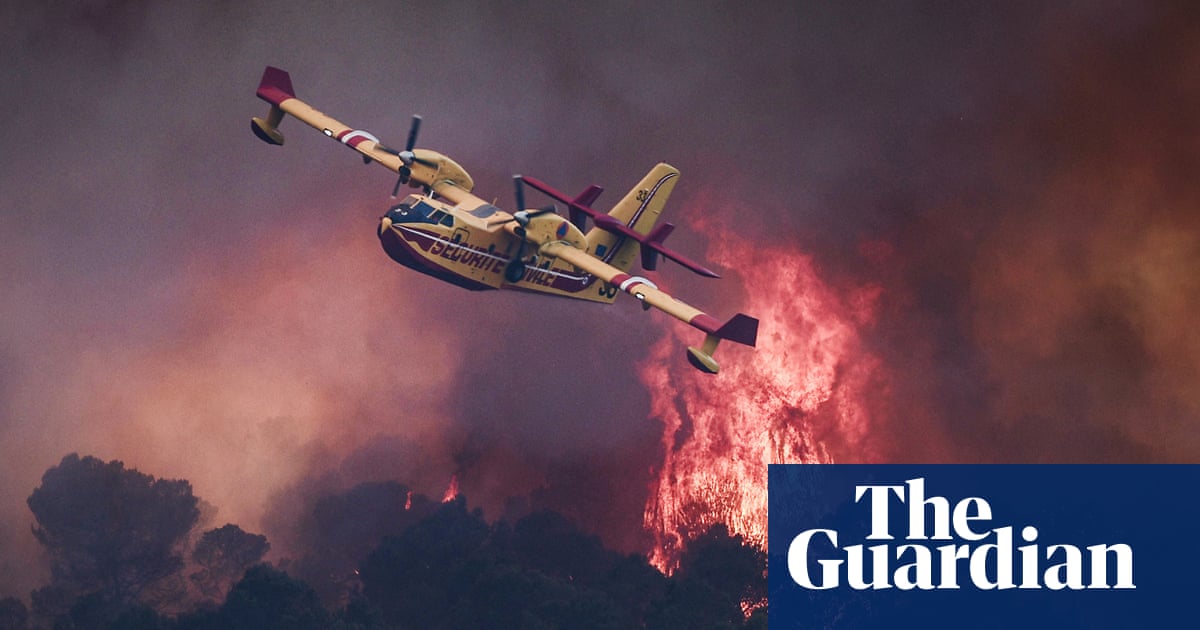
Almost 1,000 wildfires sweep across Canada, charring 3m hectares (7.4m acres) and sending a haze of smoke as far as New York. On 15 July Toronto registers the world's worst air quality as a result of the haze. Smoke kills 4,000 people in Canada each year, almost four times as many as at the start of the century. Meanwhile, in Europe, prolonged droughts create tinderbox conditions for wildfires in Greece, Portugal, Italy, Norway, Germany, Spain and France. They burn 686,000 hectares in Europe, twice the average of the past 20 years.
Extreme weather disrupts US 250th birthday festivities and the World Cup
Half of the US population is under a heat alert before 4 July independence celebrations, disrupting Donald Trump's Great American State Fair on the National Mall in Washington and other events. Dozens of heat-related deaths are reported and thousands experience power cuts.
At least nine World Cup games are played in potentially dangerous heat and humidity, while fierce storms delay three matches by more than an hour, including Mexico v England.
August
Hottest August on record
Nepal glacier collapse kills at least 1,300
Lhende Khola river valley communities are swept away after a 2 sq km (0.8 sq miles) slab of rock and glacier ice falls 1,400 metres (4,600ft) in the Himalayas, triggering a flood of water and debris. More than 5,000 people are missing and 8,600 need medical attention. Scientists say unusually warm temperatures and long-term permafrost degradation owing to the climate crisis were among the likely causes of the catastrophe.
Europe's murderous heat forces reactor shutdown
The UK and France are among a host of nations that swelter through the warmest summer (June to August) in European history. The heat kills an estimated 50,000 people in cities across the continent. Two-thirds of those excess deaths are attributable to the climate crisis. Many more are likely to have died in rural areas. As droughts spread, Romania is forced to shut down its only nuclear power station because the cooling system could not be replenished by low water levels in the Danube River.
September
Second-hottest September on record
Record heat and deadly storms lash Asia
Hundreds are killed and millions evacuated as the world's most populous continent experiences its hottest September and severe storms. Typhoon Dujuan kills at least 10 people in Japan, with violent winds of 144km/h and 832mm of rain in only 48 hours on the island of Izu Oshima. Three die in a mudslide in eastern China during Typhoon Saudel. At least 102 are killed in India and Nepal amid rain that is nine times the norm in some places. Eight die and half a million are affected by flooding in Bangkok, Thailand.
October
Hottest October on record
Governments warned to brace for peak El Niño
The UN disaster relief agency urges countries to prepare for an unprecedented "wrecking ball" El Niño that is forecast to peak around the end of the year. UK authorities advise households to stockpile a few days of basic supplies. Climate scientists project more than 450,000 people globally will die by February as a result of the additional heat brought by the super El Niño.
Protests in Indonesia after deadly fires
Demonstrators in Jakarta protest against Indonesia's worst fire season in a decade, which has scorched almost 2m hectares of forest - more than twice as big an area as last year. The choking haze is estimated to have killed 3,560 people in one month alone.
Roads turn to rivers in Chile
After the heaviest October rainfall in 76 years, the Chilean government declares the Santiago district of Las Condes a "disaster zone", with more than 1,000 people evacuated from their homes, some by helicopter.
Drought and fire in the Amazon rainforest
Months of drought leave some of the world's mightiest rivers, including the Rio Negro, Madeira and Tapajós, close to record low levels, curtailing the water transport of essential goods. This coincides with a sharp rise in fire activity in the central and eastern Amazon region, releasing so much smoke that the city of Manaus registers the second-worst air quality in the world on 12 October.
November
2026 is forecast to be one of the hottest years in history
Global temperatures tie an all-time record of 2.04C above preindustrial levels, which was set in 2023. This year is forecast to be one of the four warmest years in history, along with 2023, 2024 and 2025. Sea surface temperatures are so high that the climate scientist Eliot Jacobson calculates the odds of being this far above the norm at 33tn to one. Meanwhile, the amount of CO2 in the atmosphere reaches a peak not seen in 2m years. On the plus side, global fossil fuel emissions are likely to fall this year thanks to a shift away from oil and gas owing to high prices after the US-Israeli attack on Iran, and ever cheaper renewable alternatives.