
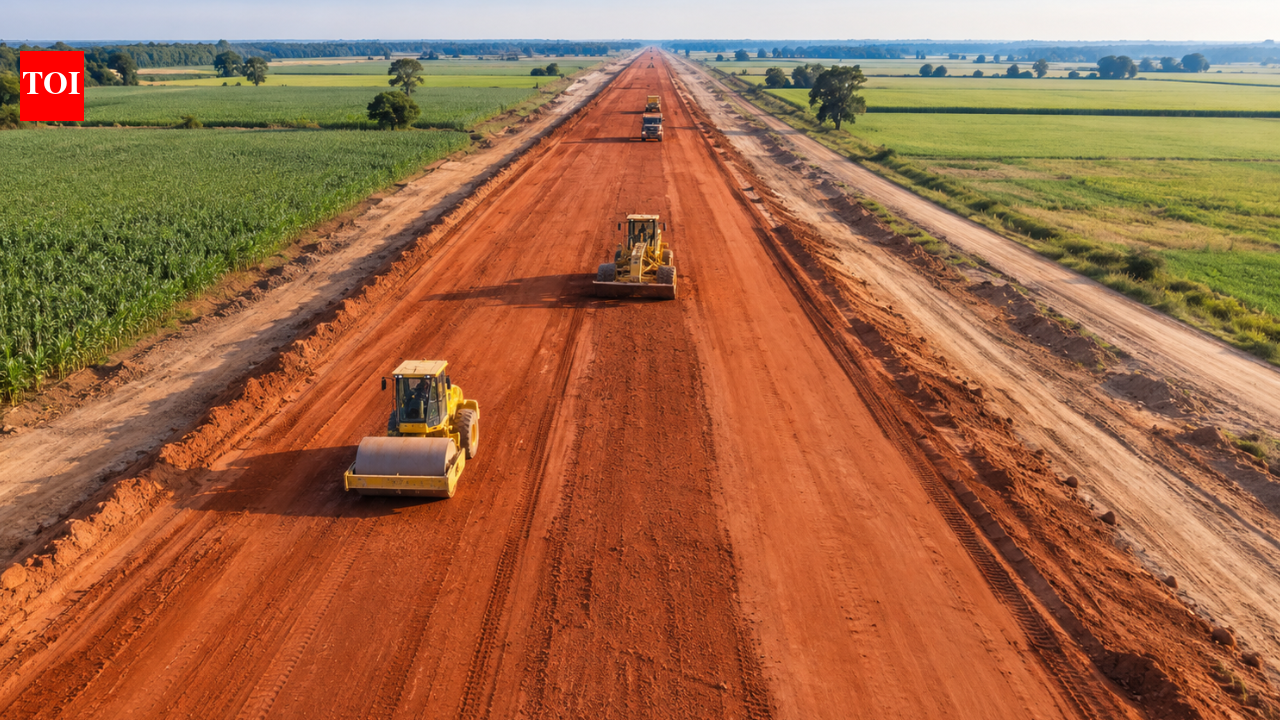
China used 17,000 tonnes of treated red mud in a 4.9-km expressway subgrade trial. Researchers mixed the waste with cement and polymers to improve its strength and safety. The project, part of the 2015 Ji-Qing Highway expansion, showed that treated red mud can successfully replace traditional soil in road construction.
Making aluminium leaves a messy leftover behind in the form of a wet, alkaline waste called red mud. Engineers in China tested it on a real expressway to see if it works. In a 2022 study published in the journal
Coatings, researchers from the Shandong Transportation Research Institute built an expressway subgrade layer using treated red mud and found that most field test points met road requirements.Why red mud is such a headache Aluminium begins as bauxite ore. Through the Bayer process, factories refine this ore to form alumina, leaving behind red mud. According to the research, each tonne of alumina creates about 1.0 to 1.8 tonnes of it. The waste is alkaline and contains trace amounts of chromium and fluoride. Much of it is stored in open-air heaps, which take up land and can harm the surrounding environment. The paper puts China's stockpile at more than 350 million tonnes, with less than 4% of it used. This is an issue all over the world. In 2020, a review by Michigan Technological University titled 'Red Mud: Fundamentals and New Avenues for Utilization' places the inventory of red mud at almost 4 billion tonnes worldwide. The review describes red mud as a dangerous waste with pH values ranging from 11 to 13.Turning waste into road material Raw red mud cannot go straight under a road. The study found that it holds a lot of water, is made of very fine particles and disintegrates quickly when soaked.
So the team mixed it with a modifier consisting of cement, phosphogypsum and a polymer at an 8% composition. In the laboratory, the treated mix reached a strength of up to 3 MPa after three days. Samples cured for seven and 28 days lost less than 20% of their strength after soaking in water. Treatment also reduced the leaching of toxic substances. Hexavalent chromium dropped by 97.9% and fluoride by 83.4% compared with untreated red mud.
Inside the expressway trial The trial section was built in 2015 as part of the Ji-Qing Highway reconstruction and expansion project in China. The treated mix containing 92% red mud and 8% modifier by mass replaced a 0.2 m thick layer of lime-stabilised soil in the upper portion of the roadbed. The trial covered a distance of 4,900 metres or 4.9 km, and the subgrade was 11 metres wide. About 17,000 metric tonnes of red mud were used up, and 14,800 cubic metres of natural soil were saved in the trial. After seven days of curing, the team tested a 200-metre section at 20 points, 20 metres apart in two lanes. At 17 of the 20 points, the resilient modulus, a measure of how well the ground rebounds under load, was greater than 90 MPa. A falling weight deflectometer, which drops a weight on the road and measures how much it sinks, recorded less than 1 mm at 16 of the 20 points. The average strength of core samples was 2.4 MPa. The researchers concluded that the overall bearing capacity was good and satisfied the road requirements.
Groundwater, cost, and limits Four wells were laid out on either side of the road to study the effects on groundwater. Eventually, the pH settled between 7.0 and 8.0, while harmful substances stayed below the limits of Class III groundwater. The results are generally similar to those of a conventional road section. They also estimated that treated red mud could save about CNY 10 per ton of compacted earthwork over cement or lime-stabilised soil when the red mud was transported 15 to 20 km. Still, this was one trial, and the bearing tests were performed after only seven days of curing. It isn't a promise for all roads around the world. But it shows how a stubborn waste can have a second life to do a useful job.