
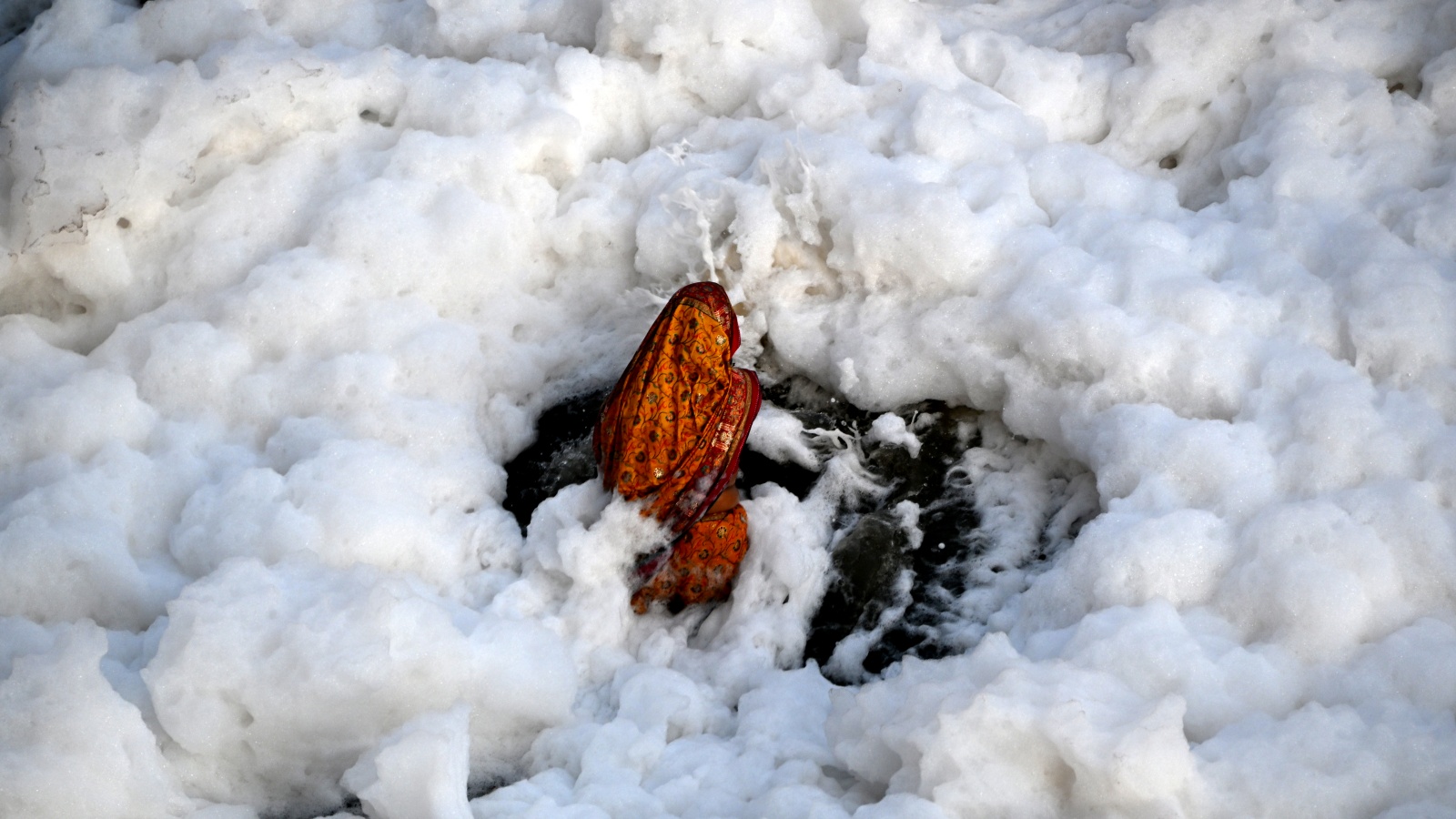
The Delhi Pollution Control Committee is yet to issue the October water quality report for the Yamuna. This delay follows the conclusion of Chhath Puja, despite Supreme Court orders for real-time data disclosure. Activist Pankaj Kumar wrote to the committee on Thursday, seeking the immediate release of all pending reports.
The last time the pollution control panel had issued a monthly water quality analysis was in September
Even as the Supreme Court has directed state pollution control boards to ensure real-time disclosure of data on discharge from sewage treatment plants (STPs) and common effluent treatment plants (CETPs) into the Yamuna, the Delhi Pollution Control Committee (DPCC) is yet to finalise and issue October's monthly water quality analysis of the river.
The delay comes even as the festival of Chhath Puja, which sees thousands of devotees offer prayers and perform rituals on the banks of the river, has concluded. The last time the DPCC had issued a monthly water quality analysis was in September, based on samples collected on the 7th of the month.
The report had recorded biochemical oxygen demand (BOD) levels and faecal coliform counts exceeding the prescribed criteria at several monitoring locations downstream of Wazirabad.
At Palla, BOD levels of 2 mg/l and 4 mg/l at Wazirabad, against the prescribed criterion of 3 mg/l for Class C water -- a classification by CPCB that should be suitable for drinking after disinfection -- was recorded. At the ISBT Bridge, the BOD level was 30 mg/l, while dissolved oxygen (DO) was 2.9 mg/l, below the prescribed minimum of 5 mg/l. Faecal coliform was recorded at 35,000 MPN/100 ml at the site, against the maximum permissible level of 2,500 MPN/100 ml.
At ITO Bridge, Nizamuddin Bridge and Okhla Barrage, BOD levels stood at 18 mg/l, 14 mg/l and 10 mg/l, while faecal coliform levels at these locations were 17,000, 15,000 and 21,000 MPN/100 ml, respectively. At Asgarpur in Haryana, the last monitoring point, BOD was 18 mg/l and faecal coliform was 38,000 MPN/100 ml. Dissolved oxygen was recorded as nil.
The delay in releasing the October analysis has also been flagged by environmental activist Pankaj Kumar, founder of Earth Warrior and Avni Sanrakshak Foundation, through a letter to the DPCC on Thursday. Kumar has sought the immediate release of pending reports of the Yamuna, major drains, STPs and CETPs, an explanation for the delay and an assurance that reports will be issued within 15 to 20 days of sampling in the future.
The letter also cited transparency obligations under the Water (Prevention and Control of Pollution) Act, 1974, and directions of the National Green Tribunal.
The issue comes amid renewed judicial scrutiny of pollution in the Yamuna. In an order earlier this week, the Supreme Court had directed that every STP and CETP install tamper-proof energy meters within a month and that readings be uploaded live, plant-wise, to CPCB and state pollution control board websites. A gap of more than 24 hours in the data feed would indicate that the plant was not operating.
The court also directed officers in charge of treatment plants and major drains to file monthly compliance affidavits. It asked the CPCB to propose a penalty mechanism under which penalties can be imposed on states, Union Territories and districts if water quality deteriorated in their respective stretches of the river.
At a review meeting on June 8 this year, Union Home Minister Amit Shah had also called for continuous monitoring of BOD, chemical oxygen demand (COD) and total suspended solids in STPs, industrial units and drains discharging into the Yamuna.
The DPCC did not respond to queries sent by The Indian Express over the reasons for the delay in issuing the analysis.
A senior Delhi Jal Board (DJB) official, while pointing out that the board monitors pollution levels in the river especially to track ammonia concentrations, said that analysis of the river water was primarily the responsibility of the DJB.