
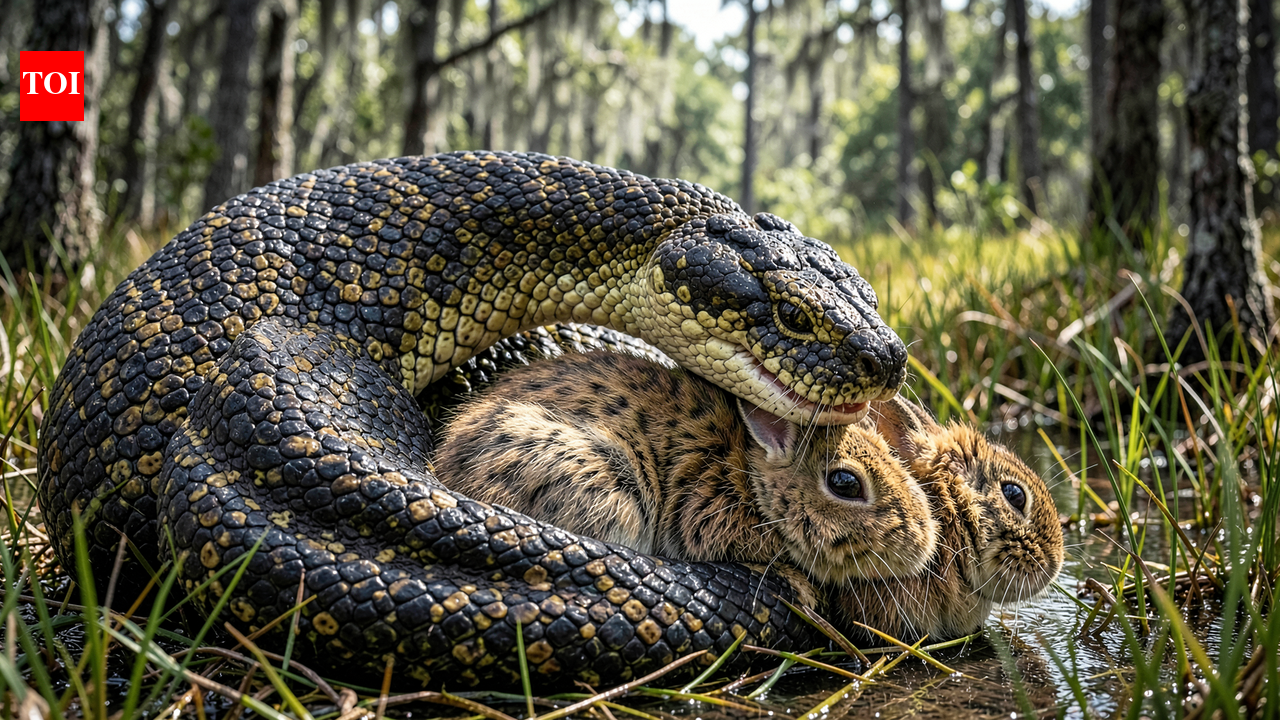
Scientists released marsh rabbits into Florida's Everglades to test the impact of Burmese python attacks; snakes caused 77% of recorded deaths. Researchers tracked the collared rabbits to confirm how these invasive snakes hunt native mammals. This 2015 study showed that python predation prevents rabbit populations from living in the park.
For years, scientists suspected that invasive Burmese pythons were contributing to the disappearance of mammals from Everglades National Park in Florida. Earlier surveys documented sharp declines as the snakes spread, but they could not establish cause and effect. To investigate the link, researchers from the University of Florida, the U.S. Geological Survey and the Florida Fish and Wildlife Conservation Commission moved marsh rabbits into the park, fitted them with radio collars and tracked their fate. Among 26 rabbits that survived the first 10 days after release in the park, 17 of 22 recorded deaths were attributed to pythons, accounting for 77% of the total. Three other deaths were attributed to unidentified warm-blooded predators. At control sites outside the park, no rabbits were killed by Burmese pythons. Published in 2015, the experiment provided direct evidence that python predation could prevent marsh rabbit populations from persisting in parts of the Everglades.
Why scientists tested Burmese pythons in the Everglades
Burmese pythons (Python bivittatus) are native to Southeast Asia but have established populations in southern Florida, including Everglades National Park. The large constrictors prey on vertebrates.
A previous analysis of python stomach contents in the park found that mammals accounted for approximately 75% of their diet, a figure cited by the researchers in their 2015 paper. Scientists had suspected that the snakes were contributing to the disappearance of native mammals for years. A 2012 study published in the Proceedings of the National Academy of Sciences titled
Severe mammal declines coincide with proliferation of invasive Burmese pythons in Everglades National Park compared historical observations with later nocturnal road surveys. Before 2000, mammals were frequently encountered during surveys in the park. From 2003 to 2011, surveys covering 56,971 kilometres recorded a 99.3% decline in raccoon observations, a 98.9% decline in opossum observations and an 87.5% decline in bobcat observations. Researchers also failed to detect rabbits. These figures measured the frequency of observations, rather than directly estimating population sizes.The declines coincided geographically and over time with the spread of Burmese pythons. However, the 2012 findings were largely correlational, leaving questions about whether the snakes were responsible for the changes. The 2015 research team chose marsh rabbits because they reproduce throughout the year and can produce up to 6 litters annually, with 3 to 5 young per litter. Their populations can persist under considerable predation pressure, making them useful for testing whether an introduced predator could suppress a native mammal population. Before moving the rabbits, researchers surveyed the park's study areas but found no evidence of existing rabbit populations at the release sites. They then designed an experiment to compare rabbit survival in areas where pythons were established with survival in areas where the snakes were rare or absent.
Radio-collared marsh rabbits reveal python predation
The researchers captured adult marsh rabbits in areas where the animals remained common and tracked them using radio collars equipped with mortality sensors. Between September 2012 and August 2013, the team captured, released and monitored rabbits across several study sites. The researchers released 31 rabbits at 2 locations in Everglades National Park: a coastal marsh and a freshwater wetland. Another 15 rabbits were moved to a procedural control site, while 49 were captured, collared and released at Fakahatchee Strand Preserve State Park, where pythons were rare or absent. These comparison sites helped researchers assess whether mortality differed between areas with established python populations and areas with little or no python activity.
The results showed a marked difference. Of the 26 rabbits in the park that survived the first 10 days after release, 22 died during the study. Pythons were identified as the cause of 17 deaths, or 77% of the 22 recorded deaths. Three other deaths were attributed to unidentified endothermic predators, meaning warm-blooded animals. One death was attributed to a known mammalian predator, while another was assigned to a different cause. At the control sites, no rabbits were killed by Burmese pythons. At the main control site, mammalian predators accounted for 71% of deaths with an attributable cause. This percentage excludes deaths whose cause could not be established, unlike the 77% figure for the park, which uses all 22 recorded deaths in its denominator.The researchers also investigated whether the introduced rabbits reproduced in the park. Pellet surveys in February 2013 detected both juvenile and adult rabbit pellets, indicating that reproduction had occurred. Rabbit pellets continued to be detected at the release sites until June 2013. The last radio-tracked rabbit in the park died in July 2013. In December 2013, about 15 months after the initial release, researchers searched the original 5 hectares of habitat and an additional 10 hectares used by tracked rabbits. They found no rabbit pellets at either release site. The findings indicated that, despite evidence of breeding earlier in the experiment, the introduced rabbit populations had not persisted.
A later study examined where marsh rabbits remained
A separate study published in Biological Invasions in 2016 titled
Invasive pythons, not anthropogenic stressors, explain the distribution of a keystone speciesexamined the distribution of marsh rabbits across the Greater Everglades ecosystem. Led by Adia Sovie and colleagues, the research assessed whether python invasion or other environmental pressures could explain where rabbits continued to occur.The team examined distance from the centre of the python invasion alongside factors including altered hydrology, habitat characteristics, mercury contamination and human development. The researchers found that distance from the invasion's epicentre best explained marsh rabbit occurrence in suitable habitat patches. None of the alternative stressors examined could explain the observed distribution. The estimated probability of finding marsh rabbits in suitable habitat ranged from zero at the invasion's epicentre to nearly 1 at locations about 150 kilometres away. The findings supported the hypothesis that invasive pythons were shaping the distribution of marsh rabbits in southern Florida. The 2016 study complemented the earlier experiment. The 2015 research tracked the fate of introduced rabbits and documented high mortality from python predation, while the later study examined the broader geographic pattern of rabbit occurrence.
What the findings mean for Everglades wildlife
The 2015 study titled
Marsh rabbit mortalities tie pythons to the precipitous decline of mammals in the Everglades identified Burmese pythons as the dominant cause of mortality among the introduced rabbits in the park. Its authors also argued that python predation could help explain declines among less fecund, or slower-breeding, mammalian prey species, including raccoons, round-tailed muskrats and bobcats. Those species were not directly tested in the rabbit experiment, so the findings do not establish the cause of every mammal decline in the Everglades. Mammals play several ecological roles: they serve as prey and predators, cycle nutrients, and influence vegetation. The researchers warned that their disappearance could affect food-web relationships and ecosystem functioning across the Greater Everglades.