
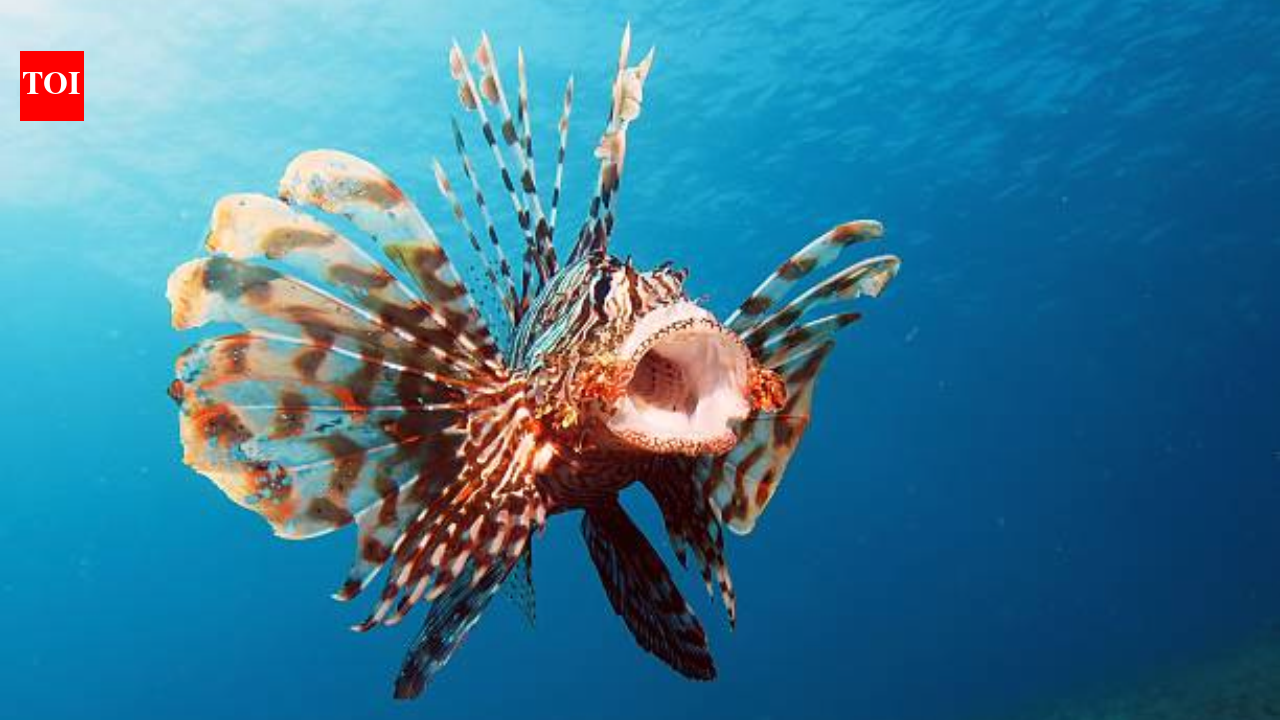
Brazil is paying fishers to catch invasive lionfish near Porto Seguro to protect the Abrolhos reefs. Since August 2026, the government has paid 10 Brazilian reais for each fish removed. So far, 440 lionfish got caught. Researchers now study these predators to see how they harm local marine life.
Imagine a fisherman pulling up his net and finding a fish that looks almost too beautiful to be dangerous. Its red-and-white stripes fan out like feathers, its fins spread like a tiny underwater crown, and its spines make it look more like an ornamental creature than a threat. But there is a problem: this fish is not supposed to be here.
Off the coast of Porto Seguro, in Brazil's northeastern state of Bahia, the lionfish has become the target of an unusual campaign. Instead of paying fishers for a conventional catch, the local government is paying them to remove an invasive predator from the sea. At least 440 lionfish have been caught, Mongabay reported and researchers are examining hundreds of them to understand what they have been eating.The urgency is not just about one fish or one stretch of coastline. The lionfish has already caused ecological damage in parts of the Caribbean and the wider Atlantic. Now its presence has been confirmed at Brazil's Abrolhos reefs, a marine ecosystem known for its extraordinary biodiversity. Scientists are still determining how widespread the invasion is there, but the arrival has raised an uncomfortable question: what happens when a predator enters a new ocean where the local fish have few defences against it?
Why is Brazil paying fishers to catch lionfish?
Since August 2026, Porto Seguro's local government has been offering fishers 10 Brazilian reais, or roughly US$1.90, for each lionfish they catch and deliver to the local fishing association, Colônia Z-22.
The campaign is a response to the rapid spread of a species that can threaten native fish populations and the livelihoods built around them. Researchers at the Federal University of Southern Bahia have examined the stomach contents of 430 captured lionfish to identify their prey and better understand their impact on local marine life.The strategy has two purposes. Removing lionfish can help limit their numbers in priority areas, while examining the captured animals gives scientists information about their diet, size and potential effects on the ecosystem.But this is not a simple case of catching enough fish and declaring victory. Lionfish reproduce quickly, can occupy different marine habitats and have spread across a vast stretch of the western Atlantic. Scientists have warned that once an invasive marine species becomes established, complete eradication can be extremely difficult.A 2023 study in the Journal of Environmental Management documented lionfish across eight Brazilian states between 2020 and 2023, with records spanning thousands of kilometres of coastline. The researchers called for coordinated monitoring, rapid responses and a national management plan. The latest effort in Bahia is taking place against that larger backdrop. Read the research.The fish comes from another ocean. Why is it thriving here?Lionfish, including Pterois volitans, are native to the Indo-Pacific and Red Sea. In their natural range, they exist as part of a marine food web shaped by thousands of years of ecological relationships.In the Atlantic, however, the balance is different. The fish has few natural predators, and native prey species may not recognise it as a familiar threat. Its large, fan-like fins help it corner prey, while its feeding behaviour allows it to consume small fish and crustaceans.Lionfish also have venomous spines that deter potential attackers. Their striking appearance may attract divers and aquarium enthusiasts, but their biology makes them a formidable invader when introduced to a new ecosystem.The precise route by which lionfish first entered Atlantic waters is not fully established. Researchers have suggested that aquarium releases played a role in the original invasion in the western North Atlantic, although Brazil's more recent expansion has also been linked to the movement of established populations through the region.The consequences are not theoretical. In research published in Scientific Reports in 2016, scientists found that invasive lionfish had reduced the abundance of a native forage fish, the tomtate, by 45% in affected areas off the southeastern United States. Earlier experiments in the Bahamas found that the presence of a single lionfish on small patch reefs reduced the recruitment of native fish by an average of 79% over five weeks.These findings come from different locations and should not be treated as measurements of the damage already done in Brazil. They do, however, show why scientists are concerned about allowing the invasion to spread unchecked. Read the research in Scientific Reports.
What makes the Abrolhos reefs especially important?
Abrolhos is not just another coral reef system. Located off Brazil's eastern coast, it is recognised as the largest and richest coral reef system in the South Atlantic.
Its most distinctive formations are mushroom-shaped coral structures known locally as chapeirões. The reefs support at least 90 coral species and 266 fish species, according to reporting by Mongabay Brasil.Some of the marine life found in the region is already vulnerable. The goliath grouper is nationally listed as critically endangered, while the blue parrotfish is listed as endangered. Abrolhos is also an important breeding and nursery ground for humpback whales in the western South Atlantic.The concern is that an invasive predator could add pressure to an ecosystem already facing multiple challenges. Lionfish eat juvenile fish, including species that may later become important to commercial fisheries. They also prey on herbivorous fish that help control algae on reefs. When those fish decline, algae can gain an advantage over corals, potentially disrupting the reef's ecological balance.That does not mean scientists have already measured widespread lionfish damage at Abrolhos. The presence of the invader has been confirmed, but researchers are still gathering the information needed to assess its distribution and severity.The distinction matters: an invasion warning is not the same as proof that an ecosystem has already collapsed. The current priority is to understand the scale of the problem while there is still an opportunity to intervene. Read NOAA Fisheries' explanation of lionfish impacts.
Could lionfish spread farther down Brazil's coast?
Researchers fear that the invasion may not remain confined to Bahia. Brazil has a long coastline containing a variety of reefs and other marine habitats that could provide shelter and food for lionfish.
The 2023 study documented the species across several Brazilian states and habitats, including shallow reefs, deeper reef environments, mangrove estuaries and seagrass beds. Such flexibility makes the fish difficult to manage using a single local intervention.The wider experience of the Caribbean also offers a warning. Lionfish populations expanded rapidly there, and research has shown that intensive, sustained removal can reduce numbers in targeted locations. But culling alone is unlikely to eliminate an established population across a large marine region.That is why researchers emphasise early detection, continued monitoring and coordination among fishers, scientists and authorities. A fisherman who knows a reef well may notice a new species before a formal survey does. Reporting those sightings can help researchers map the invasion and identify areas where removal efforts may have the greatest benefit.The goal is not simply to catch as many fish as possible. It is to slow the invasion where feasible, protect vulnerable habitats and gather enough evidence to guide future decisions.
Can people eat lionfish? There is a catch
Lionfish is considered a delicacy in some places, and turning the invasive species into a food source may offer another incentive for its removal. Researchers in Bahia are studying whether it can be incorporated safely into the human food supply.
The important distinction is that the fish's venom is associated with glands connected to its spines, not distributed throughout its edible flesh. That does not make handling it harmless. Its 18 venomous spines can cause painful injuries, and preparation requires appropriate training and care.Anyone who encounters a lionfish should not try to catch or handle it without the proper equipment and training. Local authorities may also restrict who can remove the species, particularly in protected marine areas.Selling the fish for food could potentially help create a longer-term incentive for removal. But it would require safe handling, trained fishers, appropriate processing and clear rules. It cannot replace scientific monitoring or wider conservation measures.
Can Brazil stop the invasion?
The experience of other regions suggests that the answer may depend less on a single dramatic clean-up and more on consistent action over time. Lionfish have already demonstrated how quickly an introduced predator can establish itself in unfamiliar waters.
Paying fishers to remove them is a practical way to mobilise people who know the coastline, while the scientific analysis of captured fish can help establish which native species are most at risk. But the longer-term challenge is to coordinate local removal with monitoring, research and protection of vulnerable habitats.For now, the 440 fish caught off Porto Seguro represent an important intervention, not proof that the threat has passed. The scale of the lionfish population around Abrolhos remains uncertain, and researchers need more information before they can estimate the full ecological impact.The most important discovery may not be how many lionfish can be pulled from the sea. It may be how quickly scientists and local communities can respond when a beautiful stranger begins changing the rules of an entire ecosystem.