
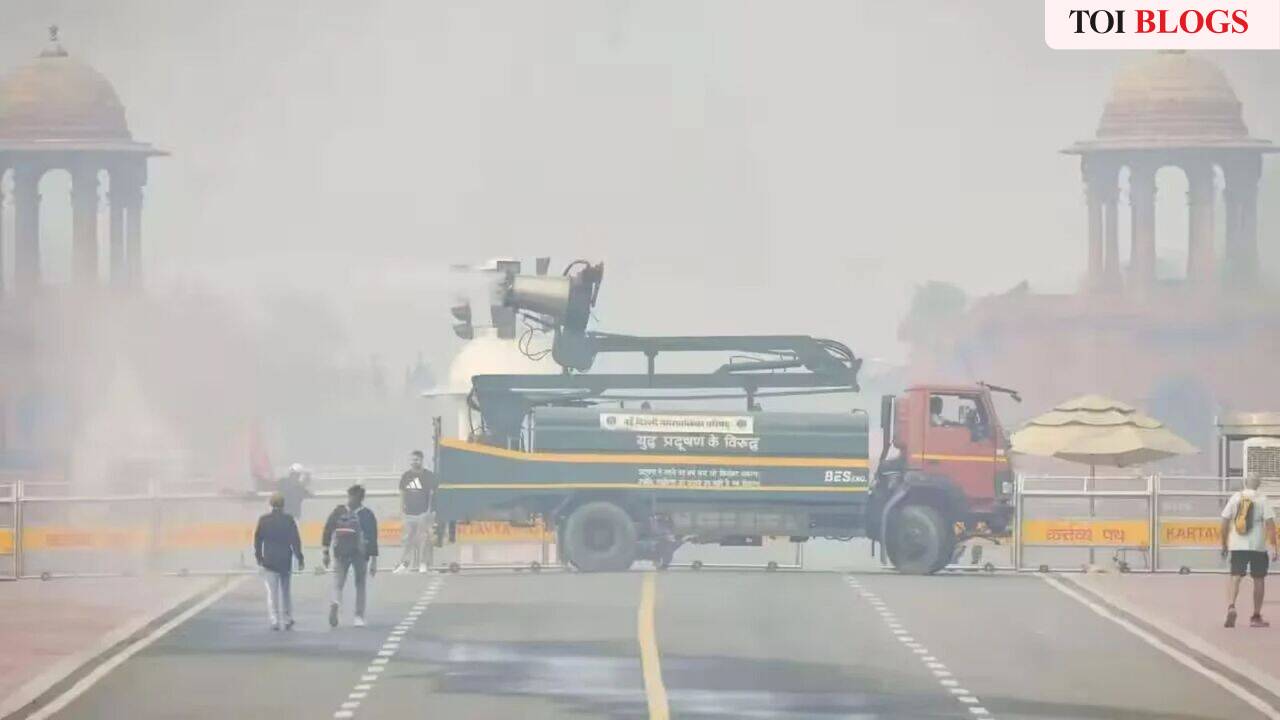
Delhi has announced a four-month semi-lockdown against toxic air. This bold step follows global lessons from cities like London and Beijing, which fought smog using strict rules and better technology. Experts said that no single measure worked alone. Delhi must now target real pollution sources to clean its winter air.
Delhi has announced a four-month semi-lockdown against toxic air. It is a bold step, but the fight is not new. London, Los Angeles, Mexico City, Beijing and Paris, all faced it, and all made good progress. Delhi can too, if it targets the real sources of pollution and acts as one NCR region.
A Problem the world has faced beforeCities from London to Paris have faced choking smog and beaten it, and none did so with a single fix. London's deadly 1952 coal-smoke episode, which killed an estimated 4,000 people in five days, led to the Clean Air Acts of 1956 and 1968, clean-fuel zones and subsidies. Today, a congestion charge and an Ultra Low Emission Zone keep polluting traffic out of central London.Los Angeles, once the world's smog capital, tackled car emissions with strict standards, cleaner fuel and better vehicle technology. It has cut bad ozone days by 40% since 2000 and, by one estimate, avoided 2.8 million school absences and $220 million in healthcare costs. Mexico City, among the most polluted cities of the 1980s and 90s, introduced a "no-driving day" in 1989 that took roughly a fifth of cars off the road each weekday, and invested heavily in public transport.
Beijing, whose PM2.5 at times exceeded that of Delhi-NCR between 2013 and 2017, paired incentives for switching from coal to natural gas with public air-quality data, and cut PM2.5 by 35%. Paris, hit by diesel pollution in the 2000s, promoted walking, cycling and public transport while discouraging private cars.The common thread is that no single measure worked. Legislation, subsidies, strict enforcement, smart use of technology, open data and public participation all had to work together.Delhi's decade of smogDelhi's winter smog drew national and global attention in November 2016, when pollutant levels spiked to about 30 times the WHO safe limit. That was when the Graded Response Action Plan (GRAP) was first introduced. Ten years on, the situation is much the same.Delhi's air carries high particulate matter all year round. In winter, extra burning of coal, wood and trash across the NCR makes matters worse, while temperature inversion and a cold surface hold pollutants close to where people breathe.What the science now saysAir quality data is never static; it changes daily with time and several associated parameters. Earlier data and public debate blamed two villains: stubble burning and Diwali fireworks. Thankfully, stubble burning has now been minimized and green crackers introduced, thanks to Supreme Court intervention. The latest 2026 data points to waste burning and traffic as the main pollutants.In October 2026, IITM Pune's Atmospheric Chemistry and Aerosol Toxicity Analysis Laboratory (AATAL), built at a cost of Rs 79.5 crore, was inaugurated in Delhi. For the first time, it breaks down air pollution composition by source. It complements the Early Warning System (EWS), which forecasts AQI, and the Decision Support System (DSS), which estimates local and regional sources.AATAL's initial data, across 15 categories, shows vehicles as a major contributor at 25%, followed by secondary organic aerosols at 18.4% and inorganic aerosols at 16.5%. Road dust contributes 10.9%. Nine types of burning (waste, mixed, crop residue, dung cake, biofuel, roadside open mass, wood, coal and industrial) together account for 29.1%.IIT Kanpur's Kotak Institute of Sustainability attaches AQI numbers to each source to communicate the science better. Over six years, Delhi's average AQI has been about 290, roughly six times the satisfactory level. If stubble burning stopped altogether, AQI would fall by only 80-90 points, to around 200. Ending the informal burning of wood and coal for cooking, tandoors and water heating, along with street trash burning and wood burning by night watchmen, villagers, slum dwellers and small industries, could cut AQI by a further 60 points, to around 140. Controlling winter traffic through public transport, CNG, EV or hybrid vehicles could then cut vehicular pollution by 50% or more, bringing AQI down to around 80. Diwali firecrackers spike pollution for only about three days, making them immaterial in the long run.Air knows no bordersIndonesia's forest fires, spread across 1.9 million hectares, have led its health ministry to report over 283,000 cases of respiratory illness, and the haze has drifted into Malaysia, Singapore and the Philippines. Pollution respects neither country borders nor state lines, a lesson Delhi must heed before planning in isolation.Delhi's challenge is a governance maze. The NCR spans eight districts of Uttar Pradesh, fourteen of Haryana, two districts of Rajasthan, and multiple authorities within Delhi itself. The Commission for Air Quality Management (CAQM) has a mandate to work with every state government, yet coordination across states and agencies remains the hardest part of the problem.The semi-lockdown: bld, but incompleteAfter a decade of measures that failed to solve the problem, the Delhi government has gone further with ten stricter curbs. They include a ban on non-Delhi vehicles below BS-VI, a halt to construction and demolition, "no PUC, no petrol", 50% work from home and doubled parking charges. Three concerns stand out.
* Air does not stop at state borders. Without matching action in Noida, Gurugram, Ghaziabad, Faridabad, the impact will be limited.
* Enforcement is uneven. Ten lakh sub-BS-VI vehicles from outside Delhi are barred from November to January, so residents of neighboring cities bear the first brunt. No equivalent announcement covers Delhi's own 62 lakh pre-BS-VI cars, which will keep moving on inner roads that police cannot patrol everywhere.
* The biggest sources are untouched. Wood and coal burning among lower-income households and solid-waste burning across the city, both flagged by IITM Pune and IIT Kanpur, are missing from Delhi's war on pollution.Rules are easy to announce. Implementation is the hard part, and only time will show whether these measures work.
Recommendations
* Act as one NCR. Align curbs, enforcement and incentives across Delhi, Noida, Gurugram, Ghaziabad and Faridabad.
* Redesign GRAP on science and data, not discretion, with triggers based on forecasts and measured source contributions.
* Introduce a permanent congestion charge in Connaught Place and other central business districts, as London has done.
* Incentivize the switch to CNG and EV heavily, as Beijing did with gas, through subsidies for households and small fleets.
* Use AI and geotagging to identify on-ground pollution hotspots and direct enforcement where it matters.
* Tackle the neglected sources. Offer clean cooking and heating alternatives to households that burn wood and coal, and stop open trash burning.
* Publish one open, real-time dataset, as Beijing did, so citizens and researchers can hold authorities to account.