
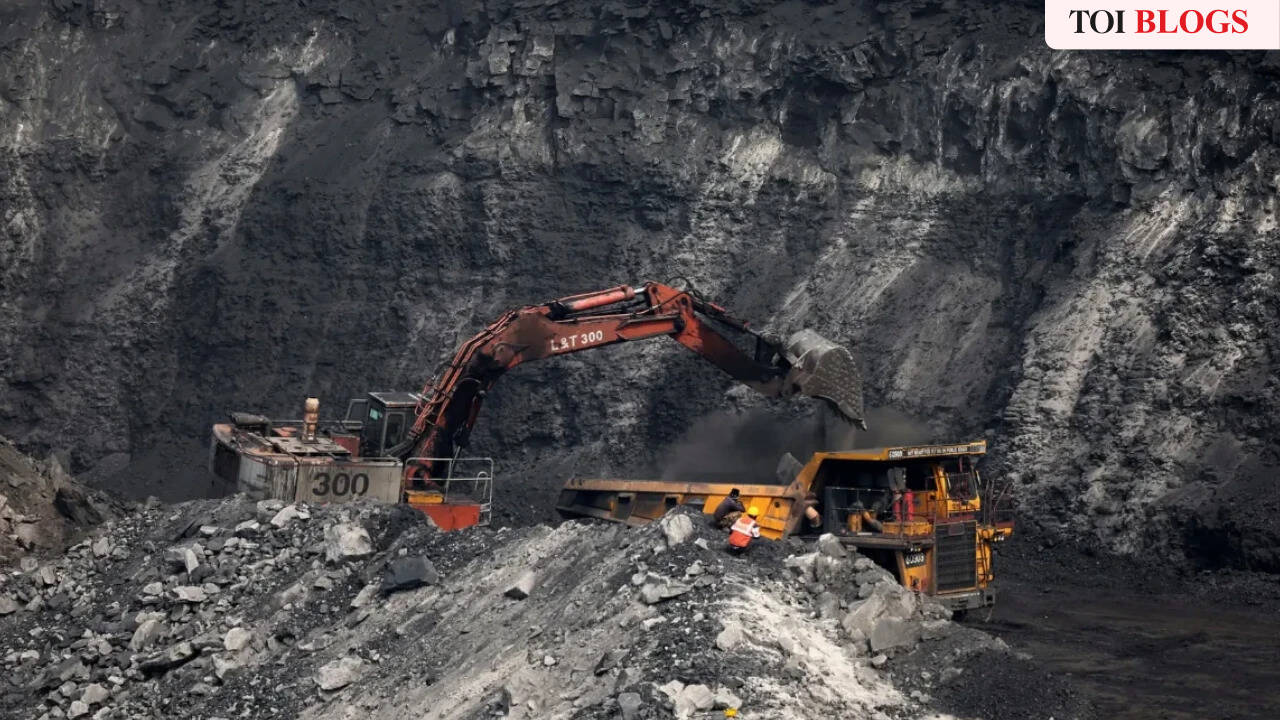
The proposed expansion of the Ashok Open Cast Coal Mining Project in Jharkhand involves diverting 928.03 hectares of forest land. This project could lead to the removal of 5.67 lakh trees. Experts said that assessing individual projects in isolation often overlooks the cumulative consequences of such large interventions on nature.
The proposed expansion of the Ashok Open Cast Coal Mining Project in Chatra district of Jharkhand presents a compelling case for examining a much larger challenge confronting India's development model: how do we reconcile economic growth and resource extraction with ecological sustainability?
The proposal reportedly involves diversion of 928.03 hectares of forest land and the potential removal of approximately 5.67 lakh trees, including 2.43 lakh Sal trees. With a proposed production capacity of 20 million tonnes of coal annually, the project raises concerns extending well beyond the immediate mining footprint.The implications for forest ecosystems, elephant habitats, biodiversity, water resources and forest-dependent communities make this an important case study in environmental governance.However, the significance of this case lies not merely in the scale of the proposed forest diversion. It exposes a deeper institutional challenge: whether India's environmental decision-making processes are adequately equipped to assess the full ecological and social costs of development.
The limitations of project-centric environmental appraisal
Environmental Impact Assessment (EIA) is intended to integrate environmental considerations into development planning. Yet, assessing individual projects in isolation can overlook the cumulative consequences of multiple interventions across an interconnected landscape.
Mining, roads, industrial infrastructure and associated settlements may each secure separate approvals, while their combined effects progressively fragment forests, disturb wildlife corridors, alter drainage patterns and diminish ecosystem resilience.The Jharkhand case illustrates why environmental appraisal must move beyond project boundaries towards regional and landscape-level assessments.A particularly important consideration is the human-elephant conflict in the state. Wildlife Institute of India research covering 2000-2023 documented 1,340 human fatalities and 400 injuries arising from human-elephant conflict incidents. Habitat fragmentation and degradation make the protection of ecological connectivity an urgent development and human-safety concern.The absence of a formally designated Protected Area should never be interpreted as evidence that a forest landscape is ecologically expendable.
Natural capital must enter the development equation
One fundamental weakness in conventional project appraisal is the inadequate recognition of natural capital.Forests are not simply collections of trees or parcels of land awaiting alternative economic use. They provide ecosystem services through carbon sequestration, water regulation, soil conservation, biodiversity support and livelihood sustenance.The removal of a mature natural forest cannot be adequately compensated by planting an equivalent number of saplings elsewhere. Compensatory afforestation may increase tree cover, but it does not automatically restore the ecological complexity, biodiversity and hydrological functions of the original ecosystem.India needs to strengthen natural capital accounting and incorporate the economic and social value of ecosystem services into project appraisal. The loss of biodiversity, water security and livelihood resources must feature in the calculation of development costs, rather than remain externalities.
Environmental governance must move from clearances to accountability
India has an established legislative and institutional framework for environmental protection. The challenge increasingly lies in the quality of assessment, coordination between institutions, implementation of safeguards and post-clearance monitoring.The Comptroller and Auditor General's performance audit of environmental clearances, covering 2016, identified deficiencies in compliance monitoring, public consultation and verification of clearance conditions.More recently, the Economic Survey 2025-26 has also recognised challenges relating to weak post-clearance monitoring, institutional capacity constraints and overlapping regulatory jurisdictions.These observations underline the need to strengthen environmental governance beyond procedural compliance.Five reforms deserve particular attention:
* Mandatory cumulative impact assessment: Evaluate the combined ecological consequences of existing and proposed projects across landscapes, river basins and ecologically connected regions.
* Natural capital valuation: Integrate forests, biodiversity, water resources, soil health and ecosystem services into economic cost-benefit assessments.
* Independent scientific oversight: Strengthen the capacity and independence of environmental appraisal, monitoring and compliance institutions, with transparent access to scientific evidence.
* Community-centred environmental governance: Ensure meaningful participation of affected communities, protection of applicable forest rights and rehabilitation that addresses long-term livelihood security.
* Outcome-based environmental accountability: Measure actual ecological outcomes, including habitat connectivity, biodiversity recovery, water quality and restoration effectiveness, rather than relying predominantly on expenditure, plantation numbers and compliance documentation.
Repositioning development priorities
India's requirements for energy, infrastructure, industrial growth and employment are undeniable. Equally important is the recognition that economic prosperity cannot be sustained by progressively depleting the natural systems on which it depends.The transition must therefore be from a clearance-oriented approach to an outcome-oriented environmental governance framework, where ecological sustainability is an integral determinant of development decisions.This also calls for greater institutional coordination between environmental regulators, forest departments, wildlife authorities, planning agencies and local governments. Environmental safeguards must be embedded in development planning from the outset, rather than introduced as corrective conditions after project configurations have already been determined.
The intergenerational responsibility
The Jharkhand mining proposal should be viewed as more than an isolated debate about coal production or forest diversion. It is a reminder that development decisions have consequences extending across generations.The real measure of progress cannot be restricted to production capacity, investment mobilisation or immediate economic returns. It must also account for the natural assets conserved, ecological resilience maintained and livelihoods protected.Environmental governance must ultimately ensure that the pursuit of economic growth does not compromise the ecological foundations of future prosperity.A forest is not an empty mine lease. It is natural infrastructure, an ecological asset and a shared inheritance. Recognising its true value must become a defining principle of India's development strategy.