
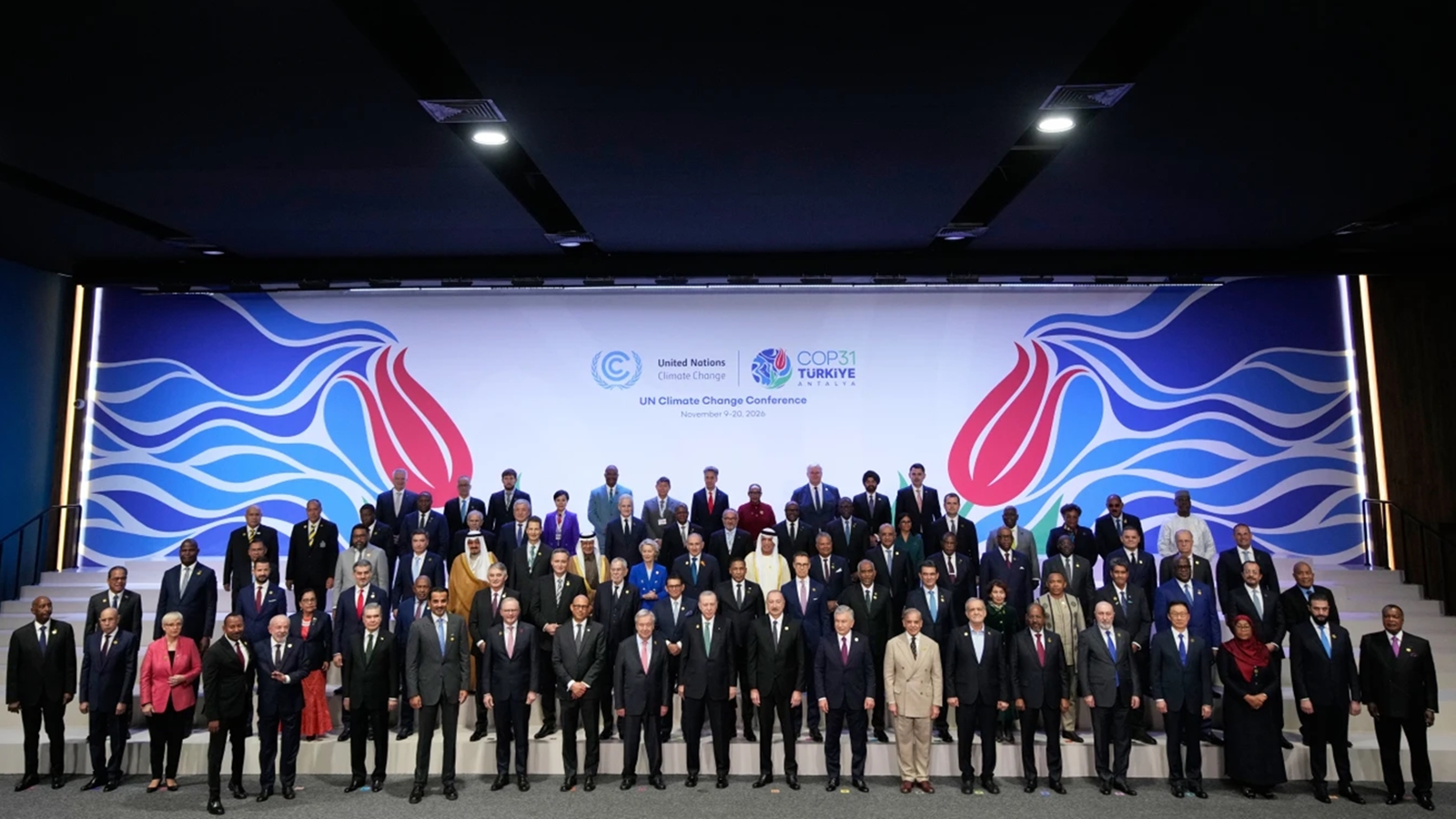
The 31st climate conference recently took place in Antalya, Turkey. While many trace talks to the 1992 Rio summit, the 1985 Villach conference was the real turning point. Scientists there predicted global temperatures could rise by 1.5-4.5 degrees Celsius by the 2030s, eventually leading to the creation of the IPCC.
Another climate conference has just taken place in Antalya, Turkey, the 31st edition of an annual event that began in 1995. These conferences, called COPs or Conference of Parties to the UN Framework Convention on Climate Change (UNFCCC), have laid down the global strategy to deal with climate change, and produced international legal architectures like the Kyoto Protocol and the Paris Agreement.
The history of international climate negotiations is often traced back to the 1992 Earth Summit in Rio de Janeiro, Brazil, but that is not the full picture. The Rio meeting, in June 1992, did not give rise to the UNFCCC, as is commonly understood. The Framework Convention was negotiated by an International Negotiating Committee (INC) set up for this purpose by the UN General Assembly in December 1990. The INC finalised the Convention in May 1992, a month ahead of the Rio summit. The finalised agreement was opened up for signatures at Rio.
Discussions on climate change had begun much before. The rise in concentrations of carbon dioxide was already well documented in the 1970s, and its consequences were fairly well understood in the scientific community. The World Meteorological Organisation (WMO) had held a climate conference in Geneva as early as 1979 to discuss the issue. In the 1980s, scientists showed that greenhouse gases other than carbon dioxide could also contribute significantly to global warming.
In light of this growing evidence, the WMO and UN Environment Programme (UNEP) held a week-long conference in Villach, a small town in southern Austria, in October 1985. This relatively lesser known conference was a turning point in establishing a global consensus on climate change. It can be truly called the birthplace of international climate negotiations. It assessed the combined influence of major greenhouse gases on the world's climate, and predicted that global temperatures could rise by 1.5-4.5 degrees Celsius by the 2030s.
It recommended the setting up of a scientific task force that could make continuous assessments of greenhouse gas concentrations and their implications. An advisory group on greenhouse gases was accordingly set up in 1986, which, two years later, evolved into the Intergovernmental Panel on Climate Change (IPCC) after the WMO and UNEP decided that a more formal scientific set-up with governments on-board was needed to deal with policy implications of climate change.
In 1990, within two years of its creation, the IPCC produced its first assessment report that highlighted the role of human activities in increasing the concentrations of greenhouse gases. Climate change had begun to make international headlines, and was grabbing the attention of scientists, policymakers and governments. Within a couple of months of the IPCC producing its assessment report, another climate conference was held in Geneva in October, as a sequel to the 1979 conference in the same city. In December that year, the UN General Assembly authorised the creation of the INC to negotiate a global legal framework on climate change. As mentioned earlier, this INC negotiated and finalised the UNFCCC which was presented before the Rio Summit for signature of countries. The UNFCCC came into effect only two years later, in 1994, after the requisite number of countries had ratified it.
you may like
The UNFCCC said its objective was to stabilise the concentration of greenhouse gases to a level that prevented dangerous interference with the climate system. It acknowledged that a group of developed countries, all of them members of OECD, were primarily responsible for the increase in greenhouse gas concentrations, and would have to take the bulk of the burden in dealing with the problem of climate change. Thus came about the principle of Common But Differentiated Responsibilities and Respective Capabilities (CBDR-RC) that developing countries swear by even today. Article 7 of UNFCCC established the Conference of the Parties, to be held every year, to review the implementation of the Convention and any other legal instruments that might be produced. It is in accordance with this article that these COPs are held every year, the most recent one being in Antalya, Turkey.