
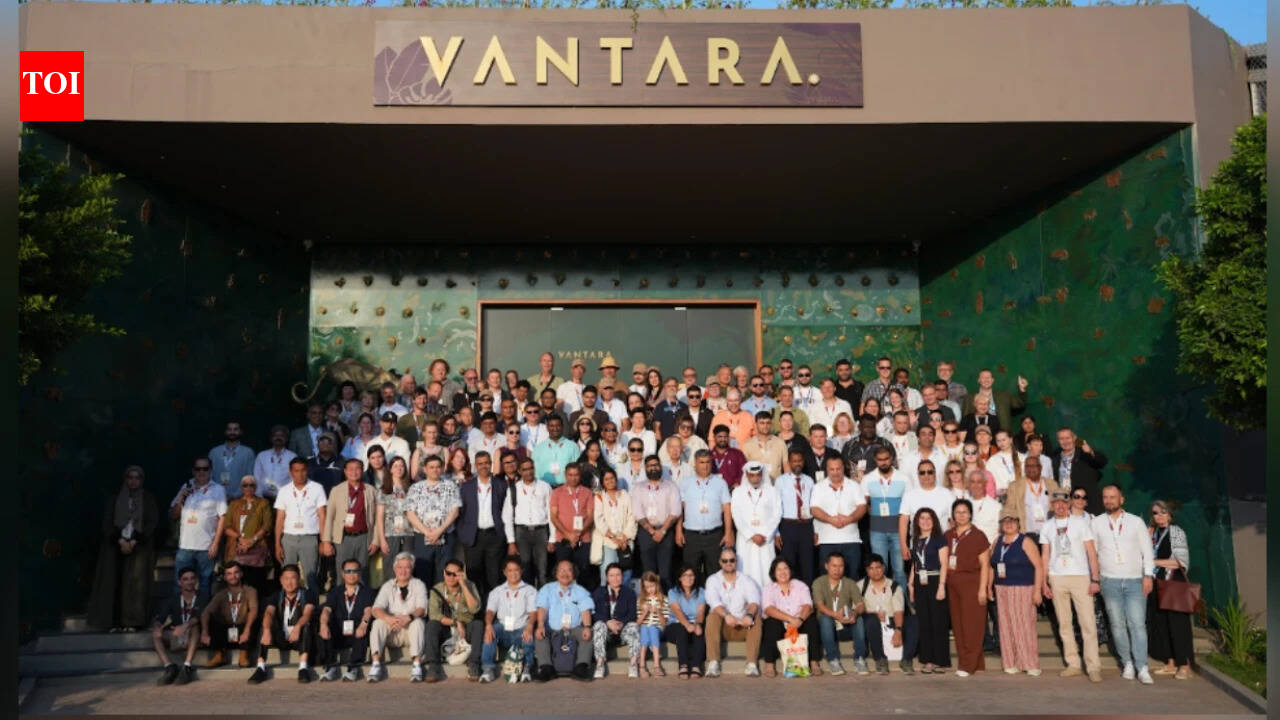
The EARAZA Annual Conference 2026 concluded at Vantara in Jamnagar, gathering experts from 98 institutions across 30 countries. Vantara announced that the ANTZ Software Platform would be offered free to members for one year. Svetlana Akulova said, "Creating global data infrastructure for biodiversity conservation" allows information to inform decisions elsewhere.
The EARAZA Annual Conference 2026 concluded at Vantara in Jamnagar, bringing together wildlife professionals, veterinarians, scientists and conservation leaders from 98 institutions across 30 countries, along with representatives of 29 Indian zoological institutions.
Held under the theme "Strengthening Global Partnerships for Wildlife Conservation", the four-day conference focused on cross-border conservation programmes, animal welfare, wildlife medicine, technology, crisis response and public engagement.The conference opened on October 26 with a performance by three-time Grammy Award-winning composer and environmentalist Ricky Kej. The inauguration was followed by a traditional lamp-lighting ceremony attended by Vivaan Karani, CEO, Vantara; Svetlana Akulova, president, EARAZA; Prof Raman Sukumar of the Indian Institute of Science; Dr V Clement Ben, member secretary, Central Zoo Authority; and Dr Brij Kishor Gupta, director, Gujarat Zoological Research and Rescue Centre.The Indian Zoo Yearbook, Volume 11, 2026, was also released during the opening ceremony.As host, Vantara announced that the ANTZ Software Platform would be offered free of cost to all EARAZA members for one year. ANTZ is a zoological management platform with an Open Data Exchange that enables participating institutions to share information across the network.The announcement aligned with one of the conference's key themes: the need for conservation knowledge and data to move more easily between institutions and across national borders. Akulova spoke about the importance of creating global data infrastructure for biodiversity conservation, allowing information generated by one institution to inform decisions elsewhere.The sessions covered coordinated conservation programmes for the Amur tiger, Oriental stork, Blakiston's eagle-owl and great bustard. Discussions also examined the conservation breeding of Boiga snakes, the reintroduction of the long-eared hedgehog, the conservation of the Indian wild ass and the ex-situ conservation of the Amur tiger.The second day focused on coexistence, urban biodiversity and public engagement. Sessions examined snake conservation and snakebite prevention, biodiversity conservation in million-plus cities and the role of citizen science.A panel on "Animal Welfare: From Inputs to Measurable Outcomes", moderated by Karani, discussed how care practices can be assessed through measurable outcomes for individual animals. Other sessions addressed the visitor experience at zoological institutions, conservation education and the role of mass media. Wildlife biologist and television presenter Forrest Galante spoke about taking conservation conversations to wider audiences.Delegates also discussed crisis management in wildlife-care facilities and disaster response in the wild. Presentations covered polar bear rescue, wildlife disease diagnostics, animal nutrition and the work of zoological institutions in Russia. Padma Shri awardee Dr K K Sarma, known for his work with elephants, shared field perspectives on human-wildlife conflict.The conference also included interactive formats such as "The Elephant in the Room", where delegates reflected on difficult questions facing the zoological sector, and the Solution Station, which invited professionals to bring real challenges in wildlife care and conservation for expert guidance.Technology and research took centre stage on the third day. Vantara presented tools developed under the ANTZ platform, including Vespr, an edge-AI bioacoustic monitor that identifies species on the device; Smart Egg Analysis, which helps teams measure and monitor eggs; and an NFC-enabled system for digitally recording animal-care rounds.Scientific presentations by Vantara experts covered non-invasive population genomics of Asiatic lions, paraveterinary training, avian rewilding, the use of artificial intelligence to understand animals and efforts to bridge ex-situ and in-situ conservation.Alongside the sessions, the conference featured an exhibition with 13 exhibitors from seven countries. The displays included veterinary technologies, wildlife diagnostics, genomics, automated microscopy, assisted reproduction systems, avian incubation equipment and remote drug-delivery solutions. Vantara's host pavilions also featured innovations in wildlife care, nutrition, architecture and technology, along with a virtual reality experience.The final day focused on science-based care for rescued Asian elephants, animal nutrition in rescue and rewilding, habitat change, cryopreservation, triage and parasite surveillance. Dr Manilal Valliyate, chief communication officer at Vantara, moderated a panel on veterinary capacity-building.The conference concluded with a gala dinner and closing ceremony, where Lifetime Achievement Awards were presented to six leaders from India and abroad: Svetlana Akulova, René Franěk, Azer Huseynov, S C Sharma, Dr D N Singh and Dr B S Bonal.The EARAZA flag was then handed over to China, host of the 2027 conference. The event concluded with a vote of thanks by Dr Brij Kishor Gupta.