
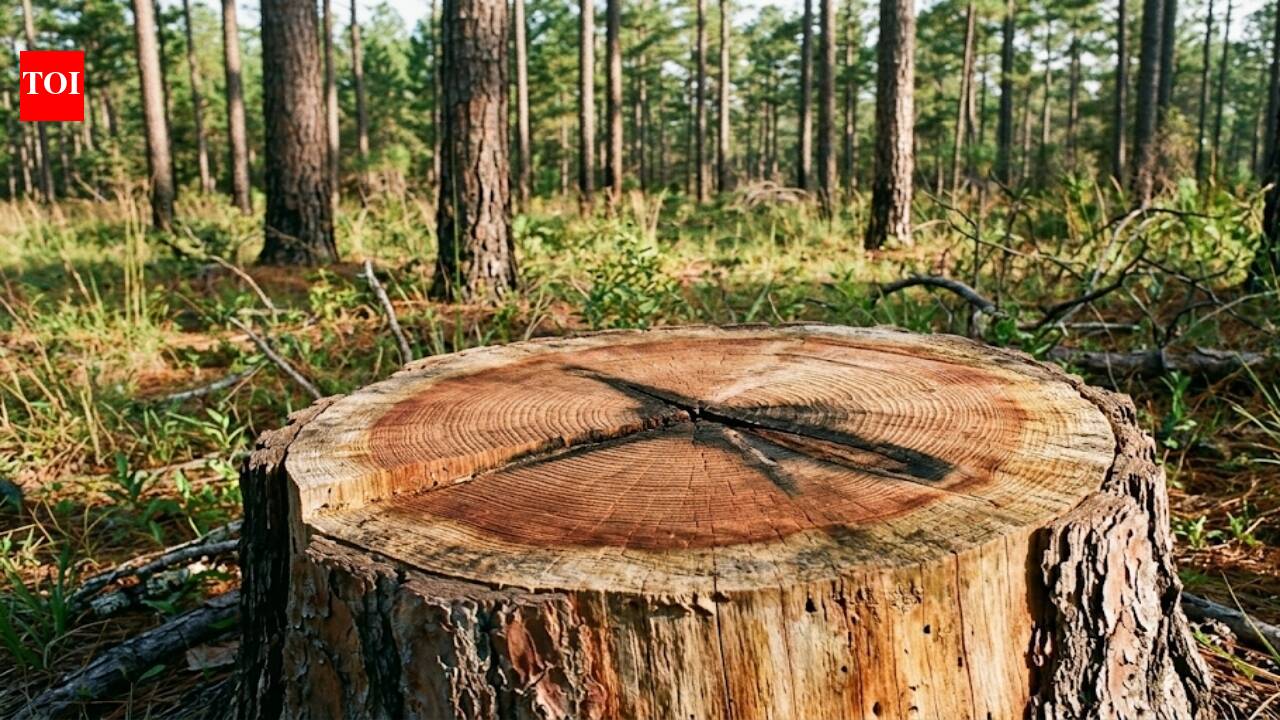
An Alabama longleaf pine stump revealed a fire scar dating to 1697, while a Pennsylvania study traced fires back to 1402. Researchers used tree rings to show how periodic fires shaped forests long ago. These findings highlight Indigenous land stewardship and the practice of purposeful burning to maintain healthy landscapes.
Evidence of events that occurred centuries before they were written down can be preserved on an ancient tree stump. Researchers may identify when a tree survived a burn and recreate how frequently woods were originally burnt by looking for fire traces inside its growth rings. Another element of that history was unearthed in 2026, when researchers studied remnants of longleaf pine in Alabama's Flagg Mountain area. Eventually, one old tree was dated to 1612, with its oldest growth and a fire scar in 1697. Fire scars dating to 1402 have been discovered in north-central Pennsylvania, providing one of the longest records of historical fire in eastern North America.Taken together, the results show how tree rings can tell us the function that periodic fires had in forming forests long before modern forest management. They also show indications of a deeper awareness of Indigenous land stewardship, including the practice of purposeful burning to maintain landscapes, encourage valuable flora and aid hunting.What the old stump revealedFieldwork in Alabama focused on old longleaf pine remnants on Flagg Mountain in the southern Appalachian region. Researchers studying the landscape were hunting for relics of trees that had lived long enough to record evidence from before European settlement reshaped much of the region.
Longleaf pine historically dominated the southeastern United States. Mature trees have thick bark and other features that allow them to survive multiple low-intensity surface fires. If flames burn around the root of a tree, a small patch of living tissue may be damaged, but the tree may not die. As the tree grows on, the injury is encircled with new wood.
A cross section can therefore display the annual growth rings and the scars from previous fires. The rings are dated, and their patterns are compared to other tree-ring data to assign calendar years. This is called cross-dating and is especially helpful when an old stump can't be accurately dated just by looking at it. In Alabama, the reconstructed record shows growth of one tree in the early 17th century and detected a fire scar in 1697. That date is considerably before modern fire suppression policies were established in the United States, yet a scar alone cannot tell who caused the fire or whether it was deliberate.The Pennsylvania record provides a separate, longer chronology. A 2022 study published in Fire Ecology reconstructed red-pine fire history in north-central Pennsylvania from 1402 to 1966. The researchers identified 1,285 fire scars representing 155 distinct fire years across 565 years of recorded fire history.The Significance of Fire in Pine ForestsBefore the era of widespread fire suppression, many woods and woodlands across the southeastern United States were subject to recurrent low-intensity fires. Lightning may ignite them, but Indigenous societies also employed fire to govern landscapes. The relative importance of natural and human-caused fires varied by location and period. Frequent surface fires in longleaf pine ecosystems maintain a relatively open understory. They control numerous fire-sensitive shrubs and trees, minimise accumulated plant detritus, and provide environments for grasses and other native ground cover to thrive. Mature longleaf pines are relatively resistant to these fires, although competing vegetation may be more susceptible.That doesn't mean every blaze of the past was of the same purpose or intensity. Indigenous tribes used fire for a variety of purposes, including to clear vegetation to facilitate access, to influence the availability of plants and to attract or manage game. Their activities were informed by knowledge of the seasons, the weather, the plants, and the areas they lived in. A separate reconstruction from Louisiana helps illustrate how frequently fire returned to longleaf pine forests. Published in the Journal of Vegetation Science in 2011, the study analyzed 190 fire scars from 19 remnant pines. It found a mean interval of 2.2 years between fires from 1650 to 1905, although intervals ranged from six months to 12 years.The Louisiana data aren't observations from Alabama, but they do demonstrate how often fires might return to a longleaf pine environment. These data help researchers understand why longleaf forests evolved features that allow older trees to withstand repeated fires and why long-term fire exclusion can modify the structure of these habitats.What the scars can and cannot tellTree rings give a more accurate history of fire than written records alone. A dated scar can tell us that a fire got to a certain tree in a certain year. Researchers can compare scars across numerous trees to determine years in which many trees were impacted, estimate the intervals between reported fires, and study whether burning occurred during the growing or dormant season. A larger collection of records also helps scientists separate local events from broader patterns. The U.S. Geological Survey's North American tree-ring fire-scar network brings together evidence from more than 37,000 fire-scarred trees across 2,562 sites. These records help scientists examine fire frequency, seasonality and relationships with vegetation, climate and human land use.Even with these records, it is still difficult to know where a given fire started. A fire scar doesn't indicate if a flame was sparked by lightning, an Indigenous land management method or some other human action. Stronger conclusions will need many lines of data, including the timing and pattern of fires, the ecology of the region and historical and Indigenous knowledge. The 1697 scar provides physical evidence that a fire reached the tree, but it cannot identify who or what started it. Although historical evidence shows that Indigenous communities used fire to manage some landscapes, attributing this particular fire to human activity would require additional evidence.Researchers are also interested in the information Indigenous populations have today. Some groups are reviving cultural burning practices that were lost through colonial relocation and subsequent fire suppression. In Alabama, the connection between traditional stewardship and longleaf pine restoration is especially essential as many of the fire-dependent ecosystems of the region have been diminished via logging, conversion of land and the cessation of regular burning. The Alabama stump and the Pennsylvania red-pine record provide two distinct pieces of evidence about historical fire. The Alabama tree records a fire in 1697, while the Pennsylvania chronology reaches back to 1402. Together with wider fire-scar research and Indigenous knowledge, these records help researchers reconstruct how recurring fires shaped forests over centuries.