
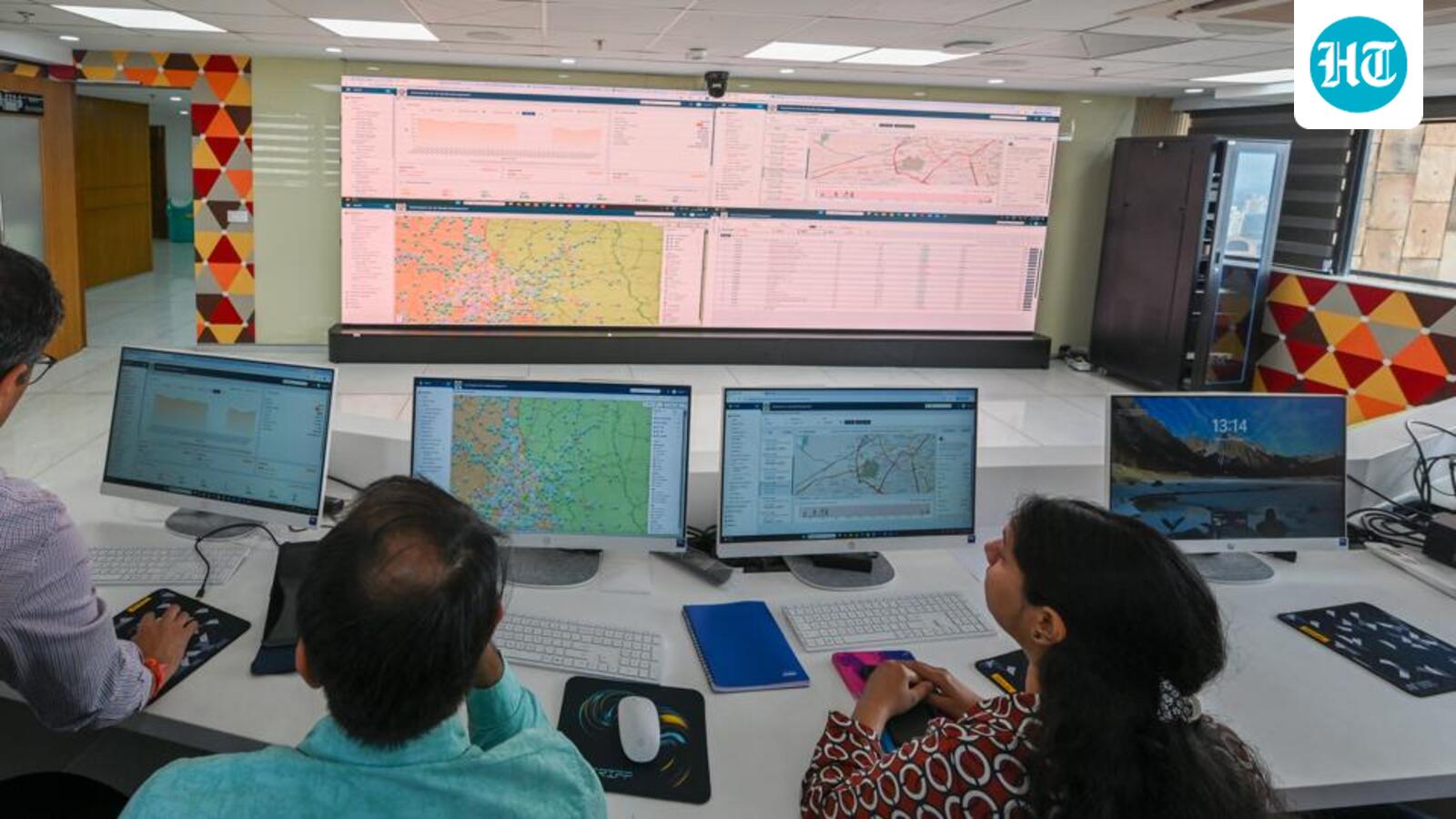
The Commission for Air Quality Management set up an in-house command centre named Pavan in Delhi to monitor pollution. The facility tracks live data from construction sites and stubble burning. An official said, "Such instances show how real-time action is," as they prepare for Union minister Bhupender Yadav’s October 30 visit.
The Commission for Air Quality Management (CAQM) in NCR has set up an in-house integrated command and control centre (ICCC) to monitor polluting activities across Delhi-NCR on a real-time basis, and the same will be operationalised soon, officials aware of the matter said.
The facility, Pavan (The Platform for Air quality Vigilance and Analytics for NCR), will receive live feeds from construction sites and landfill sites across the region, get real-time stubble burning data through multiple satellite and tracker data, observe 108 operational continuous ambient air quality monitoring stations (CAAQMS), monitor live complaints from government air pollution apps, receive data from brick kilns and track implementation of state action plans.
Officials said states can be issued data and notice of violations on a daily basis for corrective action, besides tracking long-term trends. Ahead of operationalising it completely, Union environment minister Bhupender Yadav will visit the centre on October 30 to assess the preparations made and carry out a review.
"We will gather feedback from the minister after showing him the control centre. Based on this, the necessary changes can be made, ahead of making the facility fully operational," an official said.
The facility has been set up on the 16th floor of the STC building at Janpath, where CAQM works out of.
During a visit on Tuesday, HT spotted an integrated dashboard, with a team of five CAQM officials looking at multiple feeds on separate screens from landfill sites and construction sites. Simultaneously, the dashboard displayed data from mechanised road sweepers (MRS), comparing the pre-mandated routes set for each MRS and analysing the actual distance and area covered through its GPS coordinates.
One such MRS, scheduled to cover Pataudi Chowk to Garhi Harsaru in Gurugram, had covered 56.5km the previous day, whereas the tracker displayed a preset route of only 0.28km. The machine covered 56.2km off-track, with an average speed of 23.2 km/hr -- far higher than the average speed of what an MRS should run.
"This shows that the machine did not cover the road it was mandated to cover on that particular day. Not only did this machine go off-route, it was also moving fairly quickly and thus, failed to actually perform any proper dust collection," one of the officials at the facility said,
He said that the Haryana state pollution control board and the civic body will be alerted immediately. "Such instances show how real-time action is possible," the official, who did not wish to be named, said.
The integrated dashboard also pulls data from the VAHAN database to track the vehicle count across NCR in different categories, the status of construction and demolition (C&D) waste collection and the India Meteorological Department's (IMD's) forecast for the next seven days.
While six members across two shifts will track data throughout the day on a real-time basis, over 100 CAQM officials will be overseeing the data across specific sectors to take corrective measures.
The CAAQMS dashboard, meanwhile, allows teams to track the 10 most-polluted stations across NCR at any given time, allowing localised action if needed. "If a particular station is showing particularly high readings, we can ask the state pollution control board to carry out on-ground checks. It can also help assess trends in terms of stations consistently faring poorly," a second official said.
Data will help during periodic reviews and the dashboard will be made accessible to states as well, the official said.
Earlier this month, the Delhi government had also launched its dedicated ICCC at east Delhi's Shastri Park, with AI-enabled CCTV cameras tracking more than 700 construction sites and GPS-enabled systems monitoring road sweeping machines alongside air quality stations.