
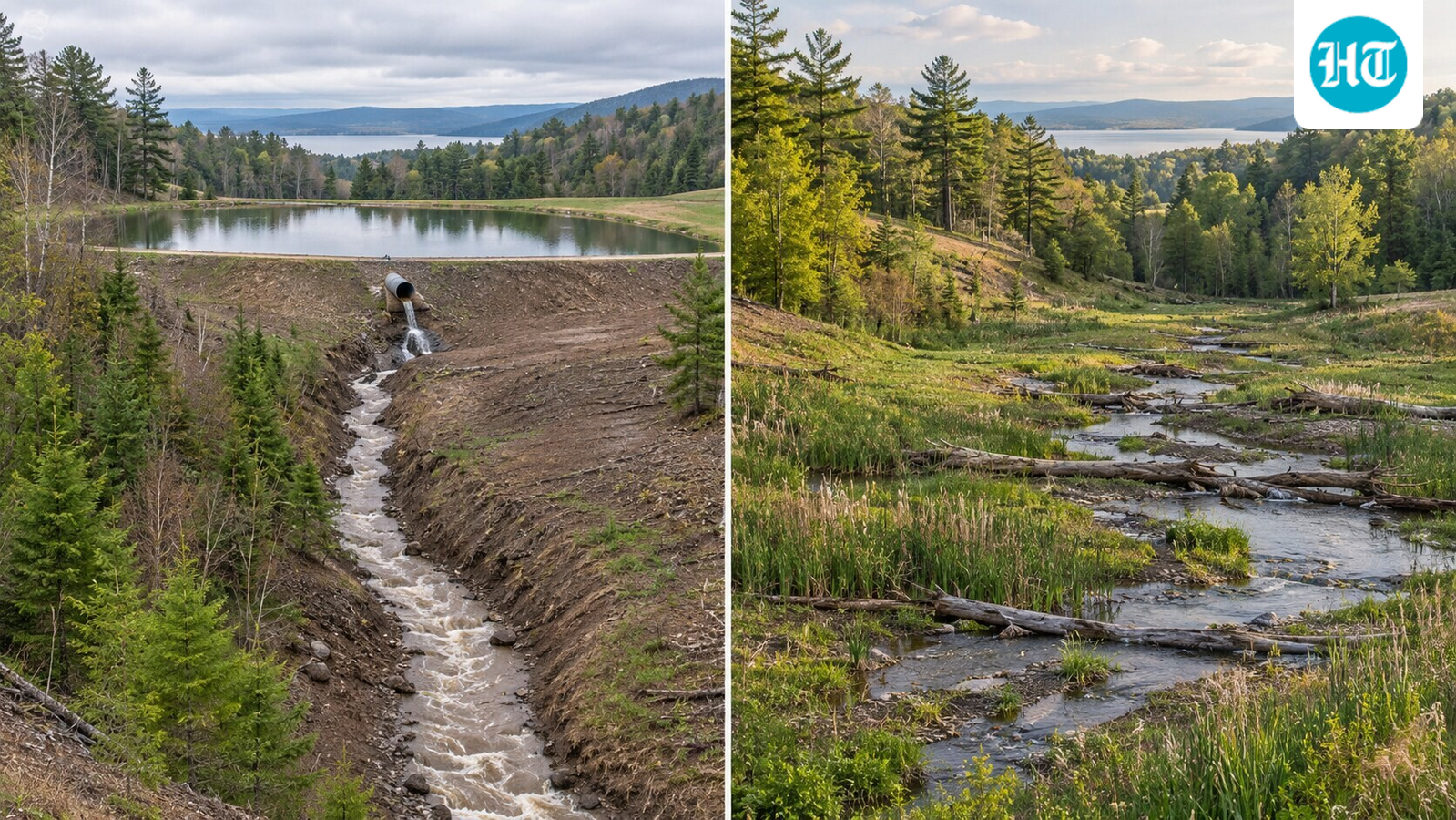
A Vermont farmer built an earthen dam in the early 1950s, but its 2022 removal finally restored the creek’s floodplain. This change helps slow down stormwater before it reaches Lake Champlain. By letting the water spread out, the project protects the land and keeps harmful soil and nutrients from flowing downstream.
Anyone who's seen a street flood after a heavy storm knows just how quickly water can move when it has nowhere to go. That was the problem with a small Vermont creek for decades. The fix began with taking something out. According to the Vermont Land Trust, a dairy farmer in Colchester built an earthen dam in the early 1950s to create an irrigation pond. The pond gave the farm a way to hold water for irrigation. But over time, the dam altered the creek's flow, impacting water quality, wildlife habitat, and the lake fed by the creek.
Below the dam, the valley floor was treeless pastureland, and the cows tramped down the soil as they wandered. The water flowed down from the dam's outlet pipe each year, eroding the creek more deeply. Because of the deep, narrow channel, the creek could not reach the floodplain, which is the low-ground area that the water flows into after a storm or a thaw. Instead, the water would gush out of the valleys as if it were being flushed through a pipe. It brought soil and nutrients, such as phosphorus, into Lake Champlain, and it also damaged habitat for fish, insects, and other animals.
In Vermont's Mad River, researchers study what happens when a huge storm tears up stream banks. The river is in Washington County and drains into the Winooski River before reaching Lake Champlain, making it a different watershed from Colchester Creek. In their paper published in the Journal of Geophysical Research: Biogeosciences, they looked at damage from Tropical Storm Irene in 2011. The study found that six erosion sites in the 0.87 kilometres of stream banks were responsible for the release of about 15.8 metric tons of phosphorus. That, plus about 17,600 metric tons of sediment, was about the same as the average annual export estimated for the watershed. Besides, the authors mentioned that higher concentrations of phosphorus could accelerate algal blooms in lakes. These figures come from an extreme storm on a much larger river, so they don't describe what the Colchester Creek released. But they do show how much sediment and phosphorus unstable banks can deliver to the lake system.
In 2021, with help from students at the University of Vermont, the team first worked below the dam. They built about 25 beaver dam analogs, or wooden structures modeled on beaver dams, as an early trial of the approach. When heavy rain came down that fall, the water slowed, pooling behind the structures and spreading into the floodplain. Scientists have tried the same idea elsewhere too. In a Scientific Reports study, an experiment at the watershed scale in Oregon's Bridge Creek saw large increases in the density, survival, and production of young steelhead after installing dams like these.
Contractors breached the dam and drained the pond in the summer of 2022. They spread the accumulated sediment to form a wide valley with interlinked dips, and they planted tree trunks at the valley bottom to act as natural weirs. The trust said the logs were helping the stream spread as intended after September rains, and cattails soon popped back up. The restored valley bottom is about 25 to 35 feet wide, and the creek is usually only four to six feet wide. This lets water take different routes rather than always hitting the same spot. By restoring the creek, its floodplain, and wetland, there's room to slow stormwater before it reaches Lake Champlain. The trust notes that it will take decades, even centuries, for the valley's full return to a highly functional ecosystem, and that healthy watersheds handle the intense storms better.