
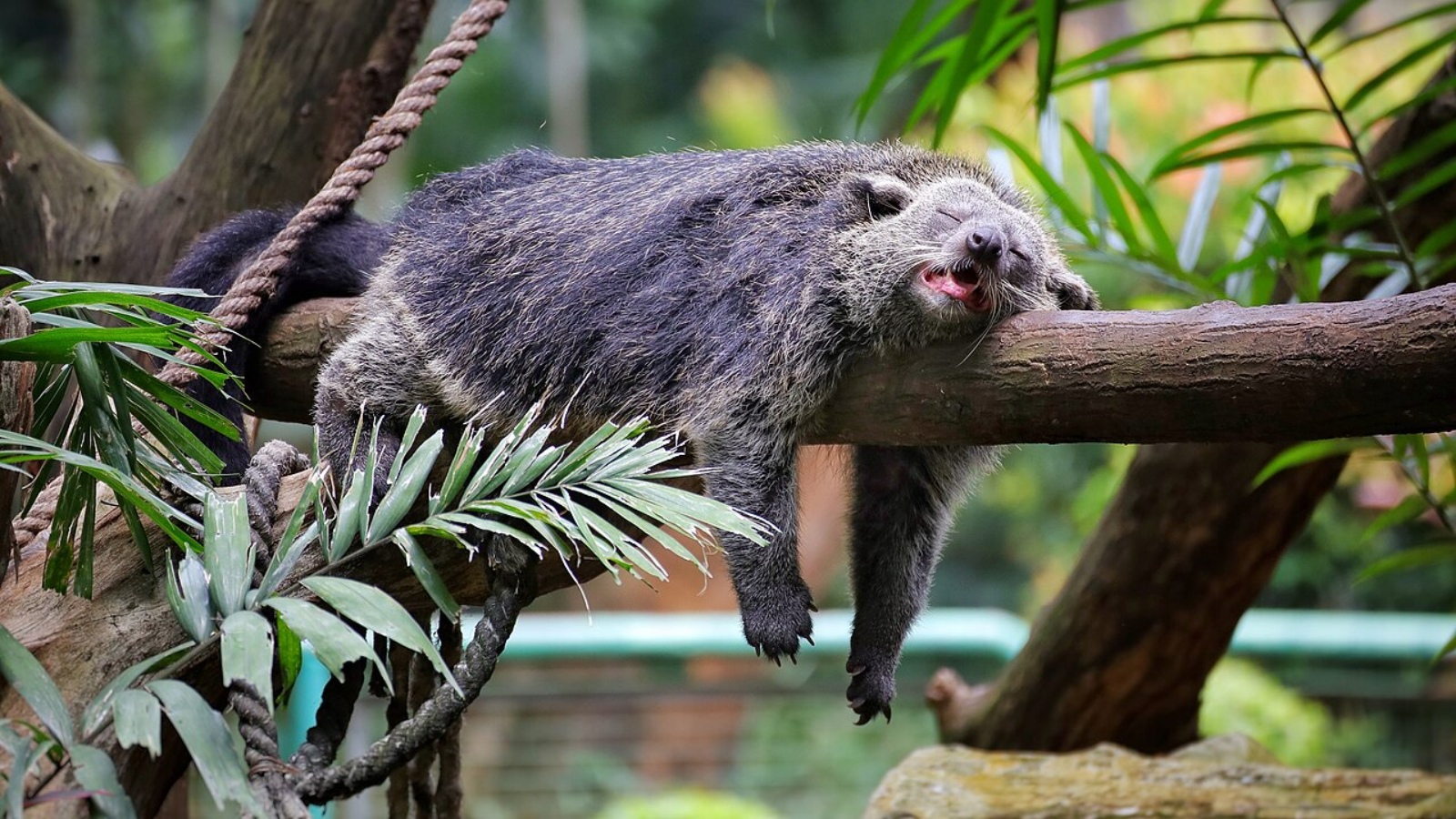
Northeast India shelters many unusual mammals that play important roles in the region's ecosystems. Beyond famous tigers, elusive creatures like the binturong and pygmy hog live in forests and grasslands. These five species show another side of the region's biodiversity, though many remain poorly studied and face serious threats.
Beyond its famous tigers and one-horned rhinoceroses, Northeast India shelters unusual mammals that are rarely seen but play important roles in the region's ecosystems.
Northeast India's forests, grasslands and wetlands support an extraordinary range of wildlife. While the region's elephants, tigers and one-horned rhinoceroses often receive the most attention, several lesser-known mammals remain elusive, threatened or poorly studied.
From a nocturnal animal known as the bearcat to a tiny wild pig dependent on tall grasslands, these five species reveal another side of the region's biodiversity.
Binturong
The binturong (Arctictis binturong), commonly called the bearcat, is an arboreal mammal found in parts of Northeast India. Despite its name, it is neither a bear nor a cat; it belongs to the civet family.
With shaggy black fur, small rounded ears and a long, prehensile tail that helps it move through trees, the binturong is adapted to life in forest canopies. It is primarily nocturnal and feeds on fruits and other food sources.
Phayre's leaf monkey
Recognisable by the pale rings around its eyes and mouth, the Phayre's leaf monkey (Trachypithecus phayrei) looks as though it is wearing spectacles. It inhabits forested areas of Tripura, Mizoram and southern Assam, among other parts of its wider range.
This arboreal primate feeds mainly on leaves, shoots and flowers. Its specialised digestive system helps it process a fibrous diet, making it well adapted to life in the forest canopy.
Pygmy hog
The pygmy hog (Porcula salvania) is one of the world's smallest and rarest wild pig species. Adults measure roughly 60-65 cm in length and stand about 25 cm tall.
Unlike wild pigs that occupy a variety of habitats, pygmy hogs depend on tall, dense grasslands. In India, they survive in parts of Assam, including Manas and Orang National Parks.
These small mammals forage for roots, tubers, insects and other food found in their grassland habitat. Their survival is closely tied to the condition of these ecosystems, which can be affected by habitat degradation and changes in grassland management. Conservation programmes have focused on captive breeding, reintroduction and habitat protection.
Asian golden cat
The Asian golden cat (Catopuma temminckii) is a medium-sized wild cat found in forested parts of Northeast India. Its coat can vary considerably, ranging from golden and reddish-brown to grey and patterned forms.
Unlike more familiar big cats, this elusive feline is rarely seen in the wild. It inhabits forest environments and hunts small mammals, birds and other prey.
Bengal slow loris
The Bengal slow loris (Nycticebus bengalensis) is a nocturnal primate found in forested areas across parts of Northeast India. Its large eyes help it navigate in low light, while its slow, deliberate movements allow it to move through the trees with care.
Unlike monkeys that leap between branches, slow lorises tend to climb steadily through the canopy. Their diet includes tree gum, insects, fruit and other plant material.
Explore more captivating stories about pets and animals here, and make us your daily stop for the latest from the animal kingdom.