
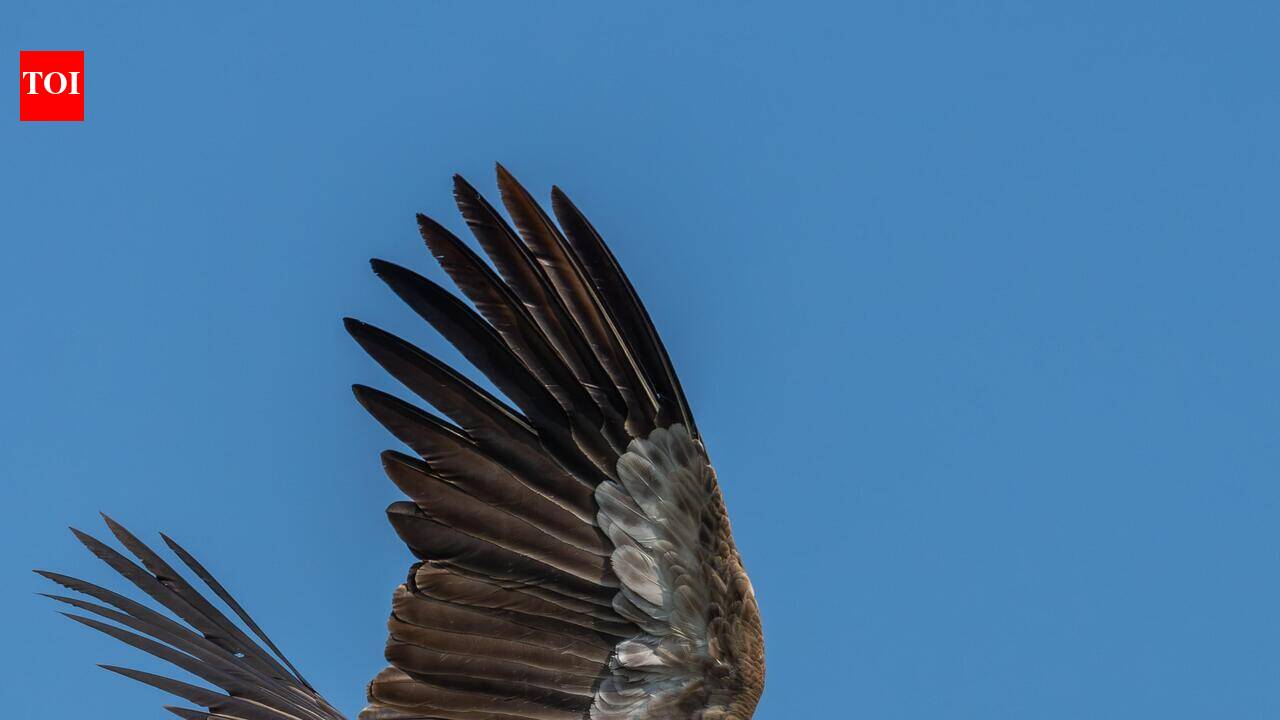
A seven-year-old female Indian vulture reached Latur’s Ausa taluka on Nov 18 after flying 10,767 km across three states. The bird, tagged F14/M99, was released from Melghat Tiger Reserve. Wildlife lover Dhananjay Gutte said, "The bird appeared healthy and was moving naturally in the wild," before it flew to Thane.
Chhatrapati Sambhajinagar: A seven-year-old female Indian vulture, released into the wild at Melghat Tiger Reserve, made a halt in Latur's Ausa taluka after clocking 10,767 km, marking the first recorded sighting of the critically endangered species in the district.It had flown thousands of kilometres across three states, crossed forests and open landscapes and even ventured into Karnataka. Then, on Nov 18, the vulture stopped in Latur.The bird is no anonymous visitor. A yellow ring on its left leg carries the tag F14. A blue one on its right reads M99. A tracking device on its back has allowed Bombay Natural History Society (BNHS) to follow its remarkable journey.The vulture was bred at BNHS's vulture breeding centre at Pinjore in Haryana. It was later released in the Somthana forest range of Melghat along with 15 other Indian vultures.Its brief Latur stop created excitement among local birders. Wildlife enthusiast Abhijit Rasal alerted Latur-based wildlife lover Dhananjay Gutte on the night of Nov 18. Before dawn, Gutte, deputy conservator of forests (Social Forestry) Amitraj Jadhav and local birder Datta Ambekar headed to the roosting site.They reached at 5.30 am and waited.
"After spending some time, we spotted the vulture perched on a tree. We photographed and videographed it. The bird appeared healthy and was moving naturally in the wild," Gutte said.The visitor did not stay for long. At 8.40 am, it took off again. It later reached Murbad taluka in Thane district.From Melghat to MP, Karnataka and back. The Latur halt is only one chapter in F14/M99's long journey.Abhijeet Das, project biologist with BNHS's Vulture Project Maharashtra, said the bird initially remained close to its release site in Melghat. "After its release, F14/M99 stayed near the site, learning to forage and building its flight muscles. It dispersed from the release site on May 28, crossing Maharashtra and reaching Madhya Pradesh. It used several landscapes known to support wild vulture populations," Das said.Then came an observation that conservationists consider particularly significant. On Sept 18, F14/M99 was spotted near Halali dam in Madhya Pradesh. It was roosting with wild vultures. More importantly, it had a full crop, indicating it had fed successfully."This provides the first evidence that the released birds are capable of independent foraging and integrating with the wild population," Das said.For a bird bred in captivity and released into the wild, those two things matter enormously: finding its own food and finding its place among wild vultures.Das said the traveller returned to Maharashtra on Nov 13."The bird entered Maharashtra again on Nov 13, crossing Akot and Malkapur and reaching Nashik, Thane and Pune. It then travelled south to near Vijayapura in Karnataka. It returned to Maharashtra on Nov 18, taking a route through Latur, and reached Thane again on Nov 20," he said.More than just a rare sightingThe Indian vulture (Gyps indicus) is listed as Critically Endangered on the IUCN Red List. The species performs one of nature's least glamorous but most vital jobs. Vultures rapidly dispose of animal carcasses, helping keep the landscape clean and limiting opportunities for disease to spread.India once had vast populations of vultures. Their numbers crashed dramatically, with experts largely linking the decline to the veterinary use of diclofenac. That makes every successfully released bird important.And every sign that a captive-bred vulture can survive, feed and move naturally in the wild adds another piece to the conservation puzzle.For Gutte, however, F14/M99's journey has also put Latur on the vulture map. He said the district's first recorded sighting was encouraging for conservation and raised hopes that its landscape could offer suitable habitat for vultures.
F14/M99, meanwhile, has already moved on. Its Latur visit lasted barely a morning. But after 10,767 km in the wild, one night's halt was enough to leave behind a first for the district.