
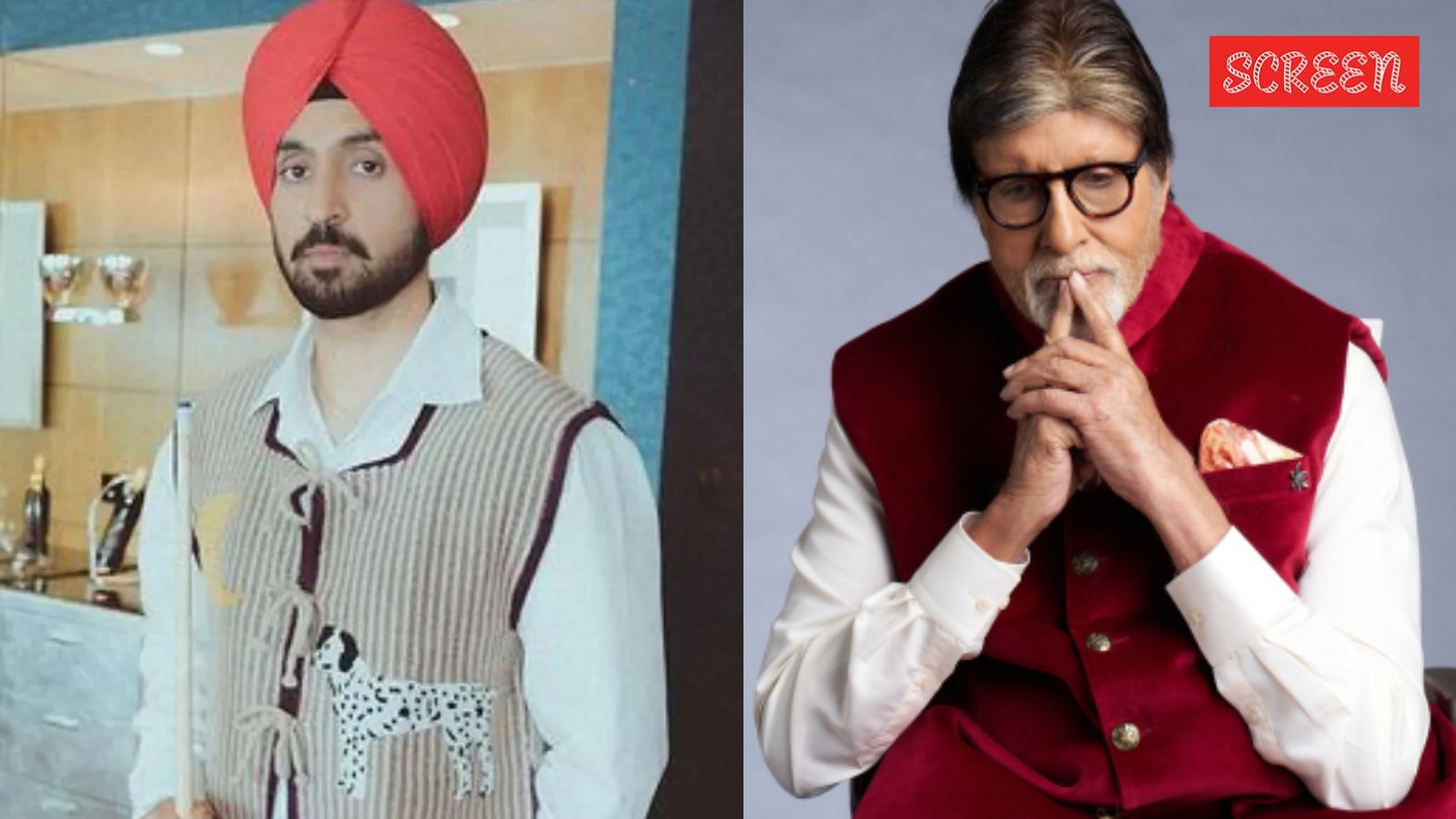
A person named Smith Johnson threatened Amitabh Bachchan and Diljit Dosanjh via email on Friday. The threats target Amitabh’s home on October 31 and Diljit’s concert on November 27. Pro-Khalistan groups linked these threats to the 1984 anti-Sikh riots, claiming Amitabh encouraged violence and Diljit showed him undue respect.
A fresh threat targeting Amitabh Bachchan and Diljit Dosanjh has revived the 1984 anti-Sikh riots controversy. Here's why pro-Khalistan groups are targeting the two stars and how the dispute began.
While the nation is still discussing the shooting incident involving Tiger Shroff, a threat email sent to Mumbai's civic body on Friday has shifted the spotlight to Amitabh Bachchan and Diljit Dosanjh. A person identifying himself as Smith Johnson allegedly threatened to target Amitabh's Mumbai residence with a grenade on October 31 and carry out a suicide attack at Diljit's Mumbai concert at Mahalaxmi Racecourse on November 27. This is the second reported threat in less than a year. But why are the two celebrities being targeted by pro-Khalistan groups?
The controversy traces back to allegations surrounding the 1984 anti-Sikh riots, which have followed Big B for decades. The issue gained renewed attention last year when Diljit appeared on Amitabh's television show, Kaun Banega Crorepati, and touched the veteran actor's feet as a mark of respect. The gesture drew criticism from separatist group Sikhs for Justice (SFJ), which accused Diljit of disrespecting victims of the 1984 violence. Since then, Diljit has also faced criticism and threats linked to his association with the Bollywood megastar.
Why has Amitabh Bachchan faced allegations over the 1984 anti-Sikh riots?
The controversy dates back to the anti-Sikh violence that followed the assassination of then Prime Minister Indira Gandhi by two of her Sikh bodyguards on October 31, 1984.
Some Sikh organisations and individuals have accused Amitabh Bachchan of encouraging attacks on Sikhs in the aftermath of the assassination. They allege that he shouted the slogan, "Khoon ka badla khoon se lenge" (blood for blood), on television, inciting violence against the community. Amitabh has consistently denied the allegations.
Although the accusations did not result in a widely documented public campaign against him immediately after the riots, they resurfaced in 2011 when he was invited to the inauguration of the Virasat-e-Khalsa heritage complex in Punjab. Amid objections from sections of the Sikh community, the Akal Takht, the highest temporal authority of the Sikh faith, asked him not to attend the event.
What did Amitabh Bachchan say in his letter to the Akal Takht?
On November 28, 2011, Amitabh Bachchan wrote to the then Akal Takht Jathedar, Giani Gurbachan Singh, denying the allegations and expressing anguish over the accusations.
In his letter, he wrote, "I am addressing this letter to you with a most pained heart. Wild, irresponsible and most unfounded allegations, by certain sections of the Sikh community, about my involvement in the inciting of violence against them during the most unfortunate Sikh riots of 1984, soon after the death of Shrimati Indira Gandhi, the then prime minister of India, has caused me acute agony."
Amitabh added that the allegations had hurt him particularly because they surfaced after he accepted an invitation from the Punjab government to attend the inauguration of the Khalsa Heritage Complex at Sri Anandpur Sahib.
"These vicious allegations have caused me deep hurt, particularly when they were levelled at a time when I had accepted the invitation from the Punjab government to attend the inaugural ceremony of the historical Khalsa Heritage Complex at Sri Anandpur Sahib, the birthplace of the Khalsa Panth," he wrote.
The actor said he had been looking forward to attending the ceremony but eventually declined the invitation because he did not want to cause embarrassment at the historic event.
He also referred to the longstanding relationship between his family and the Nehru-Gandhi family, whose ties, he said, went back to their shared city of origin, Allahabad.
"We have been together in each other's hour of grief and joy, but to allege that I was a part of the crowd that incited them to raise anti-Sikh slogans is a preposterous and blatant lie. Quite contrarily, I have always propagated the soothing of injured feelings and the maintenance of serenity. The unfortunate incidents of the riots of 1984 against the Sikhs shall always remain a blot and a dark phase in the history of our country, a country that prides itself in its secular credentials," he stated.
Amitabh also mentioned that his mother, Teji Bachchan, came from a Sikh family.
However, his denial did not put the controversy to rest.
The Akal Takht indefinitely deferred consideration of Big B's plea rather than issuing a ruling clearing him of the allegations.
The controversy resurfaces in 2014 and 2015
In 2014, the All India Sikh Students Federation demanded that a criminal case be registered against Amitabh Bachchan and urged people to boycott his films and television appearances.
The controversy also moved to the United States, where a court issued a summons in connection with a civil lawsuit alleging human rights violations linked to the 1984 anti-Sikh violence. The legal proceedings did not establish Bachchan's guilt.
The issue resurfaced again in 2015 when SFJ pursued further legal action in the United States, seeking a judgment in absentia after alleging that Bachchan had failed to respond to the summons. These were claims made in civil proceedings.
How did Diljit Dosanjh become a target?
The controversy returned to the spotlight in October 2025, when Diljit Dosanjh appeared on the 17th season of Kaun Banega Crorepati, hosted by Amitabh Bachchan. Diljit had appeared on the show to raise awareness about the devastating floods in Punjab. After winning Rs 50 lakh, he pledged the entire prize money towards relief and rehabilitation efforts for flood victims.
During his appearance, Diljit touched Bachchan's feet as a gesture of respect. The megastar warmly embraced him and introduced him as "Punjab da puttar".
However, the interaction drew criticism from SFJ, which accused Diljit of disrespecting victims of the 1984 anti-Sikh violence. In a statement, the separatist organisation alleged that the singer-actor had "insulted every victim, every widow, and every orphan of 1984 Sikh Genocide."
The group also issued threats against Amitabh and Diljit. Reports subsequently raised concerns about the security of the veteran actor, while SFJ chief Gurpatwant Singh Pannun warned of an attempt to disrupt the singer's concert in Australia scheduled for November 1, 2025.
How did Diljit Dosanjh respond to the threats?
Diljit Dosanjh did not immediately address SFJ directly. Instead, during his Brisbane concert, he spoke about spreading love and maintaining faith despite criticism.
"Always keep talking about love. For me, this earth is one. My Guru says, 'Ik Onkar.' So, this earth is one. And I was born from this earth. I am the life of this land and one day I will return to this soil," he said. He added, "So, there is only love from my side for everyone, even if someone gets jealous of me or trolls me. I will always spread the message of love. I have always done so. I don't care how anyone feels about it."
Diljit later clarified his reasons for appearing on Kaun Banega Crorepati through his Instagram Stories.
"I hadn't gone there to promote any film or song. I went for the Punjab floods... so that the issue could be discussed at the national level and people could come forward to donate," he wrote in Punjabi.
Despite his explanation, tensions continued. Pro-Khalistan slogans were reportedly raised at one of his concerts in Perth, while his upcoming show in Auckland, New Zealand, also faced threats of disruption.
Diljit confronts protesters during his Calgary concert
In April 2026, Diljit Dosanjh stopped his Calgary concert midway after spotting audience members waving Khalistan flags. Addressing the crowd, he defended his decision to appear on Amitabh Bachchan's show and argued that he had used several platforms to highlight Punjab's concerns.
"My job is not to do charity. But whichever platform I go on, I always talk about Punjab. We often say national media doesn't talk about Punjab enough. I went everywhere, including on that channel (Sony Entertainment Television for KBC) for the sake of Punjab. I put forth Punjab's issues there. I've even donated generously to my state whenever needed," he said.
The actor-singer also referred to his appearance on The Tonight Show Starring Jimmy Fallon, explaining that he had used the platform to discuss Punjab and the Guru Nanak Jahaz incident rather than promote a film or song.
"If you still have an issue that I sat across someone on television, then keep waving how many flags you want," he added.
The incident made headlines, prompting Diljit Dosanjh to clarify his position on Instagram.
"Standing outside and protesting -- anyone can do that. But if you try to come inside and harass my fans, that will not be tolerated," he wrote.
Diljit stressed that his objection was not to flags or banners but to attempts to intimidate audiences and disrupt performances.
"This is not about any banner or flag -- the real issue is your intention behind it. I told security that anyone trying to disrupt the program should be picked up and thrown out. I never said anything against any banner, so don't spread fake narratives. I've been avoiding this issue since last year -- but not anymore. Thank you. Love & peace," he added.
What happens next?
The latest reported threats targeting Amitabh Bachchan's residence and Diljit Dosanjh's Mumbai concert have brought the controversy back into focus. Both celebrities are yet to issue statements regarding the latest threat.