
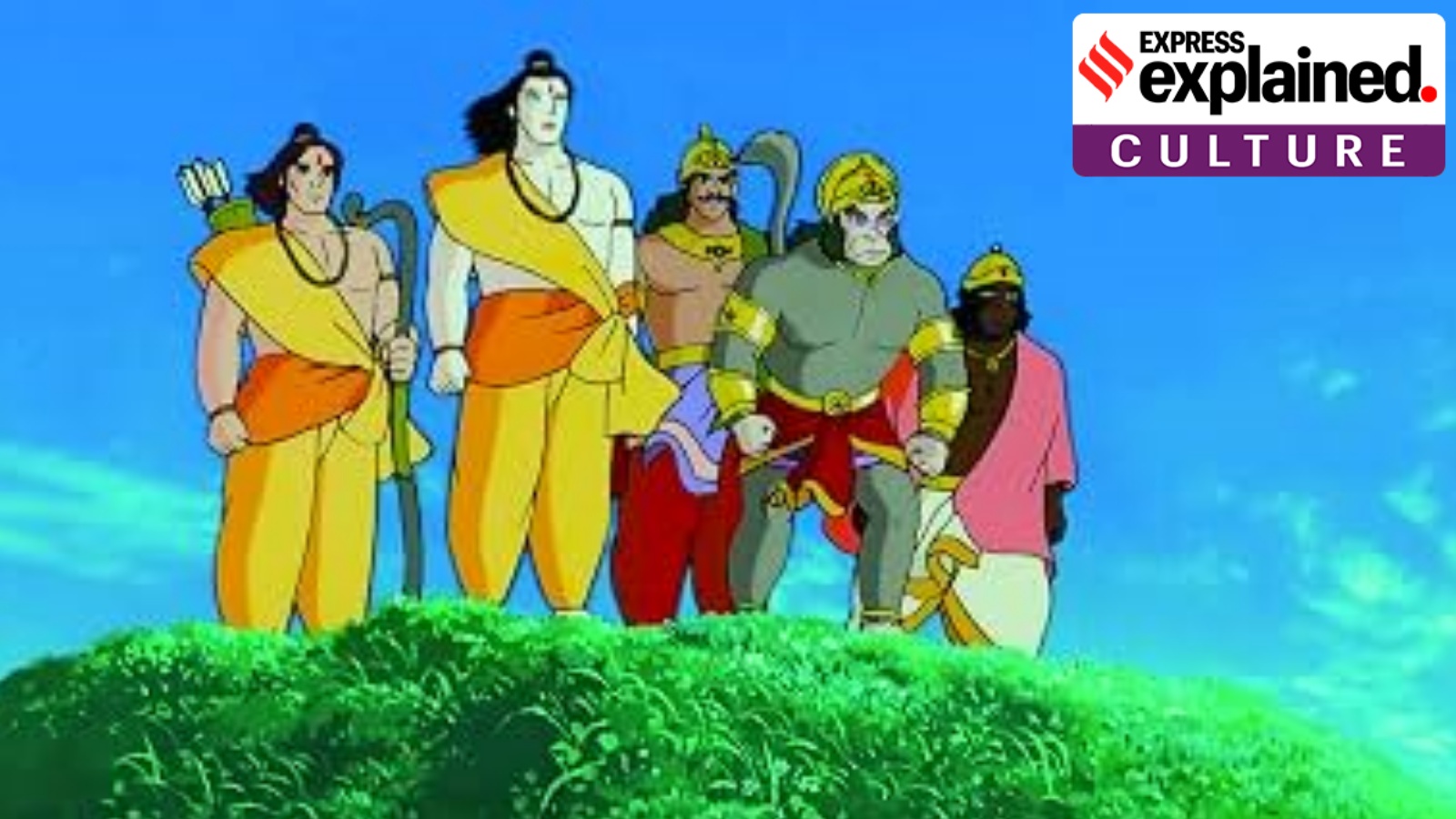
Yugo Sako and Ram Mohan’s 1992 animated Ramayana faced early opposition in India over religious concerns. Many feared a foreign filmmaker might misinterpret the epic. Despite these hurdles, the film got a restored release in 2025. It eventually found a large audience, becoming a cult favourite for many Indian viewers.
Yugo Sako and Ram Mohan's 1992 animated Ramayana spent decades navigating domestic anxieties over religious depiction and the practical hurdles of pre-digital cross-border filmmaking.
When Japanese filmmaker Yugo Sako set out to make an animated adaptation of the Ramayana in the 1980s, he hoped it would be an Indo-Japanese production. But the project ran into objections over the depiction of a Hindu epic by a foreign filmmaker and the use of animation to tell a religious story.
Ramayana: The Legend of Prince Rama was eventually completed in Japan in 1992, with Indian animator Ram Mohan as co-director. Although it premiered in New Delhi the following year, the film struggled to find a mainstream theatrical audience in India. Decades later, it became a cult favourite, culminating in a nationwide theatrical release of its restored version in 2025.
Why did the film face resistance, and how did it eventually find an audience?
How did the project begin?
Sako first conceived the idea of adapting the Ramayana in 1968, after reading a Japanese translation of the epic. Over the following years, he made several documentaries on India, including one on archaeological sites associated with the Ramayana.
According to Rea Amit, in a 2022 paper published in the Animation Studies Journal, Sako believed animation would be particularly suited to the epic's fantastical elements. He saw an opportunity to combine India's cultural connection to the text with Japan's expertise in animation.
Sako eventually collaborated with Bombay-based animator Ram Mohan, widely regarded as the father of Indian animation. Although several Indian businessmen initially expressed interest in investing, the production was ultimately financed entirely in Japan.
Why did the project face resistance in India?
One major concern was that a foreign filmmaker might reinterpret one of the most important texts of Hindu culture. Amit noted a warning by the Vishwa Hindu Parishad (VHP) to the Japanese Embassy in New Delhi against attempts to create a new interpretation of the Ramayana. He wrote that the warning followed an April 25, 1983 report in The Indian Express, which suggested that Sako's documentary project was an attempt to recreate the epic.
In an interview with IIT Bombay's D'Source, Mohan recalled that the Indian government considered the Ramayana too sensitive a subject to depict through cartoon characters. He said the filmmakers spent about four years trying to secure support for a co-production before Sako decided to proceed with a Japanese production.
The political climate became increasingly sensitive as the film took shape. In 1987, Ramanand Sagar's television serial Ramayan made its debut on Doordarshan, drawing an enormous audience. We have written about the serial here.
Off screen, the Ram Janmabhoomi campaign was gathering momentum. The VHP organised a shilanyas ceremony in Ayodhya in 1989, followed by BJP leader LK Advani's Rath Yatra in 1990.
On December 6, 1992, the month the film was completed in Tokyo, kar sevaks demolished the Babri Masjid in Ayodhya, triggering widespread communal violence.
The political climate may have complicated the film's prospects for a wider theatrical release. However, it premiered at the International Film Festival of India (IFFI) in New Delhi in January 1993, just weeks after the demolition. Amit identified religious and political tensions as possible factors behind its limited theatrical distribution, but did not establish that the demolition directly prevented its release.
So, how was the film finally made?
The film took nine years and roughly 800 million yen to complete, with most of the animation completed in Japan.
In Tokyo, co-director Koichi Sasaki and animation director Kazuyuki Kobayashi oversaw a large studio operation, involving 450 Japanese production personnel and more than 100,000 hand-drawn animation cells, according to the film's official website. Mohan, the Indian co-director, helped shape the film's visual style.
Amit described the collaboration as a form of "reversed outsourcing". Rather than Japanese studios outsourcing animation work to India, Indian artists contributed to the film's cultural and creative foundations, while Japanese teams carried out most of the animation.
The teams bridged the gap between Bombay and Tokyo through physical sketches and extensive international travel. Indian filmmaker and production designer Nachiket Patwardhan prepared drawings of Indian costumes and landscapes, which Japanese artists used as visual references.
The collaboration also presented practical challenges. In a D'Source interview, Ram Mohan recalled how drawing overcame language barriers during his trips to Tokyo. Seeing Japanese animators render Rama's dhoti like tailored pyjamas, he arranged a live demonstration showing how the garment was draped.
How did the film find its audience?
At the time of its release, the film failed to secure a wider Indian cinema run. It subsequently found an audience through television broadcasts and home video releases.
The film also encountered difficulties with international distribution. According to a 2001 account published by Beliefnet, a Hollywood studio offered to distribute the film in the US, but wanted Rama's exile rewritten as a honeymoon with Sita. Sako and co-producer Krishna Shah rejected the proposed change.
A Hindi dub, featuring television Ramayan star Arun Govil as Rama and Amrish Puri as Ravana, aired on Doordarshan and was subsequently broadcast on Cartoon Network. In October 2002, the channel included the film in its Dussehra and Diwali programming under The Great Indian Epics. VCD and DVD releases also helped it reach viewers.
The film also struggled to find a theatrical audience in Japan. Amit identified the absence of a Japanese-language dub as one obstacle. Following limited screenings in the late 1990s, the film began an extended theatrical run at a small cinema in Yokohama in September 2018.
On January 24, 2025, Geek Pictures, AA Films, and Excel Entertainment released the 4K remaster across 621 Indian screens in English, Hindi, Tamil, and Telugu, followed by a screening in Parliament.