
The folk song Chhalrey Chhalrey Waal has become a cross-border social media hit. This viral success put the spotlight on Saraiki, a language spoken in southern Pakistan and by some communities in India. Many people now want to learn the words, as the song showed the language has a distinct heritage.
Chhalrey Chhalrey Waal, an age-old folk song has become a cross-border social media hit. This has put the spotlight on Saraiki, a language that may sound similar to Punjabi but has its own distinct cultural heritage.
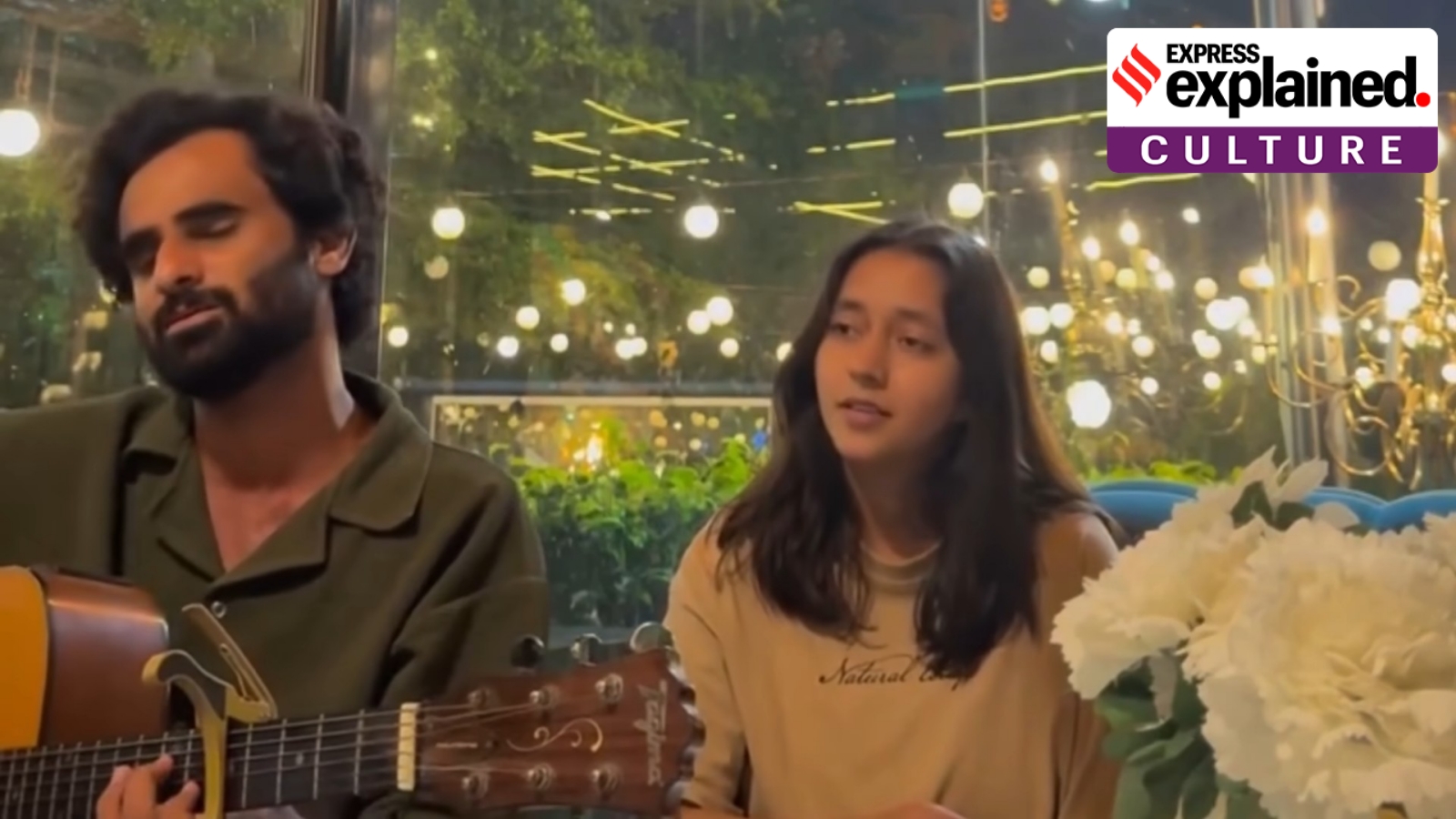
An age-old folk song has now become a cross-border social media hit after an acoustic rendition by two Pakistanis, medical student Shanzy Sial and musician Mohsin Lashari. Chhalrey Chhalrey Waal, translating to curly/wavy hair, is the story of a woman praising her beloved's charms, saying "who could ever be like you" (teriyaaan reesan kaun kare).
What has particularly caught the eye is that the song is in a language called Saraiki -- a language spoken predominantly in southern Pakistan, and extending into parts of western and central-western Pakistan as well as by some communities in India.
This has driven a number of people in the subcontinent to learn the words, attempt their own renditions and share them on social media. In the process, the song has also brought increased attention to the language, which may sound familiar to Punjabi and Sindhi speakers. Saraiki, however, still has its own distinct identity and cultural heritage.
The origins of Saraiki
An Indo-Aryan language, Saraiki is spoken predominantly in southern Punjab in Pakistan, particularly in and around Multan, Bahawalpur, Dera Ghazi Khan and Muzaffargarh.
The language extends into northern Sindh and parts of Balochistan and Khyber Pakhtunkhwa. It is also spoken by migrant communities in India, particularly those whose families came from the Saraiki-speaking regions of western Punjab during Partition. While not included in the Eighth Schedule of the Indian Constitution and not holding official status in India, the language is spoken by some people in Punjab, Delhi, Haryana and Uttar Pradesh, among others. Some of its variants, like Jhangi and Derawali, are also spoken in India. According to Pakistan's 2023 census, around 12% of the country's population speaks the language.
Saraiki is closely related to Punjabi, Sindhi and other north-western languages. According to a paper by British linguist Christopher Shackle, who is also professor emeritus of modern languages of South Asia at the University of London, published in Modern Asian Studies in 1977, Saraiki is described as "the language of the middle Indus valley".
It comes under the umbrella term Lahnda, the dialects of western Punjab. Lahnda means the land where the sun sets. The language developed in close contact with Punjabi and Sindhi while having its own form. It was also called Multani once. Saraiki as a term, however, came much later, in the 1960s, when many began asserting its identity as separate and distinctive. Saraiki is a broader term that includes Multani and others like Derawali and Bahawalpuri.
There is Southern Saraiki, Northern Saraiki, Sindhi Saraiki, Jhangi Saraiki, Shahpuri Saraiki and Central Saraiki, depending on which region of Pakistan one is living in. All these have minor regional variations in pronunciation. In India, Saraiki speakers are mostly the ones who migrated during Partition.
Saraiki's similarity with Punjabi
To a Punjabi speaker, Saraiki may sound familiar. The two languages share vocabulary, have geographical and cultural links, and have influenced each other over time. But Saraiki has its own distinctive grammar, vocabulary and sound system. While it does sound a bit like Punjabi, it isn't. It shares grammatical features with Punjabi, but its sound system is more similar to Sindhi.
Saraiki's rich literary and musical heritage
One of Saraiki's most prominent literary figures is Khwaja Ghulam Farid, a famed 19th-century Sufi poet who wrote a number of kafis (devotional poetry about love and longing) that are still sung by many. One of the more prominent ones is the poignant Sanwal Mor Muharan, a staple in classical and Sufi repertoires, notably performed by Ustad Salamat Ali Khan and Abida Parveen. His Dilri Lutti has had many historic renditions and continues to be sung by a slew of artistes. In fact, poetry and music have played a significant role in helping Saraiki survive, especially because it was not a part of formal education systems.
Pakistan's Coke Studio has also helped bring Saraiki music to a wider audience, reworking folk compositions for contemporary listeners. Its Saraiki offerings include Umaran Langiyaan, Malang and Allah Karesi, among others.
Why has Chhalrey Chhalrey Waal struck a chord?
The song is not a new composition but an old folk song popular in Punjab on both sides of the border. While no single composer is known, one of the older recordings is by Pathanay Khan, who often sang the song. He, however, recorded the song in 1989, when he was about 63. Khan drew extensively on the poetry of Khwaja Ghulam Farid and Baba Bulleh Shah, among others.
The tune of Chhalrey Chhalrey Waal also appears to have been used in the Hindi film song Na Kajre Ki Dhaar from Rajiv Rai's 1994 film Mohra. Originally composed by Kalyanji-Anandji, the song had been recorded in Mukesh's voice years earlier for a Shashi Kapoor film that was shelved. It was later adapted for Mohra by Kalyanji's son, composer Viju Shah.