
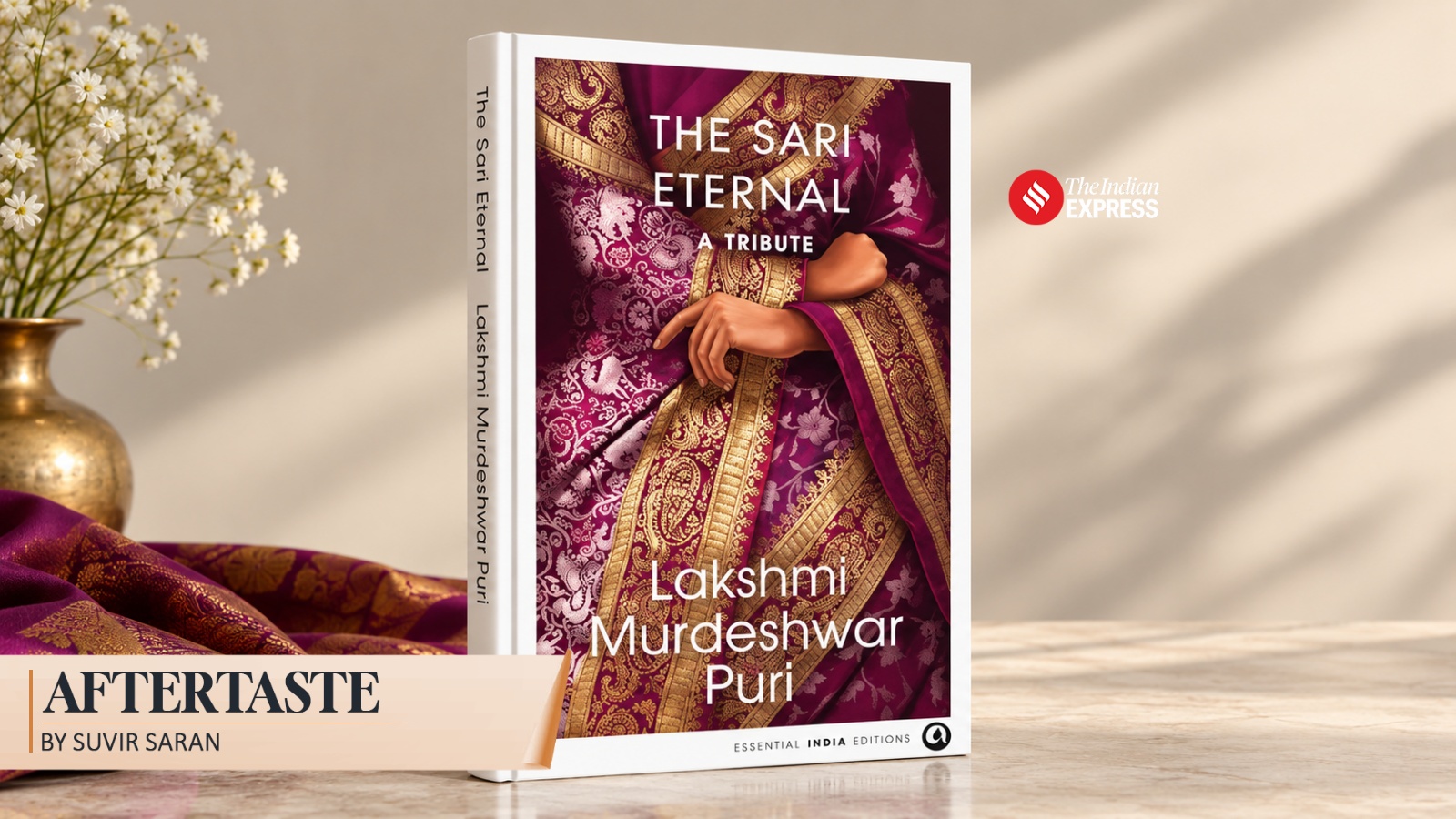
Suvir Saran reviews Lakshmi Murdeshwar Puri's The Sari Eternal, a book celebrating the sari as a symbol of identity and heritage. Puri uses personal stories to show how the garment connects to memory and history. The book explores the sari through rituals, cinema, and the lives of Indian women everywhere.
Suvir Saran reviews Lakshmi Murdeshwar Puri's The Sari Eternal, a celebration of the sari as a symbol of memory, identity and India's cultural heritage.
I have crossed paths with Mrs Puri in New York and later at parties in Delhi. We never became close or spoke at length, but I have always admired her grace and elegance, draped in a sari. My earliest foray into art, colour and India in all its plurality was through the sari. In the pleats, folds and chunnat of my mother's sari, I found a safe cocoon, a small haven. I would hide and think: if I cannot see the world, perhaps the world cannot see me.
Yet I knew what it saw -- the beauty and majesty of the sari. Lakshmi Murdeshwar Puri's The Sari Eternal brought that child back to me. Her book, too, begins with a mother's sari: refuge, memory, inheritance.
Puri's mother, Malati, presses the edge of a red-and-white Kanjivaram against her little daughter's wounded forehead. The cloth staunches the blood; its stain becomes a keepsake. It is a tender scene, never sugary, and the book's first abiding image. From there, Puri follows the sari through schoolgirl mischief, Bharata Natyam, college, marriage, and a diplomatic career, where she wore it as a cultural signature and as professional power dressing. A Japanese editor's curiosity, a Geneva delegate's compliment, a husband's turban: each encounter adds a human thread to the larger weave.
Bandhani puckers, Banarasi brocades, Kanjivaram silks, Bomkai borders, Paithani peacocks and the airy sway of a Sanganeri print arrive not as dry entries in a textile ledger but as touch, scent, sound and taste. In America, I would be summoned at friends' and relatives' weddings to help women tie their saris. I knew the names of so many patterns that people were astonished. That, to me, is the sari's quiet magic: through it we can travel across India, into its stories, its people and the hands of its weavers. My one crib is a practical one: I wish we paid those weavers more. The book's loving attention makes that question harder to set aside.
Then the lens widens. The sari moves through Hindu ritual and goddess imagery, Buddhist and Muslim histories, Christian communities, the epics, classical poetry, political struggle and popular cinema. Draupadi's endangered dignity, Savitribai Phule's spare change of clothes, a white khadi sari in the freedom movement, Rekha's chiffon, Meena Kumari's ache, Nargis's moral force: Puri reads the garment as witness, character, sometimes quiet co-star. Her most persuasive insight is that fabric does not merely cover a body. It can speak of labour, longing, belonging, agency and the right to be seen.
This is a book written from conviction. Puri's love occasionally asks the sari to carry the whole weight of India's unity, feminine power and civilizational continuity. We may want more room for women who do not wear it, or for tensions between choice and expectation. The discussion of Gen Z is most alive when it listens to young women's hesitation; at moments, its answers arrive sooner than their doubts have been allowed to breathe. Yet this ardour is part of the invitation. Puri does not hide behind a cool academic veil. She offers a personal argument, vivid enough to question and generous enough to keep discussing. The sari becomes a meeting place, not a verdict.
And the future she imagines is not folded away in nostalgia. Pre-draped saris, sneakers, skateboards, social media, young designers and new drapers enter the frame. Puri hopes inheritance can be altered, worn with play, and still remain inheritance. Tradition need not be a locked almirah; it can be a door, opened by the next generation in its own bright, daring way.
Puri's prose is at its best when memory, image and idea meet -- as they do in the blood-marked sari, in the pallu that becomes a mother's shelter, and in cinema's rain-soaked choreography. Its abundance sometimes runs ahead of its argument, but the exuberance is honest; this book wants to gather, not pare away. The result is intimate as a mother's touch, expansive as a country's loom. Read it for the histories and handlooms; stay for the heartbeat beneath them. You may finish with a renewed eye for the sari -- and the urge to pass a story, or a cloth, to someone you love.