
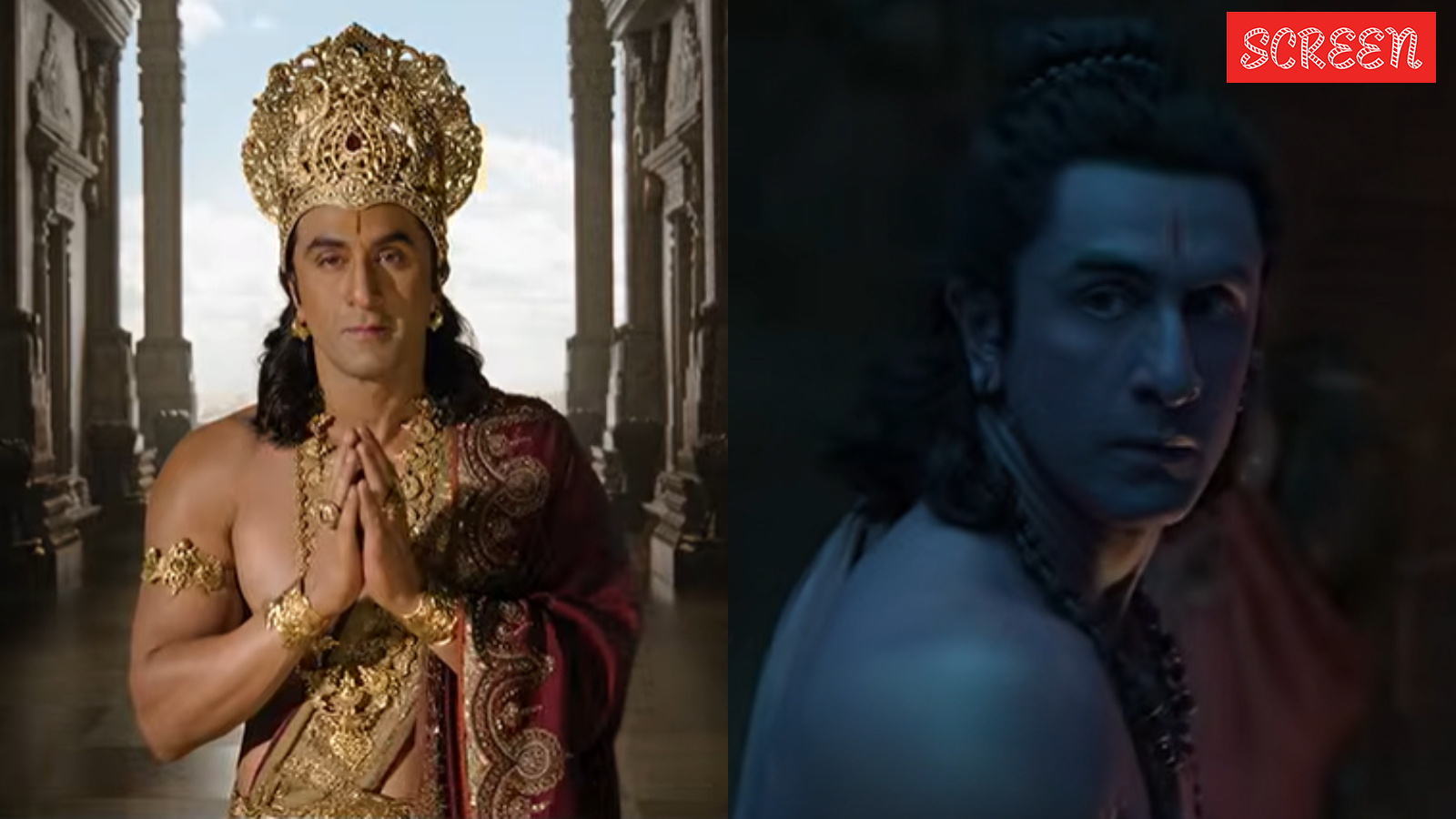
Ranbir Kapoor faced questions over his casting as Lord Ram in Nitesh Tiwari's Ramayana. Many doubted if he could play the role due to his past characters. However, his performance silenced critics. Ranbir said, "My first instinct was fear. I wondered whether I was worthy of it and whether."
Ranbir Kapoor faced questions over his casting as Lord Ram in Ramayana. But should an actor be judged before audiences have seen him perform?
Within the first few seconds of watching Ranbir Kapoor as Lord Rama in Ramayana: Part 1, something interesting happens. You stop seeing Ranbir Kapoor. You stop thinking about the troubled lover from Rockstar, the charming womaniser from Bachna Ae Haseeno, the spoilt brat from Yeh Jawaani Hai Deewani or the deeply unsettling protagonist of Animal. For those few seconds, you simply see Rama.
And perhaps that is the biggest compliment one can pay an actor playing a character as culturally and emotionally significant as Maryada Purushottam Rama.
Before Nitesh Tiwari's Ramayana arrived in theatres, there was considerable scepticism about whether Ranbir could pull off the role. The questions were understandable. How could an actor whose screen persona had largely revolved around flawed men, complicated relationships and moral ambiguity suddenly convince audiences that he was Lord Rama? Could someone whose public image had frequently been discussed in the context of his romantic relationships embody the restraint, dignity and composure associated with Rama? Before audiences had even seen him in character, a verdict of sorts had already been passed.
But should an actor be judged by his previous roles, personal choices or public perception before being given the opportunity to demonstrate what he can bring to a new character? Ranbir's portrayal makes that question particularly relevant.
The fear of playing Rama, and the responsibility that came with it
Interestingly, Ranbir himself was not convinced that he was the right person for the role when it was first offered to him. Speaking on Kaun Banega Crorepati, he said, "When I was offered this role, I knew it was not just a role but a huge responsibility. My first instinct was fear. I wondered whether I was worthy of it and whether I would be able to do it. Crores of people have deep faith in Lord Rama."
He further explained how the opportunity made him look beyond his identity as an actor. "At this stage of my life, I was getting the opportunity to become a good actor, forget being an actor, sir, to become a good human being," he said.
In his conversation with BBC Asian Network, Ranbir also spoke about how playing a mythological character left him with considerably less creative freedom than his other films.
"If I'm playing a character like in Animal or Brahmastra, there's a certain amount of creative freedom. But here, the text has been written thousands of years ago, so you try to stick to it," he said.
He also admitted that he was worried about meeting the expectations attached to the character.
"I was filled with fear. I wondered whether I was too old for the role and whether I would be able to do justice to it. I had so many insecurities and questions about myself. But the opportunity was right in front of me, and I knew it was a once-in-a-lifetime opportunity. I was also very aware of the kind of reactions it would invite," he said.
His words reveal that Ranbir understood the baggage he was bringing into the film. He knew audiences had a preconceived image of him and that playing Rama was not like portraying another fictional character, where an actor could take liberties with the personality and motivations.
He offered a simple explanation of his approach: "You have to make them believable as human beings. Give them vulnerability and real emotions."
Perhaps that is where his performance finds its footing. Rather than making Rama look like a larger-than-life superhero, Ranbir appears to have understood that the character's greatest strength lies in his ability to exercise restraint.
It is in the smallest gestures that Ranbir makes Rama believable
What makes Ranbir's portrayal interesting is that he does not constantly demand attention. His performance is not built around dramatic declarations, exaggerated expressions or an attempt to make every dialogue sound monumental. It is in the little things.
Notice his calm demeanour, the way he holds himself, the stillness in his face and the absence of unnecessary movement. Even the way he speaks to elders, slightly lowering his shoulders and appearing to make himself smaller out of respect, adds to the characterisation. Not everyone may agree with these choices, but his measured expressions, controlled voice and composed body language create the impression of someone who does not need to establish authority by being loud.
There is also something particularly striking about the way he uses his eyes. The near-stillness, minimal blinking in certain scenes and the way he holds a gaze make his presence feel different from the Ranbir audiences have grown accustomed to watching.
These are not conventional superstar mannerisms. They require an actor to hold back, resist the temptation of doing more and trust that audiences will notice the smallest details. That is no easy task when playing someone who has been interpreted, worshipped and represented in different forms for generations.
Rama's restraint should also not be mistaken for an absence of emotion. His dignity comes from how he processes situations, responds to people and places his responsibilities above personal desires. Ranbir seems to understand that the character's strength does not always need to announce itself.
Have we become too familiar with Ranbir's screen persona?
Perhaps the bigger question is whether Ranbir is such a convincing actor that audiences sometimes struggle to separate him from the characters he plays.
Think about Sanju. When Rajkumar Hirani announced that Ranbir would play Sanjay Dutt, there were questions about whether he could capture the actor's physicality, mannerisms and personality. Merely looking like Sanjay Dutt was not going to be enough. Yet, when the film arrived, Ranbir's transformation became one of its biggest talking points.
He did not merely imitate Dutt's walk, expressions or voice. He captured different phases of his life, including his vulnerability, insecurities, anger and emotional dependence on his parents. According to Sacnilk, Sanju collected Rs 342.57 crore net in India and Rs 588.50 crore worldwide, becoming one of the biggest commercial successes of Ranbir's career at the time.
Then came Animal. Sandeep Reddy Vanga's film presented Ranbir as Vijay Singh, a deeply flawed, aggressive and emotionally troubled man whose obsession with his father pushed him towards violence. The character invited considerable criticism, but there was little denying that Ranbir had created a memorable screen persona. Animal collected approximately Rs 553.90 crore net in India and Rs 915 crore worldwide, according to Sacnilk.
The contrast between these characters and Rama is striking. Sanju required him to disappear into the personality of another real-life individual. Animal required him to embrace the darkness of a fictional character. Rama demands almost the opposite instincts.
And that is precisely why his casting was such an interesting gamble. An actor's ability to make audiences believe in a character can also make it difficult for them to imagine him playing someone completely different. Ranbir's Bunny in Yeh Jawaani Hai Deewani, Jordan in Rockstar and Vijay in Animal have contributed to this perception. But should that familiarity become a limitation? His filmography should be a reason to give him the benefit of the doubt, not deny him an opportunity.
The beef controversy and why personal choices should not decide casting
The objections to Ranbir playing Rama were not restricted to his filmography or public image. An old interview from 2011, during the promotions of Rockstar, also resurfaced.
During a conversation with food journalist Kunal Vijayakar, Ranbir spoke about his family's Peshawari food influences and his preferences. "My family is from Peshawar, so a lot of Peshawari food has come with them. I am a mutton, paya, and beef fan. Yeah, I am a big beef fan," he had said.
The comment circulated on social media, with some questioning whether someone who had publicly expressed such a food preference was suitable to portray Lord Rama. The controversy resurfaced in 2022 when Ranbir and Alia Bhatt were reportedly stopped from entering the Mahakaleshwar temple in Ujjain by members of the Bajrang Dal. It came up again when his casting in Ramayana was discussed.
But an important distinction often gets lost in these debates. Playing a character is not the same as claiming to be that character. An actor is not expected to have lived the life of every person he portrays or share their personal beliefs and habits. A person can play a murderer without being one. An actor can portray a freedom fighter without having participated in the freedom struggle. Dietary choices do not automatically determine an actor's ability to understand a character.
Of course, portraying a deity is different from playing an ordinary fictional character. The religious and cultural significance demands sensitivity, sincerity and an understanding of the source material. Audiences are entitled to scrutinise the portrayal. But should that scrutiny extend to deciding that an actor is incapable of playing the role before watching him perform?
During his San Diego Comic-Con interaction, Ranbir acknowledged that there could never be one universally accepted face for Lord Ram. "The first question that popped into my head was, am I worthy? Am I the right person and why am I being gifted this responsibility to not play Lord Rama but represent him?" he said.
He explained that every devotee carries their own interpretation of Rama, which means not everyone would necessarily agree with his casting. That is a fair point. For someone who grew up watching Arun Govil as Ram in Ramanand Sagar's Ramayan, accepting another actor in the role might naturally take time. Govil's face became synonymous with the deity for an entire generation. But that does not mean every subsequent portrayal has to resemble his.
The audience needs to allow actors to surprise them
There is also a commercial argument to be made. Ranbir has repeatedly demonstrated that he can attract moviegoers across genres, whether he is playing a romantic hero, a troubled artist, a real-life personality or an unapologetically violent character.
Ramayana has opened to enormous numbers. According to Sacnilk's figures, the film collected Rs 64.85 crore net in India on its opening day, followed by Rs 48.05 crore on Day 2, Rs 69.80 crore on Day 3 and Rs 56.15 crore on Day 4. It then witnessed a massive jump on Monday, collecting Rs 107.50 crore net on Day 5. Day 6 saw an earning of Rs 94.10 crore, followed by Rs 70.65 crore and Rs 39.78 crore on Day 7 and 8 respectively. On its ninth day, the film earned Rs 33.32 crore, Rs 6.46 crore lesser than its eighth day earning. The film's worldwide gross stands at Rs 1,033.55 crore.
Of course, box-office numbers cannot establish whether an actor has done justice to a character. Ramayana is a massive production, backed by an established director, an ensemble cast, extensive promotions and enormous audience anticipation. Its collections cannot be attributed to Ranbir alone. But his presence is undoubtedly one of the film's major attractions.
And that brings us back to the original question: why were we so quick to doubt him?
There is a difference between being unable to imagine an actor in a role and believing that he cannot do justice to it. The former is a limitation of our own imagination; the latter is a judgement that should ideally come after watching the performance.
Ranbir's portrayal may not convince every viewer, and it does not have to. Rama belongs to the faith and imagination of millions, and no single cinematic interpretation can satisfy everyone. There will always be comparisons, disagreements and different expectations. But actors deserve the opportunity to prove themselves before they are dismissed.
Perhaps that is Ranbir's biggest achievement here. He has made people who were initially unsure of his casting stop thinking about whether he could play Rama and start discussing how he has played him.
And if an actor can make you forget the baggage of his previous performances, even if only for a few seconds, he has demonstrated something remarkable about his craft.
Maybe we should stop expecting actors to remain prisoners of the characters they have played. After all, isn't the ability to surprise us what makes a great actor?