
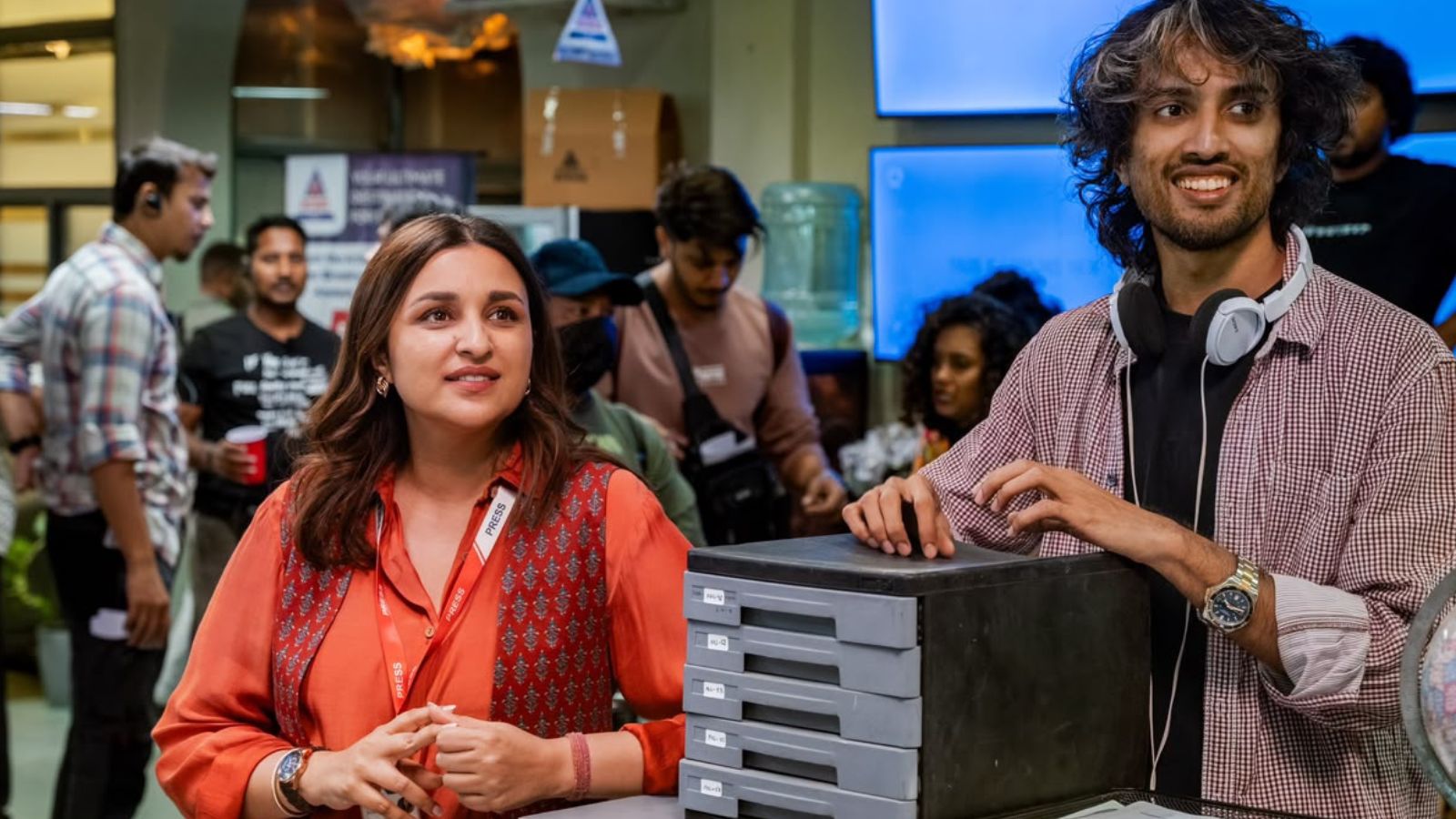
Filmmaker Dhruv Tripathi explores the dangers of illegal sand mining in his new Netflix thriller, Reporting Live. The film follows two journalists, played by Parineeti Chopra and Deven Bhojani, who lose their lives while investigating the mafia. Tripathi said, "The ending makes audiences question the cost of truth" today.
In his debut feature, Reporting Live, Dhruv Tripathi explores the dangers journalists face while investigating illegal sand mining. The filmmaker discusses the seven-year journey behind the Netflix thriller, casting Parineeti Chopra and the decision to give the story a tragic ending.
In his debut movie Reporting Live, filmmaker Dhruv Tripathi explores the murky world of illegal sand mining in India. The Netflix thriller follows two journalists, Sandhya (played by Parineeti Chopra) and Vinod (played by Deven Bhojani), as they investigate about illegal sand mining, which ultimately claims both their lives.
In an interview with The Indian Express, Tripathi talks about how a conversation in 2019 led to a seven-year filmmaking journey, why he chose Parineeti Chopra as Sandhya and why he felt the story could not have a happy ending. Here are edited excerpts.
How did a seven-year idea finally become a Netflix film?
Back in 2019, my co-writer Mihir Jadhav told me about people stealing sand and something called the 'sand mafia'. I remember being completely bewildered. Sand? Of all things? I went home that evening, started reading about it, and ended up staying awake all night. The next day I told Mihir that we had to make a film on this.
We then spent nearly two years researching and writing the script. While we wanted to make a gripping investigative drama, authenticity was equally important - whether it was the illegal sand mining industry, the inner workings of media organisations, or the realities of journalism on the ground.
What made you cast Parineeti Chopra as Sandhya and call her "the soul" of the film?
Parineeti connected with Sandhya from our very first meeting. She understood the character's ambition, determination, and imperfections. Sandhya doesn't always make the right decisions; she's impulsive, vulnerable, and deeply committed to the stories she pursues. We needed an actor who could bring all those contradictions together without making her feel like a conventional hero.
What I particularly liked about Parineeti was the emotional honesty and spontaneity she brought to Sandhya. She understood that the character's strength wasn't about being fearless, but about finding the courage to continue despite her fears.
What was the news culture at your home?
I grew up in Mumbai, and there was definitely a newspaper ritual at home. As a child, though, I was mostly interested in the last few pages -- the sports section and, of course, the cinema listings!
Television news was also part of our lives, particularly when something significant was happening. But our relationship with news was quite different then. You would wake up and read about things that had happened the previous day. There was a certain rhythm to how information reached us.
Today, with digital media, we're constantly receiving news in real time. Reporting Live made me appreciate the journey a story takes before it reaches us. Behind a headline is often somebody who has spent days, weeks, or months pursuing it, sometimes at considerable personal risk. That human side of journalism was something I became increasingly fascinated by.
Seven years is a long time to live with one story. What was the lowest point when you almost gave up, and what pulled you back?
There were certainly periods of uncertainty, but I never seriously considered giving up. What kept me going was the belief in the story and the people who believed in it alongside me.
Seven years might seem like a long time, but I've always tried to approach things one day at a time. As long as the belief is there, you keep showing up, putting in the work, and moving forward. You can't control everything, especially in filmmaking, but you can control what you do with each day. Sometimes, before you realise it, things finally come together.
What does a day look like when you're deep in a script - coffee order, playlist, rituals, superstitions?
My days tend to blur together when I'm deep in a script. That usually means watching at least one film a day, lots of reading and research, listening to the music my characters would listen to, and writing down every thought and idea related to the story in my film notebook. There are also long discussions with my core team, plenty of coffee, yoga, and spending time with my loved ones.
And then waking up the next day to see if the ideas actually made sense!
What was the first film or piece of journalism that made you think, "I want to tell stories like this"?
I don't think there was one particular film or piece of journalism. I've been making short films since I was about 15, experimenting with different genres and ways of telling stories. I've always been fascinated by cinema across genres.
For me, it begins with finding a story I connect with emotionally, and then discovering the cinematic language that best serves it. I'm interested in people, their contradictions, the little details of their behaviour and their relationship with the world around them.
With Reporting Live, what stayed with us wasn't just the scale of the sand mafia problem, but the courage of the journalists and the personal cost of their pursuit of the truth.
Netflix gave you reach, but also a platform with its own rules. What would the theatrical cut have looked like?
Netflix connected with the script and the vision of the film from our very first meeting. We didn't have to soften the story to make it fit the platform. We were fortunate to have a team that understood the kind of film we wanted to make and worked towards that vision.
As for a theatrical cut, I don't think the film would have been fundamentally different. For me, the medium of exhibition doesn't determine how honestly you tell a story. Whether someone watches it in a theatre or at home, the characters, emotions, and storytelling need to work. I would want audiences to experience the same film.
Why did Sandhya and Vinod have to die at the end of the story? Couldn't it have been a happy ending?
For me, the ending is the soul of Reporting Live. In many ways, it's what brought us to the story in the first place. During our research, we came across accounts of journalists, activists, and government officials who had been threatened, assaulted, and even killed while trying to expose illegal sand mining. These are very real consequences that people have faced simply for pursuing the truth. We couldn't ignore that reality while telling this story.
Of course, Sandhya and Vinod would have loved to go to Ira's annual day and watch her sing. They had lives beyond this investigation, people they loved and ordinary things to look forward to. That's what makes their loss so painful.
If audiences finish Reporting Live wishing Sandhya and Vinod had lived, perhaps the next time they encounter a similar story in the real world, they'll think about the human beings behind it. And maybe ask themselves: What is the cost of truth in our society today?