
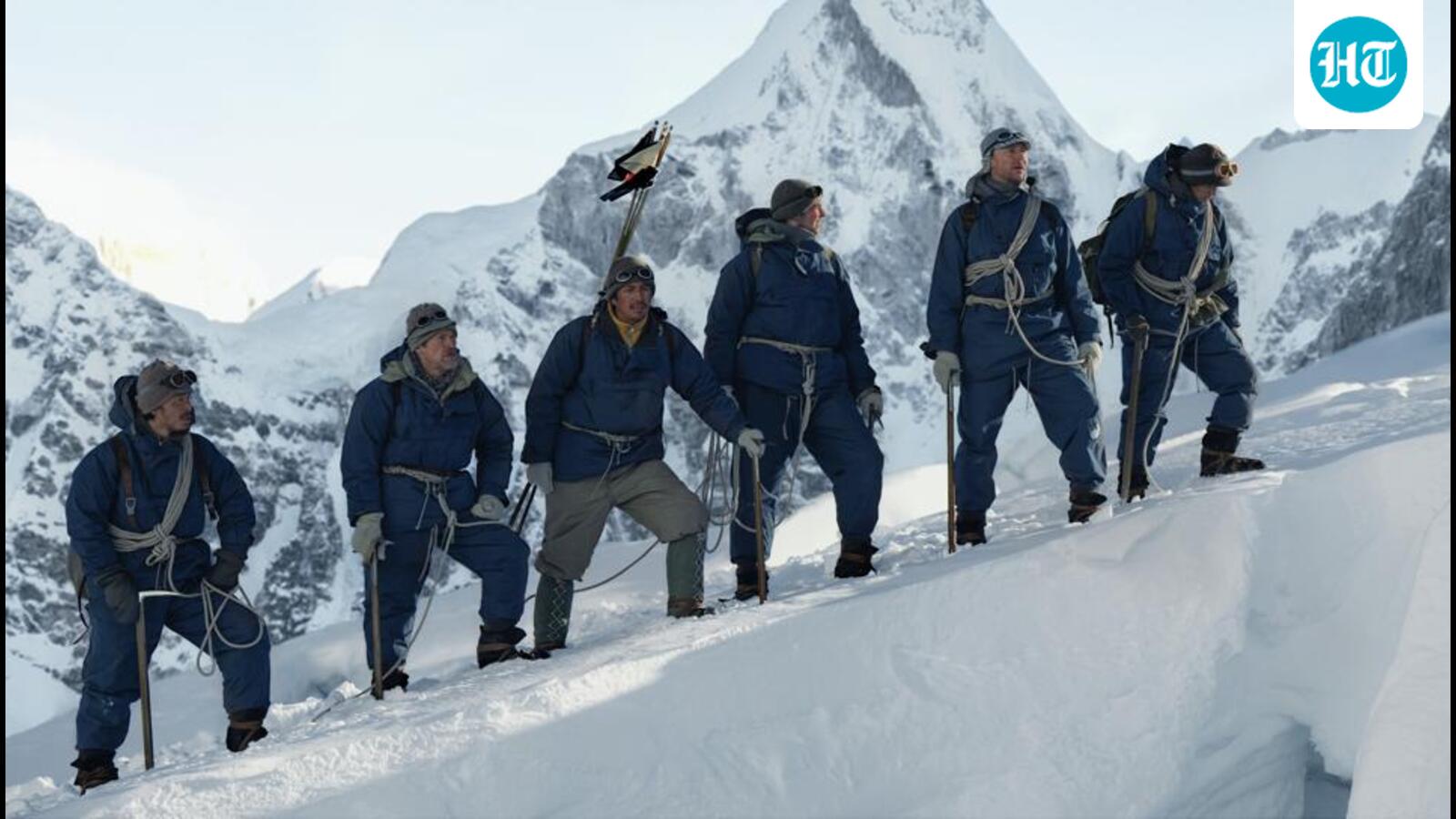
The film Tenzing, released on Apple TV on October 16, explores the life of Tenzing Norgay. He reached the summit of Everest in 1953 with Edmund Hillary. Tenzing said, "I was already here," when others spoke of colonial ambition. The story shows his deep respect for the mountain he called Chomolungma.
Who is remembered when a mountain peak is summited, and whose forgotten labour makes it possible? Is conquest the only relationship between a person and nature? Can a story of personal endurance and collective effort teach us something about our politically fraught and ecologically precarious times?
The film Tenzing, released on Apple TV on October 16, addresses these questions through a not-quite-biographical account of Tenzing Norgay (1914-86), who became the first person to reach the summit of the world's highest peak in 1953, along with Edmund Hillary (1919-2008).
Many in Tenzing's team regard Everest as a "British mountain" -- it was named after George Everest, a former Surveyor General of India -- and view its conquest as a present to their "new Queen." (Elizabeth II ascended to the throne as Queen of the United Kingdom and head of the Commonwealth in 1952.) As a "Kiwi," Hillary is an outsider on the British expedition -- and they don't let him forget it. So is Tenzing, doubly so, in fact. The family migrated from Tibet, and the Sherpas don't consider him one of their own. Neither does the expedition's leader, John Hunt, who only begrudgingly yields to his demand to be recruited as a full-fledged climbing member rather than as a head Sherpa.
The mother goddess doesn't want to be climbed," Tenzing's mother cautions him in the opening scenes. "They will offend her," she says of George Mallory, who led the first British expeditions to Everest, and whose disappearance on the mountain in 1924 functions as a leitmotif of colonial ambition throughout the film. "Mallory is the reason we are all here," says a member of the 1953 expedition, to which Tenzing quips, "I was already here."
Because to Tenzing, it isn't Mount Everest at all. He doesn't obsess over its height, nor over beating others to the punch, nor indeed over the calendar. As a young boy, he bows before the summit and calls it "my mountain." He knows it by its Tibetan name, Chomolungma (jo mo glang ma), the abode of goddess Miyo Lang Sangma (mi g.yo glang bzang ma), one of the "Five Sisters of Long Life" (tshe ring mched lnga) who pledged to protect the dharma. He regards it with awe and reverence and tells his wife that when he finally meets Chomolungma, he will ask her permission to enter, make her an offering of yak's milk, and ask her to bless their children. His Rinpoche counsels him to climb Chomolungma as a child climbs into its mother's lap.
The film also throws into sharp relief the extractive racial hierarchy of high-altitude mountaineering. It adds to a now-formidable body of work, including the director Jennifer Peedom's own oeuvre (Sherpa, 2016), which meticulously documents the invisibilised labour of the Sherpas who made these expeditions possible at immense personal risk. Long relegated to supporting roles when the story of victory is told, the Sherpas -- who lodge in old stables, are forbidden from using the bathrooms, and walk without protective footwear -- literally carry the expedition's weight on their backs. Their intimate knowledge of the terrain and time-tested intergenerational expertise ensure the mission's safety, yet they themselves are dismissed as mere porters. Multiple times in the film, they expose the conceit that valorises individual mountaineers and frames the endeavour as a feat of personal endurance and fortitude: "We get paid to carry. They get to pretend they are heroes."
When the military man John Hunt speaks of the "siege" of Everest, and Hillary explains that the British see nature as something to be conquered, Tenzing is baffled: "Maybe that's where they have been going wrong. They see mountains. We see ourselves. The mountains are the bones. We are the blood."
The film stops short of making explicit the connection between this invidious colonial legacy -- which commodified and desacralised venerated peaks while exploiting local expertise and labour -- and the ecological destruction that has followed from the unrelenting appetite to summit Everest. It also leaves unmourned the loss of a shared Tibetan Buddhist cultural world that made Tenzing's Himalayan story -- traversing Tibet, India, and Nepal -- possible in the first place. The environmental reckoning is urgent; the mourning reminds us that ecologies are held together, and dismantled, in defiance of national borders, that people have related to these mountains in other ways... and trod them gently.
Swati Chawla is a historian of the eastern Himalaya and Tibetan exile and associate professor of history and digital humanities at O.P. Jindal Global University. Yamini Suri is a cinephile and student at the Indian School of Public Policy. The views expressed are personal