
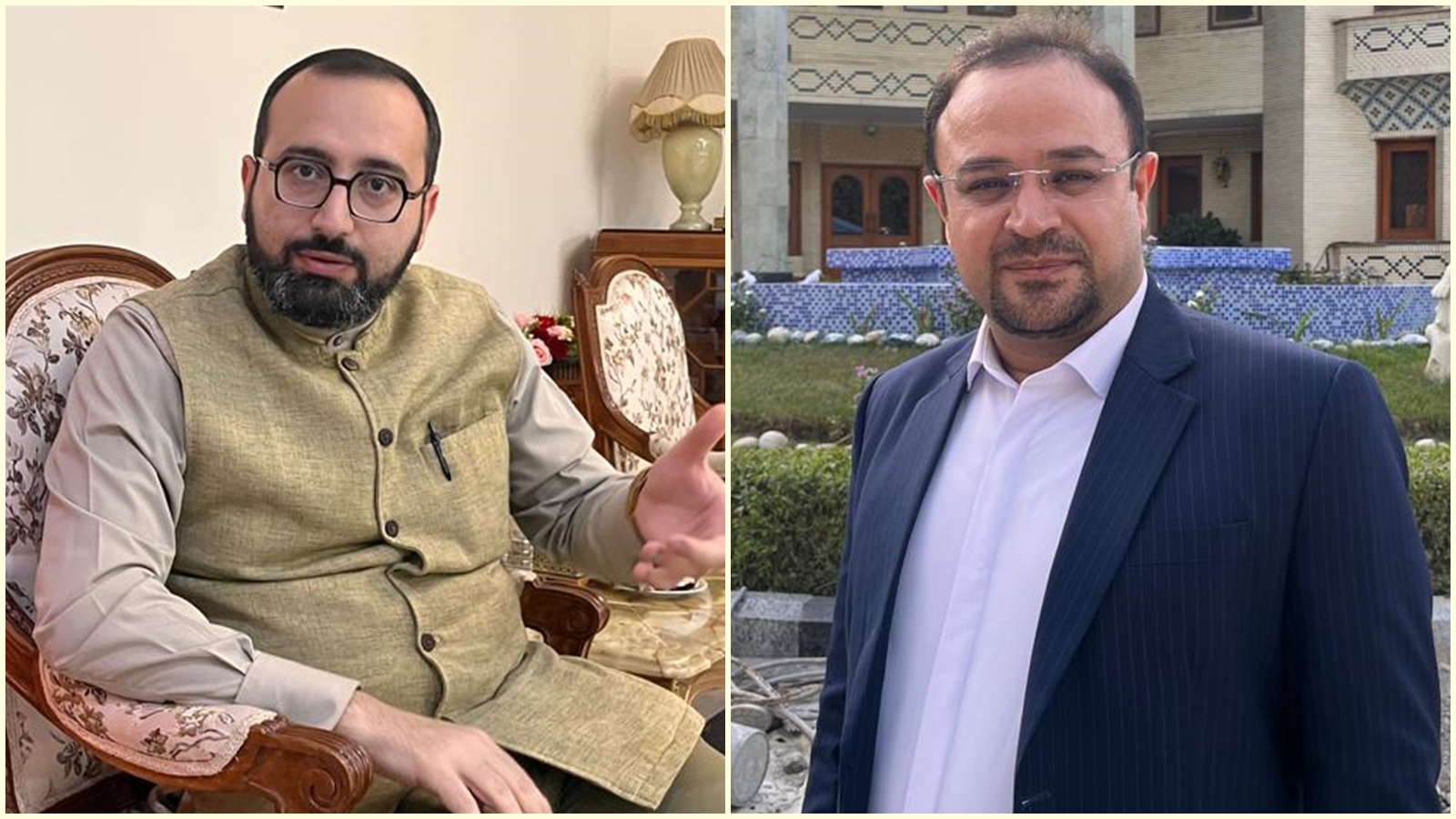
Iranian diplomats in Delhi are using Bollywood memes to target Donald Trump and engage global audiences amid the West Asia war. Diplomat Omid Babelian creates these posts from the Iranian Embassy. He said, "I am Omid. Omid means hope." These viral clips use iconic film scenes to share political messages.
Diplomats posted in Delhi are using Indian songs, film dialogues and pop culture to engage with global audience amid the West Asia war.
The Persians have a saying, "harf-e delam rā zadi", which loosely translates as "you took the words right out of my mouth". Today, it's at the heart of a string of Iranian memes from Delhi that have gone viral.
Whether it is US President Donald Trump as a heartbroken Aamir Khan in Dangal; being dumped in the "hazardous waste" bin after the midterm poll results; attired as Napoleon Bonaparte walking the plank with knives at his back and with Ranbir Kapoor singing "achcha chalta hoon, dua mein yaad rakhna... (farewell, remember me in your prayers)" -- the X handle @Iran_in_India has taken aim where the country's Shahab-3 missiles cannot: at the heart of the public.
Iranian diplomats posted in Delhi have been using Bollywood songs, dialogues and popular culture customised for the Indian audience to satirise the serious, sprinkled liberally with iconic Bollywood heroes like Hrithik Roshan's Krrish and Thakur of Sholay. And it's all fair game, whether taking aim at a helpless (and armless) UN or a bumbling, fumbling Trump.
But what might appear as mere fun and games is part of Tehran's social media strategy to engage with the global audience, which has been watching the war in West Asia with concern.
Sitting behind a computer inside the Iranian Embassy on Hailey Road is Omid Babelian, a young diplomat who has been busy crafting these memes loaded with political satire. The posts require judgment about cultural sensitivity, minority groups, and the governments of Iran and India, and he receives support from colleagues and has broad autonomy to publish. Helping and guiding him is Mahdi Esfandiari, the embassy's press counsellor.
When The Indian Express met them, Babelian introduced himself: "I am Omid. Omid means hope." His hope, he explains, is to connect with Indians using Bollywood themes and satire to highlight messages against the US President.
Babelian, who has done his Master's and PhD on Indian studies from a university in Tehran, arrived in February just a few weeks before the war started on February 28. Amid US sanctions, food shortages and uncertainty, humour helped lift dark clouds. "In Iranian society, we use a lot of memes. The new generation memes are very popular, they even use a lot of Harry Potter memes in this situation, but what got me interested was how I can use the memes from Bollywood that Indians understand well," he said.
Babelian's first introduction to India, growing up in Isfahan, was through Bollywood. "My aunt used to watch Bollywood movies. When I was a child, we watched a lot of Bollywood movies together, like Sholay, Amar Akbar Anthony, Mughal-e-Azam, Sangam, Raj Kapoor's classic movie Awara. We really liked Indian movies, and I remember that some of my aunties also learnt how to speak Hindi, and we spoke Hindi together. Then I became familiar with the Gita, and read the Gita, and also read Mahabharat and Ramayana," Babelian said over a cup of Iranian tea and biscuits.
"As a diplomat, it was important for me to understand not only the foreign policy, domestic policy and history of India, but also its pop culture," said Babelian, 34, who also watches European cinema and Marvel films and has a Star Wars sticker on his phone.
Babelian works as the representative of the Institute for Political and International Studies (IPIS) -- a foreign policy think tank based in Tehran, affiliated with the Ministry of Foreign Affairs of Iran -- at the embassy.
While in university, he studied the history of Indian cinema -- "not only the mainstream Bollywood, but also the figures like Ritwik Ghatak, and more recent movies like Lunchbox". This was besides studying Hinduism and Indian philosophy. "We study Indian policy and politics to understand the mindset of India. It was very important for us to try to understand classical Indian plays. You know that one of the important plays in Iran, which is translated from Sanskrit to Persian, is 'Shakuntala'," he said.
He said he has watched recent hits like Kabhi Khushi Kabhie Gham, Dangal, 3 Idiots and Ae Dil Hai Mushkil, and loves Arijit Singh's music.
But why Bollywood? "We talk to each other through Western language and media. The most important thing is to understand each other through our own sources. There is a famous saying -- to understand India is very difficult, but to misunderstand it, it's very easy."
The challenge here, he said, was: "How can I use Bollywood as a cinephile because in Hollywood and other cinemas, you have templates that you can work with, and others understand it. But I wanted to use movies that Indians understand and relate to."
His process is simple: he looks at situations and then tries to think of a Bollywood situation that fits aptly. "I send it to Mahdi Esfandiari, who is the Press Counsellor at the embassy, and he usually okays it," he says, with a smile.
Not surprisingly, Iranians have a sense of humour and use jokes as a relief. "Iranians are a very fun people," he said.
But Babelian is conscious of the thin line that could make humour appear insensitive. "My red line is how can I use it in a way that it's not offensive to other groups, other minorities, the government from both sides, Iran or India," he said. For instance, he says the image of Hrithik Roshan as a person with learning disabilities in the movie "Koi Mil Gaya" should not be seen as something that is demeaning to the people with special needs.
Esfandiari, in his early 40s, insists Babelian has the pulse of the people. "No, I haven't shot down his ideas and initiatives, he is quite skilled and if there is something off, I will ask him to make it nuanced," the press counsellor said. He maintains that the Iranian ambassador Mohammad Fathali has given them a free hand on their artistic and political expression.
As the war in West Asia has been underway for more than eight months now, Babelian has been working on new political memes: "I am working on something to do with the movie Dhurandhar."