
Reble is set to perform at Motoverse 2026 despite not knowing how to ride a motorcycle. The artist, who gained fame through Dhurandhar, said she turns down many Bollywood projects to focus on her own music. She calls her sudden recognition a “temporary spike” and prefers working with passionate people.
Reble talks Dhurandhar fame, Shashwat Sachdev, Motoverse 2026, her upcoming EP, Meghalaya roots and why she turns down Bollywood projects. Exclusive interview.
Reble is going to Motoverse to perform a song inspired by motorcycle culture. There is only one minor complication: she does not know how to ride a motorcycle. In fact, she cannot drive any vehicle at all.
She finds the situation funny rather than intimidating. This is her first motorcycle event, the song itself has pushed her into musical territory she has not explored before, and she has no idea what the crowd will be like. For now, that uncertainty seems to be part of the attraction. Reble has rarely sounded particularly interested in remaining inside a space merely because she already understands its rules.
That restlessness has followed her from an independent catalogue steeped in hip-hop, alternative influences and a stark visual language into an increasingly unlikely run of film collaborations. What began as a single song with Shashwat Sachdev on Dhurandhar turned into multiple tracks across two films, not because she had suddenly decided Bollywood was where she belonged, but because she liked the people in the room. She had initially assumed it would be “another Bollywood film". Watching Sachdev and Aditya Dhar obsess over the work changed her mind. For Reble, scale appears to matter considerably less than whether the people involved still care about the art after all the machinery surrounding it enters the picture.
The attention that followed has not altered her sense of proportion either. She calls sudden recognition a “temporary spike". Dhurandhar may have pushed her “200 steps" ahead of where she expected to be, but she is far more concerned with having enough music behind her years from now than with preserving the momentum of one successful soundtrack. Her next EP is part of that exercise. She cheerfully describes the EP she made when she was younger as “absolute trash", while still insisting that she loves it, like a first painting made before somebody learns how to hold the brush properly.
In an exclusive conversation with News18 Showsha ahead of Motoverse 2026, Reble speaks about entering a culture she knows little about, why an artiste’s visual identity can sometimes become art in itself, and the ideas of worship, power and rebellion running through ‘Praying Mantis’. She also opens up about her creative relationship with Shashwat Sachdev, refusing film projects regardless of their size when the chemistry feels wrong, the international surprise that followed ‘Set It Off’, and her complicated relationship with Meghalaya, where recognition, she says, arrived largely after she had already left to build a career elsewhere. And as conversations around women in hip-hop continue to circle questions of aggression, gender and legitimacy, Reble has a characteristically uncomplicated response: she would rather make music strong enough to render the argument irrelevant.
Here are the excerpts:
Q. Hip-hop and motorcycle culture are both rooted in strong ideas of identity, style and belonging. Does performing at a festival like Motoverse feel different from walking into a conventional rap gig, where the audience already understands the cultural codes of hip-hop?
This is actually my first time performing at a motorcycle event, so I don’t know yet. I think I will only be able to tell you once I am done with the performance. It is a completely new experience for me, and I am definitely looking forward to it.
Q. I also heard that you are creating a song specifically for Motoverse. What is the song about, and what kind of musical or conceptual territory are you exploring with it?
The song is definitely centred around the culture. It is also a new territory that I am exploring, both musically and conceptually. It revolves around the culture of Motoverse and the people who belong to that community.
It is definitely unfamiliar territory for me, but I am sure there is something that we have in common.
Q. Are you personally interested in motorcycles? Do you enjoy riding bikes yourself?
No, not really. I actually don’t know how to ride or drive any vehicle! But it is something I have always wanted to learn. Maybe someday I will be able to, but not as of now.
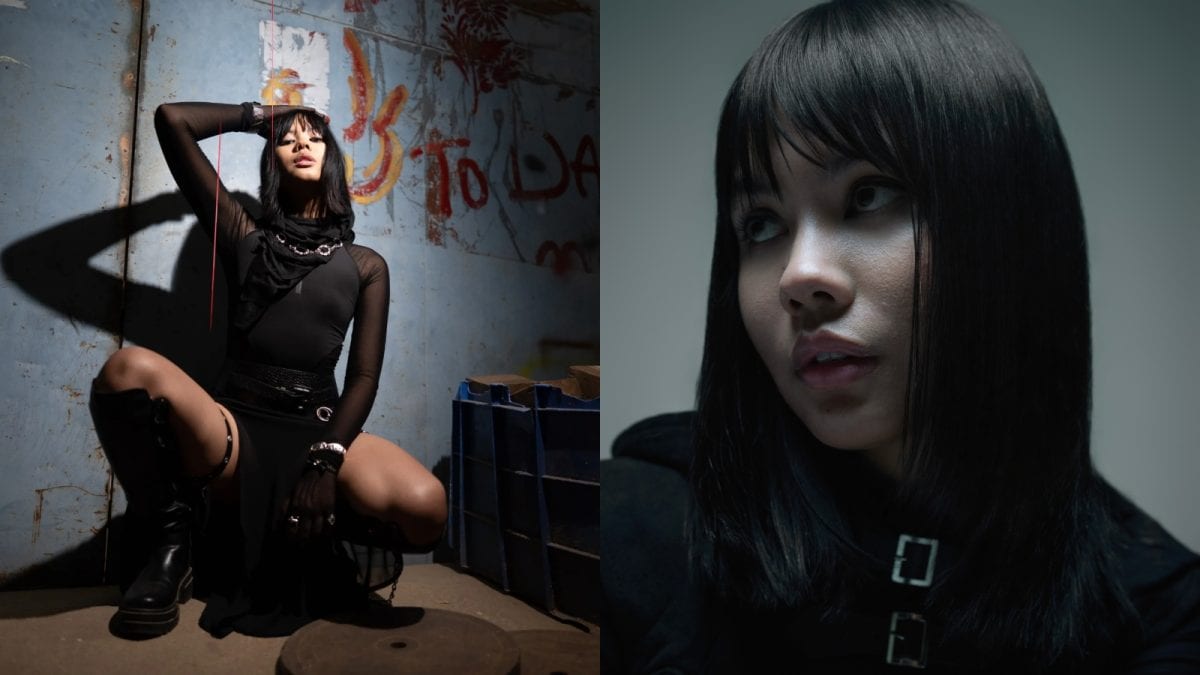
Q. The visual language of Motoverse 2026 draws inspiration from the 16-bit era, and you have developed a very recognisable visual universe of your own, particularly through black-and-white imagery and gothic textures. How important has visual identity become to the way you conceive a Reble song? Do you see the visual and musical aspects as inseparable from each other?
I think art always needs a visual identity. Sometimes, that visual identity can be even stronger than the music itself. In fact, the visual identity could be the art itself.
There is so much that goes into who a person is, how they represent themselves, what they wear and what they do. You are essentially giving someone an entire character through all of these elements.
When it comes to building that identity, I think it adds so much to an artiste because people often associate the visual identity of an artiste with their music. So, for me, the two go hand in hand. They are both extremely important to one another.
Q. You have performed across different kinds of venues, from relatively intimate spaces to massive festival and stadium settings, including Rolling Loud. Has the scale of a venue changed the way you approach your live performances, particularly how you design your setlists or present your music on stage?
Not really. The most I would add to my performances would be elements concerning my sound and my visuals. I have never really expanded much beyond those things because I strongly believe that the most important aspects of my performance are the sonics and the visuals. Those are the two core elements for me.
The scale of the venue does not really matter in that regard. Whether I am performing at a smaller venue or a much bigger festival, I always want the sound and the visuals to be present in some capacity.
There are different ways of presenting those elements depending on the scale of the performance. It does not necessarily mean that you can only showcase both of them at larger festivals.
I think it is simply a matter of adapting to different venues and finding ways to showcase your art within whatever capacity you are performing in.
Q. Earlier this year, you released Praying Mantis, which I thought was a phenomenal track. You play with the words ‘pray’ and ‘prey’, almost holding up a mirror to both the powerless and the powerful. What was the core idea that gave birth to this track, and how did you build upon it verse by verse?
The core idea was definitely about the gap between the people who worship and those who are being worshipped. That is where the wordplay between ‘pray’ and ‘prey’ comes from.
It was not necessarily a track where I was being extremely deliberate about every lyrical detail. I just sat down one day and wrote it. I generally write whatever I am feeling or thinking about at that particular moment. Sometimes it can be something quite deep, and sometimes it is just very straightforward, something that exists as it is.
This was one of those tracks where I simply sat down and wrote whatever came to me. People can interpret it however they wish to, but for me, it was definitely about the distinction between the worshippers and the people being worshipped.
Q. There is a line in the track where you play with the words ‘profit’ and ‘prophet’. In your breakdown video with In Colab, you explained that having revolutionary thoughts or being too bold often comes at a cost because people may not necessarily like you for it. Could you elaborate on that? What kind of cost were you referring to, emotionally, personally or even professionally, when an artiste refuses to dilute what they really want to say?
In that breakdown video, I gave a very simple explanation because I did not want to over-explain anything. Obviously, that can also lead to a lot of misinterpretations or assumptions.
But what I was thinking about was the idea of being different. I think opposing something that is widely believed in, or going against an idea that the masses support, definitely comes at a cost. That is regardless of whether the belief itself is right or wrong. The moral standing of that belief does not necessarily matter in this context.
If you go against something that people collectively believe in, they are generally not going to take it very well.
I think human beings like having something or someone to worship, someone they can look up to. I am not talking about gods here, but about people.
When the character of that idol is questioned, or when somebody challenges that idealised picture people have created of them, it becomes a problem. Suddenly, they might not have that same person to worship or idolise anymore.
The entire framework they have constructed around that person begins to break down, and that is when people get angry. That was essentially the thought behind it.
Q. You were initially brought into Dhurandhar for just one song, but your creative chemistry with Shashwat Sachdev eventually led to multiple tracks across two films. At what point did you realise that this was no longer going to be a one-off soundtrack appearance?
Shah and I share a really, really special friendship. We are both people who genuinely love working for the sake of art.
Shah works on different projects with different people, but for him, it is always about the art. He wants to create something that he can be proud of, and I want to create something that I am happy with as well.
I think ever since I met him, I knew I would eventually work with him on multiple things because, again, it was never really about that particular movie.
The movie was simply an opportunity for us to realise that we had developed a friendship, that we worked really well together and that we should definitely create more things together.
That is how it eventually happened across two films, and I am sure it will continue to happen across more films as well.
Q. You have mentioned that you initially thought Dhurandhar might simply be another Bollywood film. What did Shashwat Sachdev or Aditya Dhar do that convinced you they were genuinely listening to what you brought to the project as a rapper, rather than merely inserting a rap verse into a film song, as is often the case with commercial Bollywood music?
I think, at that point, it was not about the movie anymore. It was about the people involved and the kind of ambitions they had. That became a huge motivating factor for me.
Regardless of the different belief systems people might have, there was a passion for art in that room which I do not see very commonly. There was this immense passion for whatever everybody was doing.
Shah was incredibly passionate about what he was doing, and Aditya was equally passionate about what he was doing.
It was not a case of approaching it simply as a commercial project. They were actually giving everything they possibly could to what they were creating.
I saw them working, and I think that was what really moved me as an artiste.
That was when it became more than just a movie for me. I realised that I was in a room full of art, surrounded by people who were genuinely trying to do what they wanted to do.
I found that very inspiring.
Q. Your tracks across the two Dhurandhar films are sonically quite distinct from one another, particularly in terms of your delivery and rapping style. Did each track require you to tap into a different version of your rap persona?
Yes, absolutely. We experimented with different genres.
It is not necessarily the kind of music I make independently. My own music is very different, and the kind of music that the film industry requires is also very different.
But I consider myself a pretty versatile person, and I genuinely enjoy experimenting with music. Even though I may not necessarily claim some of those sounds as my original sound, I still enjoy exploring them because I believe music is extremely broad. It does not have to be put into a box.
So, whenever we worked on different songs, we approached them with different ideas, and I think we were all able to tap into different musical zones.
It is the same with Shah. Whenever he makes music, he explores different kinds of genres and sounds as well.
I believe an artiste is capable of doing much more than just one genre. I think artistes should be more open-minded about that and should definitely step outside their usual territory to explore different things.
That is essentially why we ended up with so many different sounds across those songs.
Q. After a successful film collaboration, there is always the risk of the industry approaching you with variations of the same brief. Have you already had to turn down projects that felt like attempts to recreate the sound or style associated with Reble after Dhurandhar?
So far, I really enjoy working with Shah. I would not want to work with somebody with whom I don’t think I would have a similar creative chemistry.
I don’t particularly like heavily commercialised projects. I enjoy being in a room with people who are genuinely passionate about what they do, regardless of the scale of the project.
Apart from Shah, I think the only other person I have worked with from the film industry so far is Jakes Bejoy. We worked on the soundtrack for Lokah, which was my first film project. That was a really nice experience.
Whatever projects I have worked on so far have been pretty interesting. But if there are projects that I am not particularly interested in, I do turn them down, regardless of how big they are.
At the end of the day, it really matters who you are working with.
Q. Before Dhurandhar, you were building your audience one listener at a time through your independent catalogue. Suddenly, because of the films, even people who may not have been interested in underground hip-hop started discovering your music. Did the speed and scale of that recognition ever overwhelm you?
No, not really. I think everything is a temporary spike. Building a large catalogue and maintaining some sort of long-term legacy is far more important for an artiste. I think that is ultimately the goal for everybody.
For me, I looked at it as something that pushed me much further ahead. Perhaps I was supposed to be just a few steps ahead at this point in my career, but suddenly, I had taken about 200 steps. However, I am still not where I want to be.
So, I think it was a very good push for me.
Obviously, as I mentioned earlier, the music I make independently is very different. There is definitely a good number of people who are genuinely interested in that music. There are also people who simply want to support you because they recognise that there aren’t a lot of artistes coming out of the country and representing it on an international scale.
They want to support anybody who might have the potential to make it there. That is what people did with Hanumankind as well. Everybody is trying to support somebody who could perhaps represent the country on a much larger scale.
Sometimes, people are just happy that you are from here, that you make this kind of music and that it sounds good. I think a lot of that support comes from a feeling of, “We are supporting each other because we come from the same place."
I think that is a really great thing. The support that comes from your own country and your home state forms those foundational pillars that actually help you reach a larger audience.
It is really nice to see people supporting one another in that way here.
Q. One of my favourite collaborations of yours is Set It Off with Kim the Beloved. Your voice enters the track almost like a surprise attack and takes it somewhere completely different. What do you remember about working on that song, and how did you approach writing and delivering your verse?
That track was one of the first times I experienced something like that because, before then, I was much more underground.
As far as writing the verse was concerned, I approached it simply as a rap verse. I had to write something, so I wrote what I wrote. I did not really think too much about it at the time.
But when the music video came out, it gained a little bit of international traction. It was picked up and posted by a few pages, and there were people outside India who reacted to it with genuine surprise. They were like, “Wait, is this happening in India?"
I thought that was pretty cool.
Like I said, people outside the country often have a very different image of India. They see certain depictions of India in movies and elsewhere, but they don’t necessarily get to see how diverse the country actually is.
They don’t see the different kinds of people who come from different regions, the different kinds of music we make or the talent that exists here.
I don’t think that diversity is particularly well represented globally, and because of that, there are some major misconceptions about the country.
So when people encounter something like this, there is almost a sense of shock. They are like, “Wait, Indians do this? They are capable of making this kind of music?"
I think Set It Off was one of those moments when people were genuinely surprised by what they were seeing and hearing from India.
Q. Your early musical influences range from Eminem, The Notorious B.I.G. and André 3000 to bands such as Linkin Park and the Red Hot Chili Peppers. What did rock and alternative music give you as an artiste that straightforward hip-hop perhaps could not?
I think it was primarily the attitude of the music and what people associated those songs with at the time.
Like I said earlier, one aspect is the music itself, and the other is definitely the visuals. And those visuals can exist in any form. It doesn’t necessarily have to be a music video.
It is also about how people started dressing because of those songs, how they started behaving, and what they did with that music. It is about how the music influenced the way people expressed themselves.
A lot of alternative music, and a lot of hip-hop music as well, was used as a means of rebelling against established societal norms.
I think that was what really resonated with me. I really liked that concept of rebellion.
Q. You have also consciously resisted carrying the burden of representing Meghalaya, suggesting that if your music succeeds, recognition for the place you come from will naturally follow. Do you think artistes from smaller regions are too often expected to become cultural ambassadors before they are allowed to simply exist as artistes?
I don’t necessarily think you even get to be a cultural ambassador in that situation because the kind of support that comes from here is a little different.
Often, you have to go out, do something and become somebody before you even get recognised in the place you come from. The recognition only follows afterwards, which I think is kind of sad.
For me, when I was living in Meghalaya, there wasn’t much happening in terms of my career.
Of course, a lot of my musical influences came from growing up in the Northeast. There is a very different musical culture that exists here. There is a particular kind of music that people listen to and genuinely connect with, and naturally, I caught on to that as well.
But I think my career really started taking shape when I moved out. I managed to do something for myself, and then people started catching on to what I was doing.
Obviously, there is a tremendous amount of love coming from the Northeast now. But when it comes to the place I specifically come from, it didn’t really start out that way. It took a very long time.
Initially, there wasn’t much support coming from my home state. The support that I receive now is really great, but it wasn’t always like that.
In fact, I think some of the other Northeastern states have shown me more love as well, which is quite interesting. I have experienced that kind of support in other cities too.
But yes, I think I have a very complicated love-hate relationship with the place I come from.
One thing I know for certain is that if I had stayed there, I wouldn’t have made it anywhere.
Q. Hip-hop has historically celebrated aggression in men, but when a woman is aggressive or outspoken, the conversation often shifts from her music to her attitude or personality. Have you noticed that double standard in how your own music is received?
No, man. I really don’t care about this whole gender thing, to be honest.
Obviously, there is going to be discrimination. I think this whole man-versus-woman thing is always going to exist, and people may treat you differently because of it. But personally, I have never really noticed such things, at least in my own experience.
For me, it has always been about my music and how I put it out. I don’t feel that I am any less or any more because of my gender. I think I am less or more depending on what I create.
Having said that, I don’t want to take away from other people’s experiences because their experiences are obviously going to be different from mine. I cannot take my own experience and use it to say that there is no discrimination because there definitely is.
But the whole point is that I don’t think I am here to eliminate that difference. I am just here to do my thing. And I know that what I do is strong enough to stand out and overpower this entire man-versus-woman conversation.
Q. Finally, what does the next chapter for Reble look like? What do you have in store for your listeners, and what would you like to say to the people who are coming to watch you perform at Motoverse 2026?
I am very excited. I don’t know what the crowd is going to be like, but every show is a new experience for me.
My only agenda is to give it my best and make sure that people have a good experience. People are taking a break from work, some of them are on holiday, and everybody is coming there to enjoy themselves.
I just want everybody to have fun. I am pretty excited to see what the experience is going to be like.
Q. And in terms of new music, are you planning to release something in the coming months?
Oh, yes! I have an EP coming up, and it is dropping in about a week or something. I don’t really check dates.
Ever since I started working in music, I don’t even know whether it is a Monday or a Tuesday. I just live. It is so funny because sometimes I even forget what year it is!
Q. That’s exciting! What is this EP about? Can you give us a little hint about what we can expect from it?
I did release an EP when I was younger, but I think it was absolute trash! It was garbage. But I loved that EP. I still love it.
It was like somebody picking up a paintbrush without knowing how to paint and attempting their very first painting. That was essentially what it was.
Looking back at it, I think it was really bad. I don’t particularly like it from that standpoint. But I think everybody has their first attempt at something.
This upcoming EP, however, is what I would consider my first properly made EP.
I don’t really have a very large catalogue of music at the moment, and I think this is me stepping into that phase of releasing albums and EPs and gradually building a substantial catalogue of work.
I am definitely sure that something from that catalogue is eventually going to make it. I don’t have any doubts about that.
I think my only job is to make as much music as I possibly can. Eventually, someday, something will connect with people. It could even happen when I am no longer around. I don’t know when it will happen.
But I just want to make art that I am proud of, art that I am happy with. And I know that someone out there will resonate with it.
That is good enough for me.