
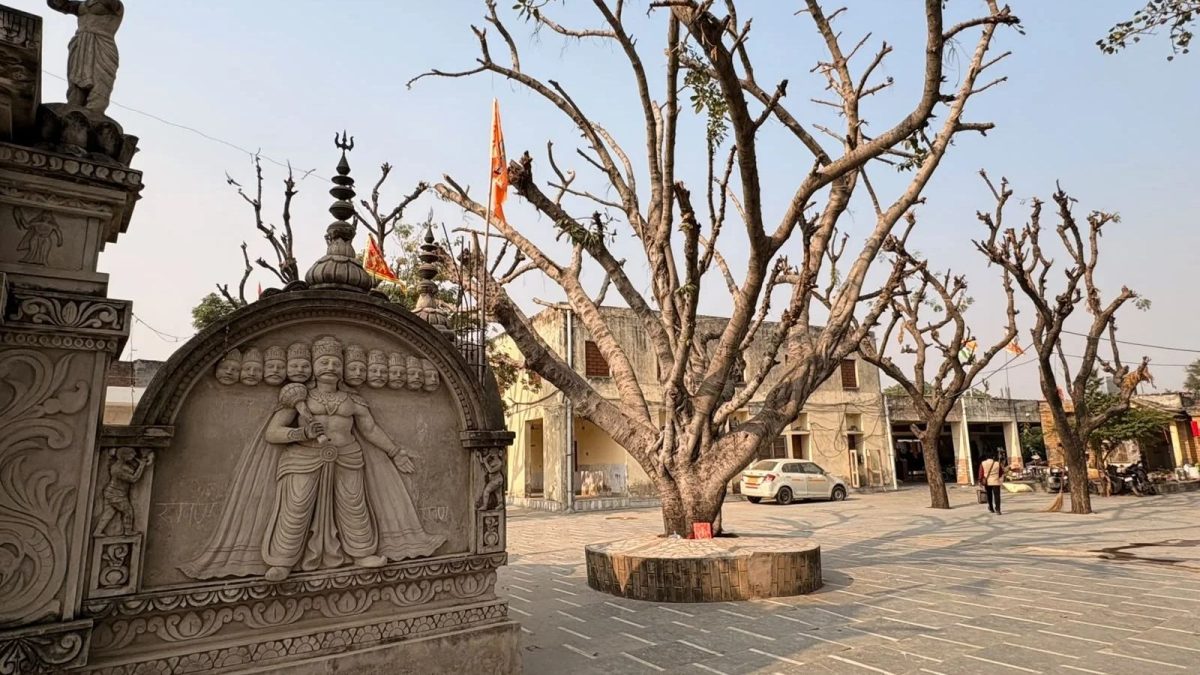
The VHP wants the film Ramayana banned for glorifying Ravana, but residents of Bisrakh village worship him as a Brahmin king. Villagers believe he was born there and honor his devotion to Shiva. "We do not and cannot look at him as a demon king," said villager Suman Bhatti.
Even as VHP seeks that the censor certificate granted to the film Ramayana be revoked for 'glorifying' Ravana, for the villagers, their king's lineage and devotion to Shiva are key
Just 35 kilometres from Delhi, in Greater Noida's Bisrakh village, Ravana has a rather different address, and an altogether different reputation.
At a time when the Vishwa Hindu Parishad (VHP) has objected to the portrayal of Ravana in the film Ramayana, accusing its makers of glorifying the demon king, Bisrakh offers a fascinating and interesting counter-narrative. Here, Ravana is not merely the antagonist who was defeated by Lord Ram. Instead, he is here remembered as a protector Brahmin king, a formidable scholar, a devotee of Lord Shiva and, above all, one of their own.
The village claims to be Ravana's birthplace, a belief rooted in local folklore and religious tradition. At the heart of this association stands an ancient Shiva temple linked to Rishi (saint) Vishrava, Ravana's father, who is believed to have lived and meditated here. The village's name is also traditionally traced to Vishrava. Local belief holds that Ravana was born and raised here, along with his siblings Kumbhakarna and Surpanakha.
For the residents, this is not merely a mythological or a religious association. It is an inherited identity that shapes how they remember Ravana and, more importantly, how they respond to the annual celebration of his death across the country. They mourn on Dussehra.
The Brahmin King Behind The Demon
The most striking feature of Bisrakh's relationship with Ravana is the emphasis on his Brahmin identity, which is also a part of the village's social-cultural-caste equation. For the villagers, his lineage, scholarship and devotion to Shiva are central to his legacy. They believe the popular depiction of Ravana as the embodiment of evil overlooks the learned king and accomplished scholar they associate with their village.
"We believe that Ravana was born here. He was a learned man, a great Brahmin and a devotee of Lord Shiva. We do not and cannot look at him as a demon king. He belongs to this village, and we worship and respect him. We don't think he committed any sin. He abducted Sita Mata while retaliating to Laxman's act of severing his sister's nose," Suman Bhatti, a villager, told News18.
The village's reverence is most visible every Dussehra. While effigies of Ravana, Meghnad and Kumbhakarna go up in flames across the country, Bisrakh does not celebrate Ravana Dahan. The occasion is traditionally observed as a day of mourning.
For residents, burning Ravana's effigy would mean celebrating the death of someone they consider their own ancestor. In fact, they believe that burning Ravana's effigy would bring bad omen to the village. His scholarship and religious learning, they argue, deserve recognition beyond his role as the antagonist of the epic.
The Priest's Defence: He Stood Up For His Sister
The temple priest, known as Mahant Ramdas, takes this alternative understanding of Ravana a step further. His defence is not limited to Ravana's scholarship or religious devotion. It extends to the very episodes of the Ramayana that define his character as the antagonist. He also believes that the movie Ramayana depicts Ravana in a "better" light.
For the priest, Ravana was a learned Brahmin king who stood up for his sister Surpanakha after what Laxman did to her. Like the villagers, he too interprets Sita's abduction as an act of retaliation for his sister's humiliation. More significantly, he insists that Ravana never violated Sita's dignity and kept her in Ashoka Vatika in Lanka.
"Ravana was a learned Brahmin king. He stood up for his sister. What happened to Surpanakha was the reason behind his taking Sita away. But he never touched Sita. He kept her in the Vatika. We believe he was a king who performed his duty. He is the only Brahmin we are proud of. He is the pride of the Brahmin community," the priest said.
It is an interpretation that places family honour and a sense of duty at the centre of Ravana's actions, offering a markedly different reading of an episode that has defined his place in the Ramayana.
The priest's argument also revealed why Ravana's Brahmin identity mattered so much in Bisrakh. He is remembered not simply as a powerful ruler, but as a man of religious learning whose legacy, according to the village, has been overshadowed by his role in the epic.
The VHP's Ravana Problem
The timing of Bisrakh's story is particularly significant. The VHP has demanded that the censor certificate granted to the film Ramayana be revoked and its screening halted, alleging that the film glorifies Ravana and distorts Maharishi Valmiki's epic.
VHP chief Alok Kumar and its general secretary Bajrang Lal Bagra objected to the alleged portrayal of Ravana as a liberator of the oppressed and downtrodden. The organisation has also raised objections to what it considers omissions and distortions in the depiction of key episodes involving Lord Ram.
The controversy has taken the debate beyond filmmaking and artistic interpretation to a larger question of cultural and religious ownership. The VHP's position centres on preserving what it considers the traditional moral framework of the Ramayana. Bisrakh's local tradition, meanwhile, foregrounds Ravana's Brahmin lineage, scholarship, devotion to Shiva and his relationship with his sister.
There lies a conflict of ideas and interpretation of Hindu mythology and epics. At a time when his portrayal on screen is facing objections, an entire village in Uttar Pradesh continues to remember him with reverence.
Who Owns Ravana's Legacy?
There is a larger social and political dimension to this debate. Ravana's Brahmin identity is central to Bisrakh's reverence, while his scholarship and devotion to Shiva offer the village a way of remembering him beyond the familiar image of the demon king.
Across India, Ravana occupies different places in regional folklore, religious traditions and cultural memory. Some foreground his scholarship and devotion to Shiva, while others remember him primarily as the antagonist defeated by Ram. In certain communities, his death is not celebrated in the conventional Dussehra tradition.
The Ramayana has travelled across languages, regions and generations, producing different interpretations of its characters. Ravana, perhaps more than most, embodies this multiplicity.
Acknowledging his scholarship does not necessarily mean endorsing his actions. Equally, remembering him as the antagonist does not erase the traditions of communities that consider him an ancestor. The question is whether a character from an epic as vast and diverse as the Ramayana can have only one accepted interpretation.
For the VHP, the film's portrayal crosses a line in its interpretation of the epic. For this village in UP, Ravana's legacy has always been considerably more layered. And that is what makes this village's story fascinating. The debate over Ravana's glorification may have found a new expression in cinema, but in Bisrakh, the argument has been part of local faith and folklore for generations.
Across much of India, Dussehra ends with Ravana's effigy going up in flames. Here, the day traditionally ends in mourning. The demon king, it seems, has more than one identity in India's cultural imagination. In Bisrakh, he is not just the king of Lanka. He is the Brahmin son of this soil.