
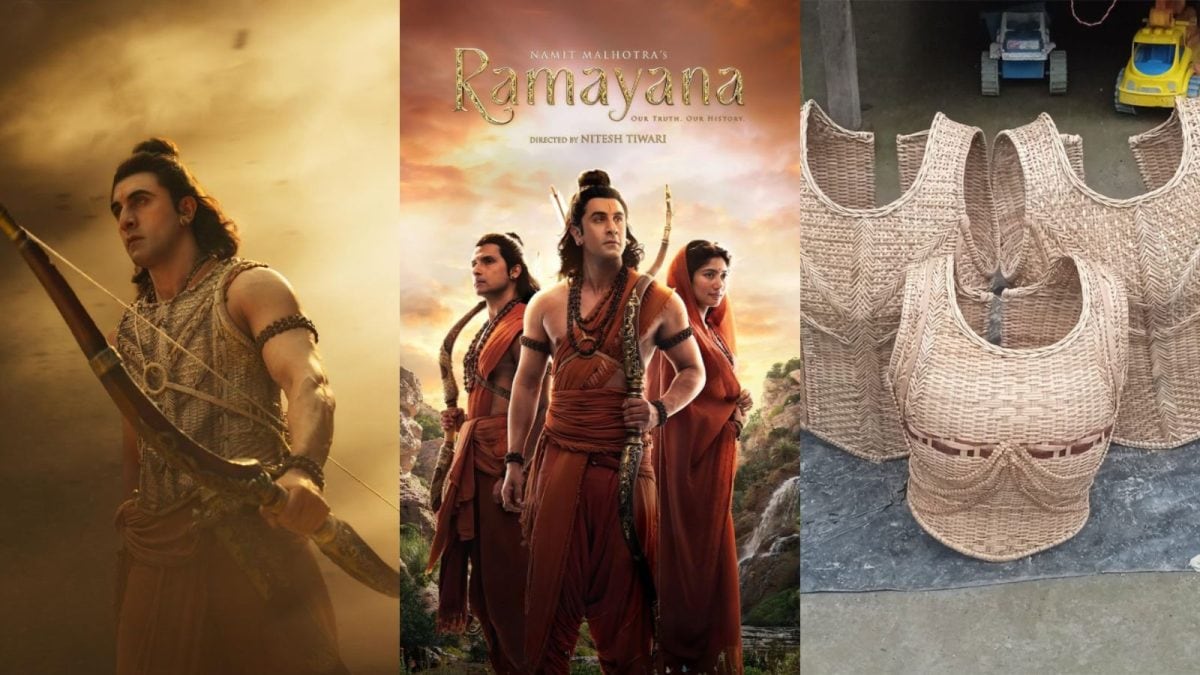
Master artisan Jaynal Abdin and 15 craftspeople from Assam spent three years creating 30-35 pieces of cane-and-rubber armour for the film Ramayana. The team worked hard to make the gear comfortable for actors. As the film earned Rs 350 crore since November 5, these unique designs got much attention.
Master artisan Jaynal Abdin and a team of 15 craftspeople from Assam's Barpeta district spent nearly three years creating 30-35 pieces of cane-and-rubber armour for the film
The armour worn by Ranbir Kapoor as Lord Rama and Ravi Dubey as Lakshman in Nitesh Tiwari's Ramayana has an interesting story that goes far beyond the film's costume department. Made using a combination of traditional cane craftsmanship and rubber, these unusual pieces were painstakingly handcrafted by a team of artisans from Assam's Barpeta district over several years.
As the first part of Namit Malhotra's Ramayana, released on November 5, continues to draw audiences to theatres and has reportedly earned around Rs 350 crore, details of the film's elaborate visual design are also coming into focus. Among them is the distinctive armour seen in the sequence where Rama, Lakshman and Sita prepare to face the army of Khar and Dushan during their exile.
Behind these costumes is master artisan Jaynal Abdin from Jania Banglipara village in Barpeta. Working with 15 local artisans, he handcrafted approximately 30-35 pieces of armour over a period of three to three-and-a-half years. What began as an assignment involving traditional cane work eventually turned into an experiment with different materials to create armour that was both visually striking and comfortable for actors to wear during action sequences.
How Assam's artisans developed the cane-and-rubber armour
Speaking to ANI, Abdin revealed that the project initially reached him through Abdul Malek of the local organisation Gram Unnayan in Jania, rather than directly from the film's production team.
"It first came to Abdul Malek ji of Gram Unnayan here in Jania. He called me over and said a project had come in and asked me to take a look. They had initially sent a file containing the drawings and designs," he said.
After studying the designs, Abdin agreed to take up the assignment and discussed the work with his team. Soon, representatives from the film's team arrived in the village to coordinate the process. "Soon after, 5-6 members from their team arrived here, and a member named Sagar stayed back with us to help oversee the measurements and corrections," he added.
However, translating the designs into wearable armour was not straightforward. The initial pieces had fitting issues and had to be sent back for corrections. Even after the measurements were fixed, the use of pure cane presented another challenge. The material was too rigid and uncomfortable for the actor wearing it.
"After we fixed the initial cuts, they made the main actor of the film wear it, and he said it was very hard and tight, which cane naturally is. They asked what alternative material could be used. I told them we could craft it from whatever material they provided," recalled Abdin.
The production team subsequently supplied black and green rubber as an alternative. However, weaving the material on its own did not produce the desired result. Abdin then proposed combining the two materials to retain the traditional look while making the armour more flexible.
"When I spoke to costume designer Ajay, I suggested using half cane and half rubber. He agreed and asked us to make one sample," the Assam-based artisan remembered.
The hybrid design was eventually approved, allowing the team to move ahead with production. But the work continued in unpredictable phases, with the artisans sometimes waiting months between orders and then having to deliver multiple pieces at short notice.
"The work was continuous; sometimes there would be no news for three to six months, and then suddenly a call would come asking for eight or ten pieces on very short notice before shooting resumed," Abdin told the agency.
Interestingly, the artisans were initially unaware of the film they were contributing to. They had only been told that the armour was being made for a film project and that their work would receive recognition eventually.
"They only told us it was for a film shoot and assured us that our work would bring us recognition later. Now that the film has been released, we finally know the truth. I have not watched the film yet, but I will definitely watch it because a small part of my own handiwork is in it," the artisan concluded.
Why Ramayana's costume team turned to Assam
The choice of cane was not incidental. The film's costume department had been exploring materials that could plausibly have been available to Rama and Lakshman during their years of exile in the forest.
In an interview with India Today NE, costume designer Ajay Kumar explained how the team approached the research and development process. "When we started thinking about the armour, our first question was what resources would have been available in the forest during their vanvaas. We looked at the descriptions of armour in the scriptures and considered what materials could have been used during that period. That is how Sarpat cane entered the conversation," he said.
The team initially approached furniture-making units in Mumbai, including workshops in Goregaon and Juhu. However, finding artisans who could work with cane to create body-fitted armour proved difficult. The search eventually took them to Assam, where Abdin and his team helped develop the basic structure. Sarpat cane formed the framework, while jute, locally known as morapaat, wooden beads and other decorative elements were incorporated into the design. The final product was completed in Mumbai.