
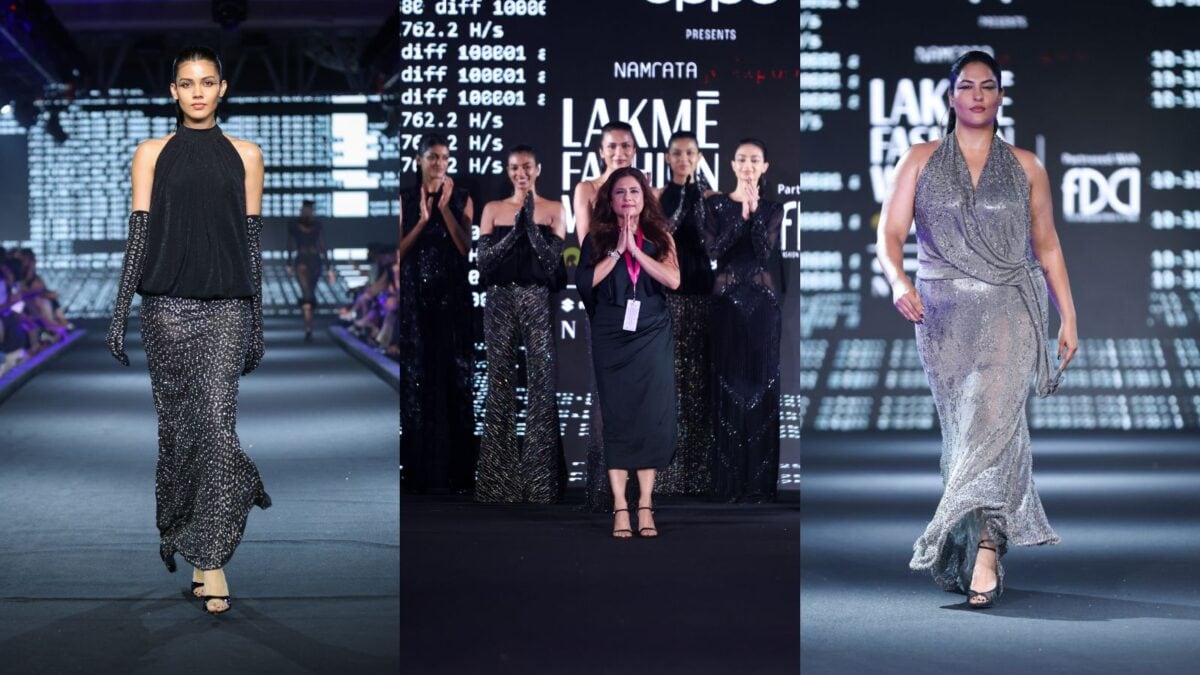
Namrata Joshipura showcased her OBSIDIAN collection at Lakmē Fashion Week, moving beyond the traditional little black dress. She used liquid metallics, sculptural silhouettes, and intricate embellishments to redefine evening wear. Joshipura said, "Black is not a safe choice; it is a canvas for endless experimentation," bringing bold, modern glamour onstage.
With sculptural silhouettes, elongated jumpsuits, liquid metallics and intricate embellishments, Namrata Joshipura's OBSIDIAN reimagines after-dark dressing
Black has a reputation for being the safest thing in a wardrobe. Namrata Joshipura would like a word. At Lakmē Fashion Week in partnership with FDCI, the designer made a compelling case for black as anything but a fallback, sending out a collection called OBSIDIAN that paired its inky depths with liquid silver, gilded embroidery and embellishments.
There were elongated jumpsuits, body-skimming gowns and silhouettes that balanced architectural structure with fluid movement. Metallic surfaces did much of the talking, but the details rewarded a closer look: three-dimensional embellishments, jewel-like textures and intricate threadwork lent the collection its depth. In a conversation with News18, Joshipura spoke about the inspiration behind OBSIDIAN, her approach to contemporary glamour and the ideas that shape her design language. We also caught up with the designer on what it takes to create clothes that feel bold yet refined, and how she sees the relationship between personal style, individuality and the way women dress today.
1. Your work has a recognisable design language. How do you keep it relevant without repeating yourself season after season?
For me, it is about constantly questioning what I already know and looking for new ways to interpret it. While my design language has a certain consistency, the inspiration, materials, techniques and silhouettes evolve with every collection. I enjoy experimenting with textures, embellishment and the relationship between a garment and the body. With OBSIDIAN, for instance, I explored the depth of black and its interaction with light and metallic surfaces. The foundation remains familiar, but the expression is always evolving.
2. Black is often called the safest colour in fashion. How do you make it feel anything but safe?
I have always believed that black can be one of the most expressive colours in fashion. Its impact depends on how you work with it. Through unexpected proportions, reflective surfaces, three-dimensional embellishment and contrasts in texture, black can feel powerful, sensual and dramatic. With OBSIDIAN, I wanted to explore its luminosity and depth, showing that a monochromatic palette can have as much dimension and personality as a collection built around multiple colours. For me, black is not a safe choice; it is a canvas for endless experimentation.
3. What's the most unexpected thing that has ever inspired a design: a film, a person, a city, a song or something completely random? And what inspired this collection?
Inspiration can come from almost anywhere. It could be a visual encountered while travelling, an interesting surface, a piece of art or simply the way light falls on an object. I am particularly drawn to contrasts and details that might otherwise go unnoticed. OBSIDIAN was inspired by volcanic glass, with its deep black colour and naturally reflective surface. I was fascinated by the idea of something so dark possessing such brilliance. That became the starting point for exploring light, texture, metallic finishes and the many possibilities within a monochromatic palette.
4. Indian occasionwear has traditionally been associated with weddings and elaborate embellishment. Is there now a stronger market for contemporary eveningwear that exists outside these occasions?
Absolutely. I think there is a growing appetite for contemporary eveningwear that goes beyond traditional wedding dressing. People are looking for pieces that work for cocktail evenings, intimate celebrations, parties and other occasions where they want to express their individual style. There is also greater openness to jumpsuits, contemporary silhouettes, monochromatic dressing and embellishment that feels distinctive rather than conventional. Indian consumers are becoming more confident in how they dress, and that creates exciting opportunities for designers to explore occasionwear in a more versatile and personal way.
5. Fashion has embraced quieter luxury, even as maximalism continues to find an audience. Where do you see your aesthetic fitting into this conversation?
I have never felt that a designer needs to fit entirely into one category. My aesthetic has always allowed room for both restraint and drama. I enjoy working with embellishment, texture and statement-making silhouettes, but I also believe in being considered about how each element comes together. For me, it is not about choosing between quiet luxury and maximalism; it is about knowing when to use each. OBSIDIAN explores this balance through a focused colour palette, where the impact comes from the interplay of materials, light and detail rather than an excess of colour.
6. Does the pressure to create viral fashion moments risk making designers prioritise visibility over longevity?
I think it can, if visibility becomes the primary objective. Fashion naturally thrives on moments of excitement and discovery, but a collection needs to offer something beyond a single image or viral moment. The pieces that stay relevant are often the ones that have a strong point of view, thoughtful design and a sense of individuality. Social media is an important platform for reaching audiences, but it should complement the creative process rather than dictate it. For me, the real goal is to create something that captures attention in the moment while continuing to feel relevant long after.
7. How has social media changed the way you design, particularly when a look is often first experienced through a phone screen?
Social media has changed how quickly fashion is seen and experienced. A garment may reach a global audience through a photograph or a short video before someone ever sees it in person. That makes the visual qualities of a piece, including how it captures light, communicates texture and moves, particularly interesting to explore. With OBSIDIAN, the reflective surfaces and three-dimensional embellishments naturally create a strong visual interplay. However, I do not design exclusively for the camera. A garment must also have depth, craftsmanship and presence in person. The strongest designs translate across both experiences.
8. With international luxury labels competing for Indian consumers, what can Indian designers offer that global brands cannot easily replicate?
Indian designers bring a distinct cultural perspective, an understanding of the Indian consumer and a creative sensibility shaped by the world we live in. We can interpret global fashion conversations through our own experiences, aesthetics and relationship with craftsmanship. At the same time, Indian designers are increasingly creating work that speaks to an international audience without losing their individual identity. I think the opportunity lies in offering a perspective that feels authentic and contemporary rather than trying to compete purely on the terms of global luxury. Originality and a clear design point of view are what ultimately distinguish a designer.
9. After years in the industry, what are you less interested in as a designer today, and what are you more willing to experiment with?
I am less interested in following trends simply because they are popular or designing something because it is expected to work in a particular way. I am much more interested in exploring ideas that genuinely excite me, whether that means experimenting with materials, rethinking familiar silhouettes or finding new ways to use embellishment. Over time, you develop a stronger understanding of your own design language, which also gives you the confidence to take risks. I want the work to keep evolving and surprising me, while retaining the sense of identity that makes it recognisable.
10. What is the one thing a woman can wear that instantly makes you think, she gets it?
Something she wears with complete confidence and that feels entirely her own. It could be a beautifully cut black jumpsuit, an unexpected combination of textures or a statement piece styled in a way that feels effortless. I am always drawn to women who understand proportion and know how to balance a look without overthinking it. Ultimately, it is less about a particular garment or trend and more about individuality. When someone is comfortable enough to make a look of their own, that is always compelling.