
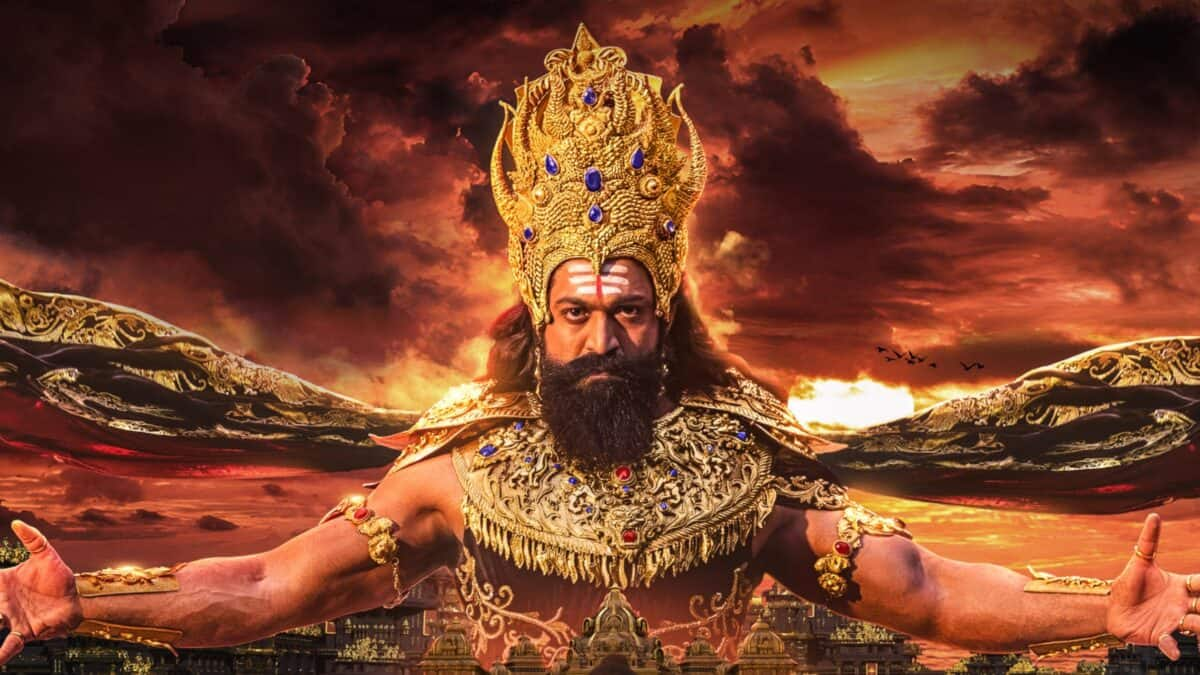
Namit Malhotra’s Ramayana is a visually spectacular film that largely respects the story of Rama. While the movie succeeds in its grand scale and reverential tone, it falters by turning Ravana into a Marxist messiah. This intellectual shift feels out of place, distracting from the simple spirit of the epic.
Visually spectacular and largely reverential, the film undermines its own achievement with the 'Das Kapitalisation' of Ravana
I was sceptical about watching Namit Malhotra's Ramayana. The spectre of Adipurush loomed large. I couldn't risk another disappointment, especially with a story I have always loved so deeply, one that truly epitomises Bharat's civilisational soul.
Unlike the Mahabharata, the Ramayana has a relatively simple, linear plot. It is the story of Maryada Purushottam Rama, who fights the evil Ravana without ever abandoning his dharma. Yet, this simplicity is precisely what makes the Ramayana so compelling -- and so difficult to recreate.
During my early years in journalism, I was repeatedly told to write simply. But simplicity is deceptively difficult to achieve. The same applies to the Ramayana.
In a sprawling saga full of twists and turns, a filmmaker can afford to occasionally lose sight of the story's spirit and still hold the audience's attention through pace, intrigue, and spectacle. The Ramayana offers no such escape. Its simplicity demands balance, stillness and, above all, reverence throughout.
More importantly, you cannot capture the essence of the Ramayana by substituting intellectualism for faith. You need to balance the two. You need faith as much as reason -- and the wisdom to know where one ends and the other begins.
Ramanand Sagar's Ramayana was hardly perfect. Its imperfections were glaring. Still, it worked because it was unpretentious. It approached the sacred with reverence rather than intellectual arrogance.
Hanuman Ansh, earlier this year, succeeded for very much the same reason. It celebrated the sacred instead of attempting to explain it, much less intrude upon it. This distinction is fundamental.
Circumspect yet hopeful, I decided to watch Namit Malhotra's Ramayana. I had my own concerns, but I desperately wanted the film to succeed. Its success could open a hundred doors for similar explorations of our civilisational inheritance on an equally grand scale.
I emerged from the theatre with mixed feelings. Thankfully, this was no Adipurush. Several elements worked for the film. The scale was majestic, the visual imagination breathtaking. The Ravana-Jatayu battle was particularly spectacular. And I am not going to get too worked up about Mithila being portrayed as a hilly region.
Another strength was the reverence with which the film approached Rama and Sita. It largely preserved the bhakti bhava, although at times the devotion felt somewhat contrived. Nevertheless, the emotional appeal was evident for the most part.
Despite criticism from certain quarters, I thought Ranbir Kapoor did a decent job as Rama. He seemed a little uneasy in the initial part but found his groove once he moved into the jungle. Sai Pallavi was convincing as Sita.
The real surprise, however, was Ravi Dubey as Lakshman, who brought a welcome touch of humour to a character more commonly associated with flashes of anger.
The film's real hero, however, was Ravana. And therein lay both its greatest strength -- and its most serious weakness.
While the filmmakers approached Rama with reverence and faith, intellectual analysis seemed to supersede faith in their treatment of Ravana. And when the mind overwhelms the heart, especially in an exploration of the sacred, distortion is often the result. Ravana, thus, needed a backstory. His villainy needed justification. His transgressions demanded sociological explanations.
The result was a curious ideological makeover. Ravana emerged as a Marxist messiah, liberating suffering masses from the tyranny of capitalist Devas. Kubera, the flabby, privileged ruler of Lanka, became the embodiment of an exploitative establishment that Ravana heroically overthrew.
The symbolism was unmistakable. Ravana was the revolutionary fighting for the downtrodden; the Devas were the ruling elite protecting the privileged. Lanka became the theatre of class struggle. Karl Marx, it seemed, found his way into Valmiki's universe. In the process, it was conveniently ignored that Kubera was Ravana's elder half-brother.
Most Hindus familiar with the epic would easily see through this 'Das Kapitalisation' of the Ramayana. They would know that Ravana was not merely an ambitious king who occasionally crossed moral boundaries.
He was a brutal king who normalised violence and persecution. He was a serial sexual predator who even violated the modesty of his daughter-in-law. Indeed, one traditional account explains his reluctance to force himself upon Maa Sita through a curse he incurred after violating another woman.
Now juxtapose this with a scene in which Ravana kills his own brother-in-law for attempting to molest a maid in public. An unsuspecting viewer, especially in the West, might well emerge from the theatre believing Ravana to have been a great feminist, besides being a rebel!
Of course, a three-hour film cannot accommodate every episode of an epic. And this is where I believe some of the 'critics' have gone overboard.
There is, for instance, no scene in the film of Rama bidding farewell to his mother(s) before leaving for the forest. Nor do we see the lengths to which he went to dissuade Lakshman from accompanying him and Sita. The Parashurama-Rama-Lakshman confrontation is not well depicted either.
One can overlook these omissions, though. One can even accept the creative liberty of showing Sita and Lakshman fighting alongside Rama against the Rakshasas, although Valmiki's Ramayana is categorical about Rama fighting alone in the relevant episode.
Such liberties do not fundamentally alter the story's moral universe. Besides, as my wife remarked with a smile, Sita fighting alongside Rama suited modern sensibilities. She liked it. And I was fine with it.
But why humanise Ravana at the cost of distorting his character -- and the nature of the story? We burn Ravana's effigy every year for a reason. He embodied adharma in its most perverse form. Such was the scale of his tyranny that Bhagwan Vishnu had to incarnate as Rama to end it.
To recast Ravana as a revolutionary in the communist mould is to do a disservice to the Ramayana. To portray him as a dutiful son who embraces the Rakshasa identity primarily to please his mother is a dangerous fictionalisation. And to reduce Sita's abduction to an act of revenge for Lakshman's mutilation of Surpanakha is to obscure Ravana's lust for Sita, which is unmistakable in Valmiki's telling.
If Adipurush imagined Ravana in an Alauddin Khilji-like mould -- sadistic, barbaric, evil personified -- Namit Malhotra's Ramayana could be accused of giving him the aura of a wronged revolutionary.
One film demonised him beyond recognition. The other humanised him into ideological absurdity. Both missed the point.
Ravana was neither merely evil incarnate nor a misunderstood Marxist messiah. The Sanatana imagination never needed such simplistic binaries.
Ravana was a Shiva bhakta par excellence, a formidable scholar, an accomplished musician and a powerful king. Yet, none of these accomplishments absolved him of adharma. That is the beauty of the Sanatana worldview.
A man can be extraordinarily accomplished and profoundly flawed. His virtues do not erase his sins; his sins do not extinguish his virtues.
Ravana's tragedy was not that he lacked virtues. It was that his virtues could not save him from his vices. And he had many.
The ideological distortion of the Ramayana is not a new phenomenon, especially in the so-called mainstream intellectual circle.
Sheldon Pollock, a prominent American Indologist, for instance, while accusing Sanskrit's "Brahmin elitism" of originally influencing British colonialism and German Nazism -- yes, you heard it right -- has interpreted the Ramayana as a political code through which "proto-communalist relations could be activated and theocratic legitimations rendered".
He alleges that the Ramayana's portrayal of Ravana and the Rakshasas as "others" forms the ideological foundation for later-day hatred of Muslims. In his view, the sacred Hindu epic itself has been instrumental in legitimising violence against Muslims.
The Ramayana has thus for long been a casualty -- and a vehicle -- of a larger ideological battle. For decades, in fact, a politically motivated Dravidian narrative, reinforced by sections of Left historiography, has portrayed Ravana as a Dravidian defender resisting Aryan hegemony. In the process, what is conveniently overlooked is Ravana's Brahmin lineage.
The late Narendra Kohli, whose pioneering literary retellings of the epics deserve recognition beyond the Hindi literary world, offered a fascinating inversion of this argument. Rama and Lakshman did not enter the forests at the head of an imperial army.
They went as exiles, stripped of the trappings of royal power. They forged alliances with forest-dwelling communities who, in a modern sociological interpretation, might be associated with Scheduled Tribes. Rama united these communities against the formidable kingdom of Lanka, ruled by a king of Brahmin lineage.
So, who was fighting whom? An Aryan imperialist subjugating indigenous peoples? Or, an exiled prince mobilising marginalised forest communities against a mighty Brahmin ruler?
This is precisely why the Ramayana cannot be reduced to a Marxist morality play. Its universe is too expansive, its philosophical foundations too deep, and its understanding of human nature too sophisticated.
Namit Malhotra's Ramayana should have avoided falling into this trap. It does not need to be made relevant through imported ideological frameworks that cannot see beyond the binary of the class war.
It has remained relevant for millennia precisely because it speaks to something far more enduring than the fashionable intellectual anxieties of any particular age. Its power lies not merely in the triumph of good over evil, but in the moral complexity of human existence.
It reminds us that greatness without dharma is ultimately self-destructive, that power without restraint becomes tyranny, and that even the most formidable accomplishments cannot redeem a life surrendered to ahankaar (ego) and adharma.
To be honest, Malhotra's Ramayana had so much going for it -- scale, spectacle, talent and reverence. I laughed and cried with Rama and Sita, though not as much as I would have liked.
I enjoyed Yash's Ravana, too. But the ideological makeover of Ravana was unnecessary, avoidable and dangerous. Valmiki had already given us a character of extraordinary complexity -- a man of immense virtues undone by his own vices. He needed neither obsessive demonisation nor ideological redemption.
The Ramayana does not need Marx to remain relevant. Nor does Ravana need 'progressive' rescuing from his adharma. If anything, it is our understanding of the epic that needs rescuing from the fashionable prejudices of our times.
One hopes the second part of the film, slated for release on Diwali 2028, remembers this. For, then, we will have a sure-shot winner.