
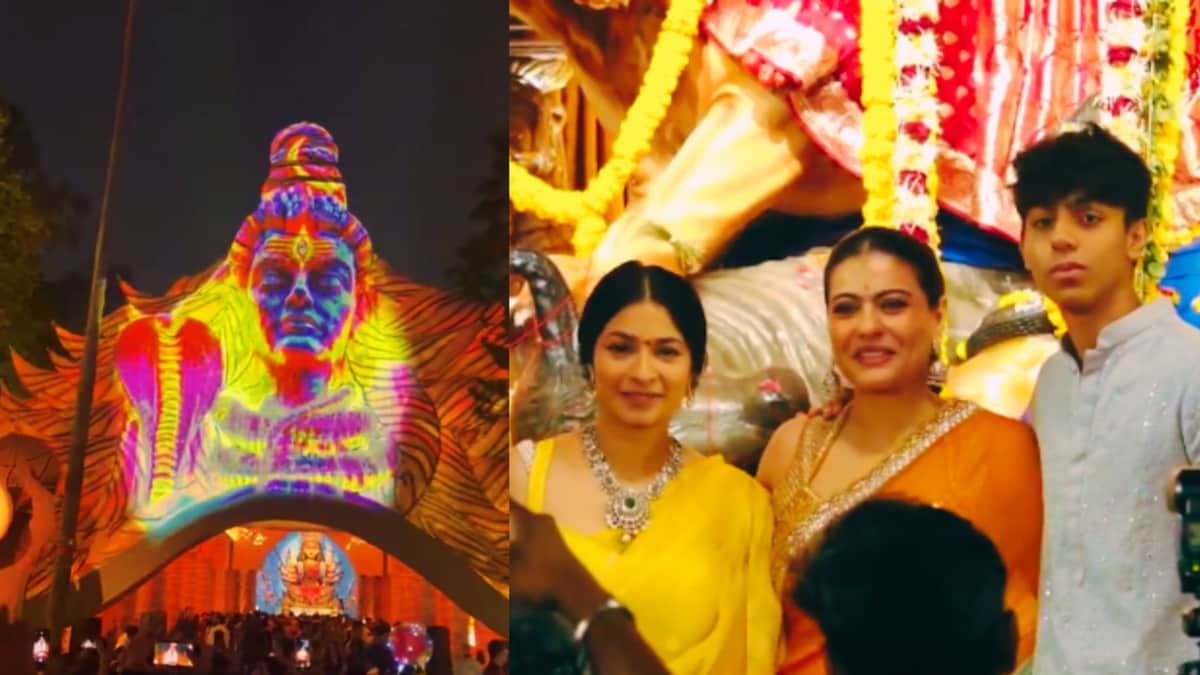
Kolkata’s Allen Park Durga Puja has sparked a heated debate over religious identity and tradition. The pandal, organised by Kolkata Sanatani Sangha, uses fierce Tandav imagery and Aghori-inspired performances to depict Goddess Durga. While many visitors flocked to see the dramatic presentation, others questioned if this approach changes the festival.
Why is Kolkata's Allen Park 'Tandav' pandal sparking debate over faith and identity? Meanwhile, Kajol's family brings an 80-year-old Durga Pujo tradition to life in Mumbai
KOLKATA: Durga Puja celebrations have entered their main phase in West Bengal, with elaborate pandals, spectacular lighting and traditional rituals drawing crowds across Kolkata. But one of this year's most talked-about attractions is also among its most contentious: the first-ever Durga Puja at Allen Park on Park Street, where a dramatic presentation of Goddess Durga's battle against Mahishasura has turned the festival into a debate over religious identity, cultural traditions and the changing character of Bengal's biggest celebration.
The Allen Park pandal, organised by Kolkata Sanatani Sangha, departs from the more familiar festive spectacle associated with Park Street. Instead of relying primarily on decorative installations and traditional musical arrangements, it uses the fierce imagery of Durga's Tandav, Aghori-inspired performances, dramatic lighting and thumping music to portray the goddess as a powerful force confronting evil.
The result has drawn visitors curious about the unusual presentation, while also prompting sharply different reactions online.
The controversy has unfolded against a wider backdrop of political change in West Bengal, renewed emphasis on religious traditions and questions about the role of public funding and permissions in organising Durga Puja.
Allen Park's 'Tandav' Theme: A Celebration Of Faith Or A Break From Tradition?
Allen Park has long been associated with Kolkata's Christmas celebrations and the Park Street Carnival. Its entry into the Durga Puja calendar marks a new chapter for the iconic stretch, traditionally known for its festive lights, restaurants and year-end celebrations. This year, the venue has adopted a distinctly different visual language for Durga Puja. The presentation draws on the goddess's fierce aspect and the mythological battle in which she defeats Mahishasura, the shape-shifting demon who represents evil.
A widely circulated post on X described the production as an experience unlike conventional pandals, highlighting the combination of Aghori performers, forceful music and elaborate lighting. Another reaction circulating online declared that Bengal was "making up for the lost 70 years", reflecting the political interpretation some visitors have attached to the new pandal.
The reactions have not been uniformly positive. The presentation has also prompted questions about whether a festival celebrated through an extraordinary mix of devotion, art, music and community traditions should be framed primarily through religious identity.
For many visitors, however, the central attraction is the dramatic retelling of the goddess's victory over Mahishasura.
CM Suvendu Adhikari, Mamata Banerjee Exchange Festive Wishes Amid Political Debate
The political backdrop has added another dimension to this year's festivities. West Bengal Chief Minister Suvendu Adhikari inaugurated the Allen Park Durga Puja on October 12, playing the dhaak during the ceremony. The event was organised by Kolkata Sanatani Sangha, which has links to BJP functionaries.
The emphasis on Sanatani traditions has featured in the wider political conversation surrounding the festival, with supporters describing the new approach as a renewed focus on religious and cultural roots.
Former Chief Minister and opposition leader Mamata Banerjee, meanwhile, shared a festive message wishing people courage, good health and happiness. Her message read: "May the divine mother bless all with courage, good health and happiness. Shubho Maha Saptami, to one and all."
More Than 58,200 Pandals? Permissions And Grants Become Part Of The Conversation
The scale of Durga Puja across West Bengal is another major talking point this year. Figures cited in the discussion around the festival put the number of pandals at more than 58,200, reportedly almost 13,000 higher than the previous year. The expansion has been linked in public commentary to easier permission procedures and government grants for puja committees.
The issue has also revived debate over permissions granted to puja organisers in previous years. One claim circulating online said that around 800 Durga Puja committees in Murshidabad had reportedly been denied permission last year, while CM Adhikari has said that all the committees concerned have now received approval.
Such claims have become part of a wider political discussion about access to public spaces, administrative processes and the support available to religious and cultural organisations. For organisers, timely approvals and financial assistance can make it easier to stage elaborate celebrations. For critics, the questions are whether the process is transparent, whether all communities receive equal treatment and how public support should be administered.
A Mini Kolkata In Mumbai: Kajol And The Mukherjee Family Mark 80 Years Of Durga Puja
While Kolkata's pandals command attention, Mumbai is also celebrating Durga Puja with a major milestone. The North Bombay Sarbojanin Durga Puja, popularly known as the Mukherjee family's Durga Pujo, is marking its 80th year in 2026. Established in 1948 by Padma Shri Sashadhar Mukerji, his wife Satirani Mukerji, J.M. Bhadra and other members of the founding committee, the celebration began as a neighbourhood gathering in Santacruz. Over the decades, it has grown into one of Mumbai's best-known Durga Puja events, attracting devotees, visitors and Bollywood personalities.
Sashadhar Mukerji, a prominent film producer associated with Bombay Talkies and Filmistan Studios, helped establish the puja's family-centred traditions. Leadership subsequently passed through generations, including Ram Mukerji and Deb Mukerji.
This year's pandal draws inspiration from Kerala's Guruvayur Temple, offering a distinctive architectural setting for the celebrations. The idol of Maa Durga, traditionally sculpted by Kolkata-based artisan Amit Pal and his team, is about 17 feet tall and is among the biggest Durga idols displayed in Mumbai.
The 80th edition was inaugurated on October 15, with actor Kajol attending alongside her mother, veteran actress Tanuja, and sister Tanishaa Mukerji. Filmmaker Ayan Mukerji and actor Sharbani Mukherjee were also among the family members associated with the celebrations.
Kajol shared pictures from the occasion on social media, describing the day as being about Maa in all her forms - as a mother, daughter, protector and goddess.
The Mukherjee family's association with the puja has made it a prominent fixture on Mumbai's festive calendar. Bollywood personalities, including Kajol and her cousin Rani Mukerji, have long been associated with the celebration, along with other members of the extended family.
The event has also become known for offering fans an opportunity to see film personalities participating in familiar rituals rather than appearing only at formal entertainment events. From the unveiling of the idol to dancing to the beats of the dhaak and taking part in sindoor khela, the celebration brings together celebrity presence and family tradition.
Celebrity Bhog, Dhaak And Sindoor Khela: The Family Tradition Continues
One of the most recognisable features of the North Bombay Sarbojanin Durga Puja is its community-oriented atmosphere.
The celebrations traditionally include bhog, the food offered to the goddess and then distributed among devotees. Kajol, Rani Mukerji and other family members have been associated with serving bhog during the festivities, adding to the event's reputation as a gathering that brings stars and ordinary visitors together.
The annual programme also includes the rhythmic beats of the dhaak, rituals around the goddess's idol and sindoor khela, in which married women apply vermilion to one another as part of the celebrations.
For many visitors, these traditions offer a connection to Bengal even while they live and work in Mumbai. The puja has evolved from a local community event into a major cultural gathering, but its organisers have sought to preserve the sense of family and participation that marked its beginnings.
The milestone year also highlights how Durga Puja has travelled beyond Bengal, with Bengali communities across India keeping its rituals and cultural traditions alive in cities such as Mumbai.