
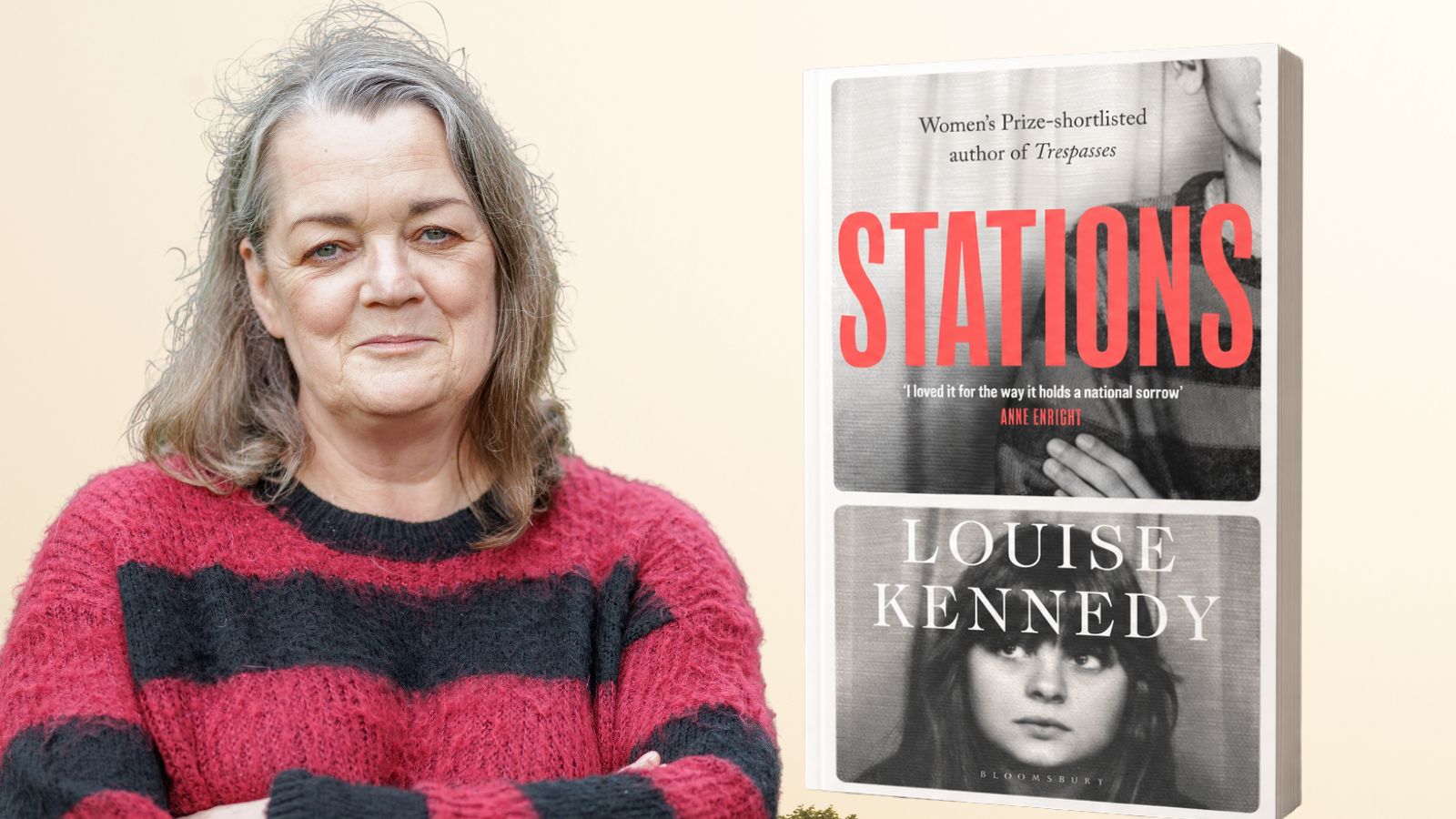
Women’s Prize finalist Louise Kennedy explores themes of migration and identity in her new novel, Stations. The book follows Róisín McCaffrey from 1982 to 2007 as she moves from Ireland to a London squat. Kennedy said, “With Stations, there's a feeling of transience,” reflecting on her own life and writing.
The Irish author's new novel, Stations, follows a Northern Irish girl from a town in Kildare (a county west of Dublin) to a London squat. Kennedy talks about borders, emigration, the rise of the right and writing through cancer.
Louise Kennedy grew up a few miles from Belfast and moved south in 1979, across the border from Northern Ireland (part of the UK) to the Irish state, when she was 12. At her new school, she was teased and dropped her northern accent. Decades later, after almost 30 years as a chef, she became one of Ireland's most celebrated writers.
Her debut novel Trespasses, set during the Troubles (the three decades of violent conflict in Northern Ireland), was a Women's Prize finalist and was adapted for television by Channel 4 in 2025. Stations follows Róisín McCaffrey, who was a character in Kennedy's short story collection The End of the World Is a Cul-de-Sac.
In the early 1980s, Róisín moves south with her family after her father, a Catholic who joined the Royal Ulster Constabulary (RUC), the North's police force, breaks down. At school, she meets Red Camelin, a charming boy from a wealthy family. When he is driven out of town, she follows him to a squat in Pimlico, London. The novel moves from 1982 to 2007, through Margaret Thatcher's London, addiction, and her search years later for the boy she never stopped loving.
Kennedy spoke to The Indian Express about the politics of migration, Partition, and writing through cancer and what the kitchen taught her about writing. Edited excerpts:
Why the name Stations? The book is full of them: Victoria coach station, Penge East, Paddington (all in London). In what sense did you first think of it?
With Stations, there's a feeling of transience. There are the actual stations, but there's also the life of a new immigrant who isn't yet rooted. There's also somebody's station in life, wherever you're destined for or find yourself. And there's the idea of having ideas above your station, as Róisín throws herself into a more middle-class English life. She doesn't stick with it forever, but she certainly throws herself at it. There's a religious connotation, too: the Stations of the Cross, the 14 images displayed around Catholic churches of Christ carrying the cross. The thing is, while it's happening, nobody knows there's going to be a resurrection. It's the idea of a journey towards something that maybe can't be escaped.
Why make Róisín's father, Conor, a Catholic, join the force, which was about 90% Protestant?
People leave the North for all kinds of reasons, and I wanted even that reason to be unsympathetic. Now, I actually think her father is a sympathetic case. He's a Catholic who can't get work. Catholic nationalist politicians (who favoured a united Ireland) say he should join the police, that it will make it less partisan. He gets in, and death threats are issued.
Then he realises his colleagues don't trust him because he's a Catholic. He has a breakdown, and he's quite a broken person when they leave. Politically, he's taken a really difficult position. I wanted Róisín facing challenges on every front, and also to be self-absorbed and a bit hysterical, and to see how that would work out and what she'd learn.
The Indian subcontinent has lived through Partition, and Ireland has grappled with it too. Do you see parallels in how families carry a border, even after accents are dropped?
It doesn't leave you. I left the North when I was 12, and I've lived in the South since. I speak like someone from the South because I got teased a lot at my new school. I did some events in Germany last week, and one of the moderators talked about the Republic of Ireland. That does not exist. (Under its Constitution, the state is called Ireland; 'Republic of Ireland' is its official description.)
The country is called Ireland, but within it there is a political border the British drew at the time of Partition (in 1921, when six counties in the north-east stayed in the UK as Northern Ireland). That's not an Irish border. It separated us from the rest of Ireland, and I don't think we can ever get that back. And for any of us who left, you very quickly realise that you don't belong to one place or another. That is always there.
Until 1985, condoms in Ireland were available only on prescription, and her mother needs an annulment (a Catholic Church ruling that a marriage was never valid) to remarry because divorce is illegal. How far have Ireland and the world come on women's rights?
We were the first country to introduce marriage equality by a public vote (in a 2015 referendum). Other countries tweaked their constitutions, but we had to vote on that one issue. Divorce was introduced in the '90s (by a 1995 referendum that passed with 50.3% of the vote), but only just; it was quite a close call.
Women's reproductive rights are being protected (Ireland legalised abortion after a 2018 referendum), but some things are terrifying. Look at (President Donald) Trump's America and the abortion rights rollbacks in Texas and other states. I think it's bloody terrifying across the board.
A colleague asks Róisín every Monday whether she spent the weekend marching and rioting. A pensioner at the dole office (the British unemployment benefit office) mocks her "lazy Irish face". You capture the hostility towards the Irish in mid-80s London. Do you see a difference in how Britain treats migrants today?
Both examples are from my own experience. The IRA (the Irish Republican Army) was engaged in a bombing campaign in Britain throughout the '70s and '80s. People weren't comfortable having us around, but I always felt no one tried to understand why we were in England. Maybe there's a blind spot about the colonial past.
Honestly, I don't think things are better for migrants anywhere. The rise of the right is making it really quite frightening. Italy has fallen (to the far right). Germany has started to vote for the right. In the '80s, there was a veneer of politeness. People possibly didn't want us around, but mostly they kept that to themselves. Now, every time I look at Instagram, I see people being pushed around and shouted at. I don't think things are any better. In Britain, it really looks like Nigel Farage (leader of the right-wing, anti-immigration Reform UK party) could be the next prime minister.
The Celtic Tiger (Ireland's economic boom from the mid-1990s to the 2008 crash) appears in 2007 through Irish developers buying Battersea Power Station. Today young Irish people are emigrating again. What has Ireland learned?
I have two children, and one of them is in London. My sister has three kids, and they've all left: two are in London, and one is in Denmark. They are leaving hand over fist, and they are all educated. It shows in hospitals too. The Irish health service has a lot of problems, and young Irish graduates don't want to stay, so they go to Canada or Australia. Young people in other jobs are leaving because the alternative is staying at home with their parents. There's nowhere to live; there's no housing supply. We fell into such a deep recession, all because of the property market. We over-borrowed, overstretched, and banks started to collapse. I wonder if, sometimes, maybe in other countries too, we tend to react rather than plan.
The book is critical of how the state treats people who fall into addiction and homelessness. How could states do better?
States certainly could do better. If there aren't enough homes in the private sphere, there certainly aren't enough in the public sphere, and that's an even bigger problem. We have moved towards a largely capitalist model. In both Britain and Ireland, for years a really big public housing stock was built up. It meant you could be really quite poor and still have a roof over your head. That is not the case anymore, and it has made many people's lives precarious. People with jobs are becoming homeless, sleeping on couches and moving into hotels.
As the country has become less religious, the Catholic Church no longer has the hold it once did. Like everybody else in Ireland, I have so many issues with the Church: how it handled the clerical abuse scandals, how women were treated in the Magdalene laundries [Church-run institutions where women deemed 'fallen' were confined and made to work unpaid] and the mother and baby homes. And yet there was a sort of kindness there, an altruism, which I think is disappearing with modern life.
Food is almost an emotion in this book: the turkey pie, the Golden Wonder potatoes (an old Irish variety), an empty fridge. How does the kitchen shape the way you write?
I was a chef for years and years, but I loved to cook even as a child. My mother only let me make cakes; she wouldn't let me tackle dinner. I've fed people all my life, and it comes through in my writing without me thinking about it.
A restaurant kitchen is a really highly sensory environment. I could be plating dishes under the heat lamps, and I'd know from a change in sound behind me that a pan needed attention. I'd reach back and turn the dial, or push it to a cooler place, or call over my shoulder to another chef. All your senses are going at the same time. I probably still experience the world that way, and it's a good thing for writing. Everywhere I go, I get it all at once: the smell, the feel of rain on my hands, the sounds and the sights.
You wrote Trespasses after a melanoma diagnosis, and Stations thanks your oncologist. How have illness and the weight of a celebrated debut shaped your writing?
I can't really separate cancer from Trespasses, or from this one either. I had melanoma and fairly horrible surgery on my back, so I knew I'd have about three months off work. At first I was freaking out. I needed some project to take my mind off my predicament. When the cancer came back, this time it was stage four, and I had to go on treatment. The new immunotherapy drugs are very strong and strange. They do weird things to your body; they don't always work, and they can have spectacular side effects. In my case, they did work. I was on them for two years. The cancer is all gone, but it did leave me with complicated endocrine problems. I have to take drugs all day; I carry syringes, patches, gels and tablets, and I have alarms for when to take them.
The main thing is the fatigue. When I was writing Stations, I sometimes literally fell asleep at my desk. My answer is to take an afternoon nap when I can and drink a hell of a lot of tea. Especially with Trespasses, something bad happened in treatment every day, and something really good happened with the book. So I think I've been very lucky.
The main thing is the fatigue. When I was writing Stations, I sometimes literally fell asleep at my desk. Especially with Trespasses, something bad happened in treatment every day, and something really good happened with the book. So I think I've been very lucky.
Is Stations a novel about regret or about forgiveness?
Both, but I would say regret, honestly. Róisín does forgive some of the people around her. But her biggest challenge is forgiving herself. She's not quite there, but she's getting there.