
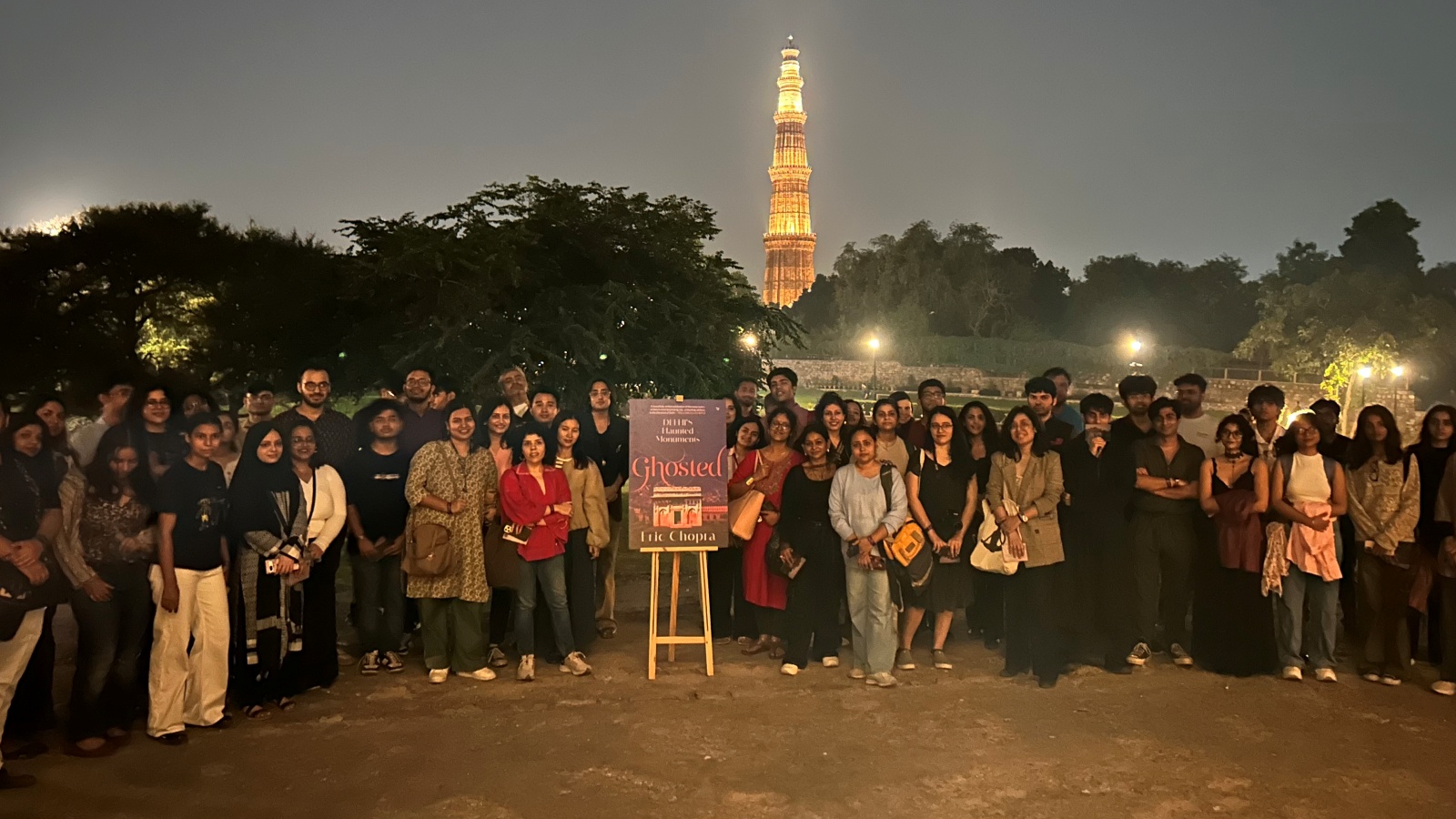
Delhi residents are showing a growing interest in paranormal activities through haunted walks and horror movie screenings. Enroute Indian History is hosting two haunted walks this Saturday and Sunday. Organiser Eric Chopra says, “I try to give abundant space to both horror and history in my work.” Many people join.
At one such recent walk, Jain claims, the guests had “supernatural sightings”. “My colleague leading the Jamali-Kamali walk said it was a very spooky night. Many participants messaged us that they felt an eerie presence… They said while returning, they saw a Djinn in the form of a Nilgai looking at them…” she says.
While other guided walks curated by her heritage and education organisation, Enroute Indian History, are mostly academic, the ‘haunted’ ones are more engaging with people sharing their own stories and experiences. “The response has been amazing. We assumed participants would be mostly youngsters, but many 40-50-year-olds join us too. Thrill-seekers have no age.”
For Halloween, Enroute Indian History is organising two ‘haunted walks’ on Saturday and Sunday.
‘Haunted’ past
One of the oldest continuously inhabited cities in the country, Delhi’s past is usually talked about in terms of seven historical cities — deserted, ruined and rebuilt — that shaped the present Capital.
In ‘City of Djinns’, the classic travelogue and memoir on Delhi, author-historian William Dalrymple writes: “…Delhi was destined to appear in a new incarnation century after century. The reason for this, said Sadr-ud-Din, was that the djinns loved Delhi so much they could never bear to see it empty or deserted.”
“Delhi is such an old city, it is impossible for it to not have its own concept of horror,” says Eric Chopra, who hosted his first-ever ‘haunted walk’ at the launch of his book, ‘Ghosted: Delhi’s Haunted Monuments’, on Halloween last year.
“Most of Delhi’s abandoned monuments carry a sense of trauma from the past, including recent events like Partition and Emergency. So I focus on non-fictional understanding of the haunted phenomenon, rather than relying on local beliefs,” he adds.
For Halloween, Eric’s platform, Itihasology, is hosting a free ‘haunted walk’ in Mehrauli on Saturday, marking the first anniversary of his book.
But he says, “I don’t like to call it a haunted walk; it seems a bit presumptuous… I try to give abundant space to both horror and history in my work.”
Immersive walks
Anthropologist Mohammad Anas also focuses on uncovering the historical legends and local folktales of the Djinns at his ‘haunted walks’. Now, he’s slowly moving towards making the experience more immersive, by hiring on-site actors and projectors.
“History has largely been restricted to a handful few academicians. My aim is bringing it to the masses in a fun, infotainment-driven way.”
His organisation, Unzip Delhi, is also hosting a ‘haunted walk’ at Mehrauli on Saturday evening.
Focus on history
For many, intertwining history with horror to tell the stories of historical monuments has been a priority. On the other hand, another heritage walk curator, Shah Umair — more commonly known as ‘Sikkawala’ as he is also a numismatist — says too much “focus on supernatural myth dilutes the history of these monuments”.
Referring to Jamali-Kamali, he says, “By the 1980s, Mehrauli monuments were deserted, and became a refuge of drug users and petty criminals. So the haunting rumours were used to keep the police away.”
“Even on my walks, people often keep asking me if the site is haunted or not… But I don’t believe in the haunted aspect of heritage, I just like to focus on the history,” Umair adds.
Chopra and Umair add that the oldest recorded supernatural sightings at most of these sites are from the post-internet era — when blogs and media picked up these stories and popularised them.
Before a recent walk at Feroz Shah Kotla, he posted a message: “You may have heard people suggest avoiding strong perfumes when visiting the site. I don’t personally subscribe to these beliefs, but I’ll leave it entirely up to you to decide what you believe.”
‘Sikkawala’ is organising a Mehrauli heritage walk on Sunday.
Special screenings
Away from Mehrauli, at an abandoned cafe in South Delhi’s Jangpura, S Tara and Karmaditya Bagga — filmmakers by profession and co-founders of ‘Khatarnaak Films’ — host weekly horror film screenings.
Perhaps the only such movie club of its kind in Delhi, ‘Khatarnaak Films’ has so far organised 23 screenings this year.
On average, each event sees 20-30 participants, and up to 40 on good days. “We keep the tickets affordable, they cover food and other expenses, plus we also offer discounts to a few regulars… The idea is to inculcate a culture of appreciating horror movies from across the world. I have always loved the horror genre… it is sort of what got me into filmmaking,” Tara says.
They recently also held a two-week horror filmmaking challenge.
For Halloween, Khatarnaak Films is organising an overnight sleep-camp on Saturday — with movies, snacks, games and cosplay. The venue is available on-demand, say the organisers.
The challenges
Curating such events, however, come with their own challenges — access to sites and safety in after-hours.
Malcha Mahal and Bhuli Bhatiyari Ka Mahal have been permanently closed by the Delhi Archaeology Department, points out Jain. “For over a year, we kept asking for permission to hold walks there, but to no avail.”
Another challenge is historical sites close by 7pm.
“Another challenge is safety. I only hire women academics to lead the walks as women are under-represented in the art and history world. But I fear for their safety, especially at night,” she underlines.