
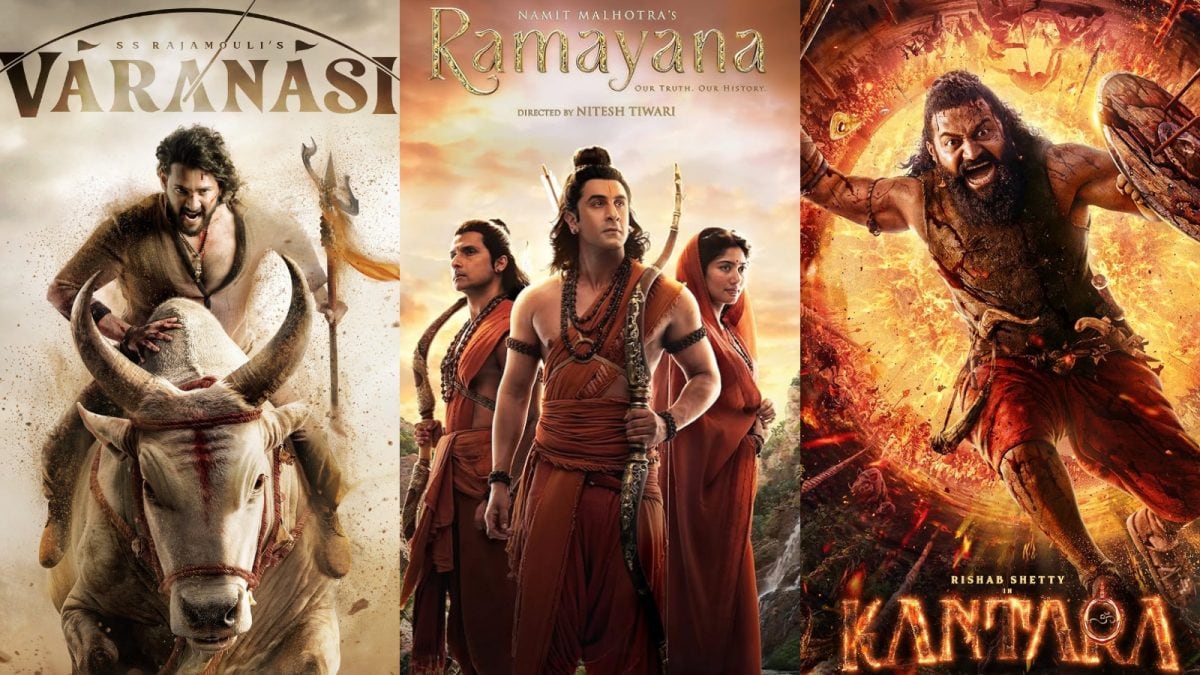
Bollywood is betting big on mythology by using star power and mega-budgets to bring ancient epics to the big screen. Films like Hanu-Man and Mahavatar Narsimha showed that audiences love these stories. Now, Nitesh Tiwari’s upcoming two-part Ramayana aims to capture this growing interest with a massive, star-studded cast.
Bollywood is betting big on mythology with star power, mega-budgets & spectacular VFX. But can the box-office ambition match the storytelling?
For generations, the stories of Lord Rama, Lord Krishna, Lord Hanuman and the many revered figures of Indian mythology have been woven into the fabric of our lives. We have grown up listening to them from our grandparents, watching their stories unfold on television, reading about them in books and encountering their teachings in our homes and festivals. For millions, these are not simply stories from the past. They are an expression of faith, values, tradition and a deeply personal cultural inheritance.
And now, they are finding a new life on the big screen.
Only, the scale has changed rather dramatically. Magnificent kingdoms, elaborate sets, spectacular battle sequences, international technicians and cutting-edge visual effects are giving filmmakers the opportunity to bring these timeless narratives to cinema audiences in ways that were once difficult to imagine.
Mythology is having quite a moment in Indian cinema. What is particularly interesting is that it is no longer confined to devotional filmmaking. Producers are increasingly looking at India's epics, legends and folklore as a rich source of mainstream entertainment, with the potential to draw audiences across generations.
The success of Prasanth Varma's Hanu-Man was an early indication of this changing appetite. Made on a relatively modest budget, the film drew inspiration from the devotion and extraordinary strength associated with Lord Hanuman, giving the superhero genre an Indian flavour. Its mix of action, humour and imaginative storytelling struck a chord with audiences. Then came the animated feature Mahavatar Narsimha, which brought the story of Lord Vishnu's Narasimha avatar to theatres and found an impressive audience.
There is something encouraging about these successes. They suggest that audiences are happy to revisit familiar traditions through cinema, provided the filmmaker brings sincerity and imagination to the telling. Younger viewers get the excitement of fantasy and adventure, while older audiences find the pleasure of seeing stories they have known all their lives presented in a new way. It is quite a lovely meeting of generations. And the industry has clearly taken notice.
The great mythological gold rush
The ambitions are getting bigger, and nowhere is this more evident than in Nitesh Tiwari's two-part Ramayana. With Ranbir Kapoor as Rama, Sai Pallavi as Sita, Yash as Ravana and Sunny Deol as Hanuman, the film has brought together an impressive cast. International visual-effects expertise from DNEG and a musical collaboration involving Hans Zimmer and A. R. Rahman add to its global ambitions.
The reported ₹4,000-crore investment across the two films, including production, post-production and promotional expenses, has understandably become a talking point. The second instalment is planned for Diwali 2028, and expectations are enormous.
But Ramayana is only one part of a much larger picture. Hombale Films and Kleem Productions are developing the Mahavatar Cinematic Universe, an ambitious seven-film animated franchise exploring the avatars of Lord Vishnu. Following Mahavatar Narsimha, Mahavatar Parshuram is planned for December 2027, with further films around Rama, Krishna and Kalki in the pipeline.
There is also Rishab Shetty's Jai Hanuman, the sequel to Hanu-Man, with Shetty stepping into the role of Hanuman, and Vicky Kaushal's Mahavatar, in which he is set to play Parashurama. Nayanthara returns in Mookuthi Amman 2, while animated projects such as Maha Devi Adishakti - The Legend of Maa Durga are exploring stories of the divine feminine.
Even S. S. Rajamouli's Varanasi, starring Mahesh Babu, Priyanka Chopra Jonas and Prithviraj Sukumaran, promises to bring mythology, adventure and time travel together.
It is quite a line-up. And one can understand the excitement. India's epics offer a wealth of stories, relationships, conflicts and philosophical questions that filmmakers could explore for years. Hollywood has built hugely successful franchises around superheroes and fantasy worlds. Why shouldn't Indian cinema explore the extraordinary narratives that have been part of its cultural heritage for centuries?
There is, however, a difference between announcing a cinematic universe and creating one that audiences genuinely want to return to. A collection of films with familiar names may generate curiosity, but sustaining that interest requires good writing, engaging narratives and characters that stay with us. Even the grandest of cinematic plans need a strong story at their heart.
When spectacle meets substance
There is no doubt that technology has opened up wonderful possibilities. The worlds described in our epics can now be recreated with elaborate sets, sophisticated visual effects and international expertise. Celestial weapons, magnificent kingdoms and extraordinary battles can be brought to life on a scale that earlier generations of filmmakers could only imagine.
And why not? There is no reason Indian cinema should be shy about ambition. We have the stories, the talent and increasingly the technical ability to tell them beautifully.
But somewhere amid all this excitement, it is worth remembering that the most expensive visual-effects sequence cannot do the work of a good screenplay.
S. Rajamouli's Baahubali offers a lovely example of getting the balance right. Its grand kingdoms, dramatic battles and larger-than-life heroes were certainly part of its appeal. But what really drew audiences in was the story: family, betrayal, ambition, identity and sacrifice. We wanted to know who would inherit the throne, why the betrayal had happened and what would become of the people at the centre of it all. The spectacle made us look; the story made us care.
That balance becomes especially important when filmmakers take on narratives that are deeply cherished by millions.
The fine line between creative freedom and sensitivity
Om Raut's Adipurush is worth remembering in this context. The film arrived with enormous anticipation, a star cast led by Prabhas and a substantial budget. Its opening was impressive, but the conversation soon turned to its visual effects, dialogue and portrayal of revered figures. The makers eventually agreed to revise certain dialogues following the criticism.
The reaction was a reminder that mythological filmmaking carries a responsibility quite unlike that of making an ordinary fantasy film. For many people, the Ramayana and Mahabharata are not simply familiar literary narratives. They are living traditions, deeply connected to faith, family, regional identity and personal belief.
At the same time, these epics have travelled across languages, regions, art forms and generations. They have been retold through different traditions and interpreted in different ways. That diversity is part of their richness, and cinema should have room to explore it.
A filmmaker need not be restricted to reproducing a familiar version of a story. There is room for imagination, fresh perspectives and even challenging interpretations. But understanding the significance of the material is equally important. The idea is not to take away creative freedom, but to exercise it with thought and sensitivity.
Audiences, too, can hold two feelings at once: a willingness to welcome a fresh interpretation and a desire to see something they hold sacred treated with care. That is not an unreasonable expectation.
Perhaps the most exciting way forward is to look beyond the stories we already know so well. India has an extraordinary wealth of narratives waiting to be discovered.
Beyond the familiar epics
India's mythological and folkloric inheritance is far too rich to be restricted to the Ramayana and Mahabharata. Every region has its own legends, local deities, oral traditions and stories that have travelled through generations. Many have barely been explored by mainstream cinema.
Kantara showed just how rewarding this territory can be. Rooted in the Bhoota Kola traditions and spirit worship of coastal Karnataka, Rishab Shetty's film found audiences across the country without losing its regional identity. In fact, it was that very identity that made the film so distinctive.
Shetty's observation that "more regional is more universal" is worth remembering. The film did not try to make its world less local to attract a larger audience. It simply told its story with conviction, allowing viewers from elsewhere to discover a culture they may not have known much about.
Then there is Tumbbad, which found a fresh audience during its theatrical re-release. Its haunting tale of greed, an ancestral curse and a mysterious deity was quite different from the familiar mythological spectacle. Yet audiences responded to its unusual setting and storytelling. It was proof that Indian folklore has plenty to offer beyond the stories we already know by heart.
Think of the possibilities. The traditions of Theyyam, the legends of the Northeast, tribal folklore and stories of lesser-known regional deities could open up entirely new worlds on screen. There is no shortage of material. What is needed is the curiosity to go looking for it, and the care to tell those stories in their own spirit.
There is also so much to discover within the familiar epics themselves, particularly through the experiences of their women. Deepika Padukone has previously spoken about exploring the Mahabharata from Draupadi's perspective. It is an interesting thought. What might Sita's story look like if told through her own experiences and choices? What about Kunti, Gandhari, Mandodari or even Surpanakha?
These are women with complex and compelling stories of their own. Looking at an epic through their perspectives need not take anything away from its larger narrative. It might simply help us see something we had not quite noticed before. And surely that is one of the pleasures of revisiting a story: discovering something new even when we think we know it so well.
A divine opportunity, but no divine guarantee
With so many projects in the pipeline, it is tempting to believe that mythology could become the industry's next great box-office formula. But there is a small danger in getting carried away. Once a genre starts delivering hits, everyone wants to be part of the success. Before long, audiences can find themselves watching one similar film after another.
Hollywood's superhero experience offers a useful reminder. Even the most popular franchises have discovered that familiar characters, enormous budgets and interconnected stories cannot guarantee endless excitement. Eventually, audiences want something new.
Indian cinema must be careful not to turn mythology into another production-line exercise. A popular subject is not an automatic box-office ticket, just as a spectacular battle sequence does not necessarily make a film memorable.
The real opportunity lies in telling these stories with the warmth, imagination and emotional depth that have kept them alive for generations. There is room for grand spectacles, intimate character studies, animated adventures and little-known folk legends. There is room for fresh interpretations, too, provided they are approached with thought and an appreciation of what these stories mean to different people.
Perhaps that is what makes this moment so exciting. We have inherited stories that have travelled through centuries, crossed regions and been retold in countless ways. They have endured because every generation has found something meaningful in them. The challenge for today's filmmakers is to bring that same sense of wonder to the cinema.
The stars may bring audiences to the theatre, the budgets may make the headlines and the trailers may promise the heavens. But once the lights go down, it is the storytelling that has to hold our attention.
And if there is one thing that never goes out of fashion, in cinema or otherwise, it is a really good story.