
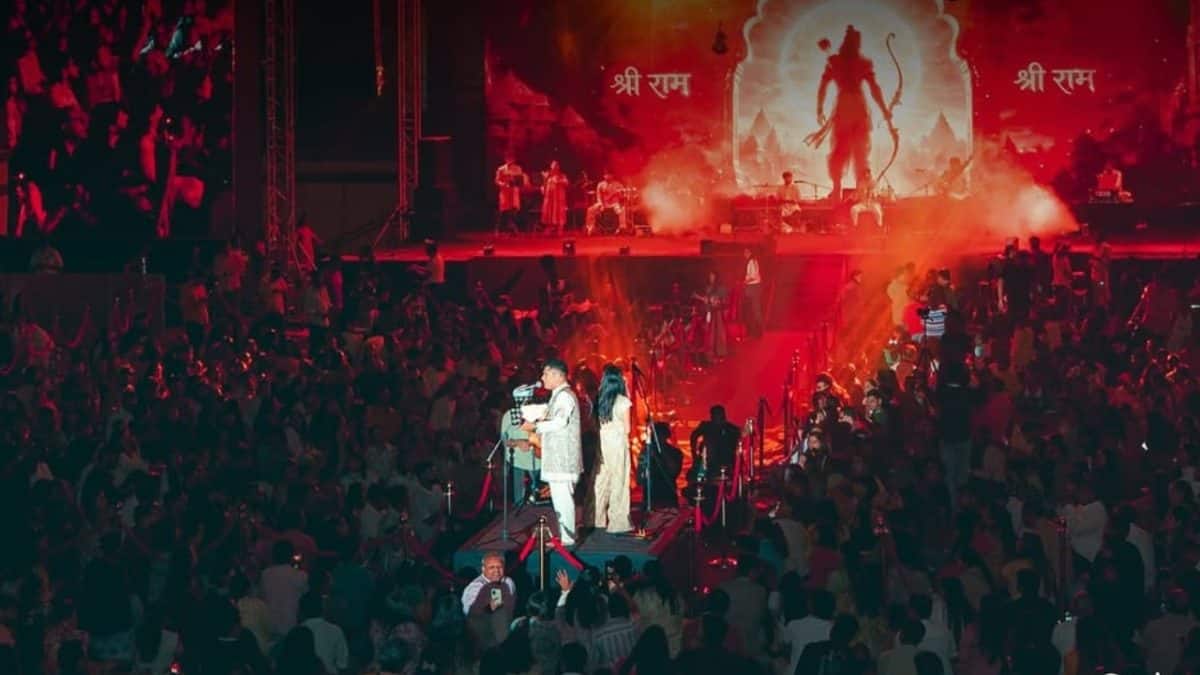
Backstage Siblings performed at the UK Parliament in London, bringing their unique devotional music to an international stage. Former corporate traders Raghav and Prachi Agarwal started this movement to connect young people with traditional chants. They use acoustic guitars and crowd participation to make bhajan jamming a popular, modern experience.
As Backstage Siblings perform at Westminster, a look at how two former corporate traders built a viral subculture by stripping traditional devotional singing down to acoustic guitars and crowd participation
In a shift for modern devotional music, the brother-sister music act Backstage Siblings brought their signature communal devotional sessions into the halls of the UK Parliament in London. The performance inside Westminster marks an international turn for a grassroots cultural movement that has gained momentum across India over the past two years, moving sacred chants out of traditional temples and into unexpected modern spaces.
The appearance in London comes as part of their broader UK tour, which included large-scale public sessions. For an audience gathered in Westminster, the duo performed acoustic renditions of traditional chants, translating a distinctly Indian spiritual subculture into an international institutional setting.
Who are Backstage Siblings?
Backstage Siblings consists of Kolkata-born siblings Raghav and Prachi Agarwal. Before entering the music scene, both pursued corporate careers in finance: Raghav worked as an investment banker, while Prachi was a fixed-income trader. Driven by a shared interest in redefining how young audiences interact with devotional music, both left their corporate roles to focus on their collective project full-time.
Growing up in a household where family satsangs were a routine part of daily life, the duo noticed a growing disconnect between traditional devotional formats and younger generations. Rather than performing classical concerts where the audience remains passive listeners, they pioneered a format they call bhajan jamming.
What is Bhajan Jamming?
At its core, bhajan jamming strips away the formal boundaries of conventional religious performances. The concept relies on simple acoustic setups, contemporary rhythms, and call-and-response group singing designed to encourage maximum audience participation.
The group name itself reflects this framework: the performers position themselves not as distant headliners, but as facilitators, treating the crowd as the primary lead vocalists. By replacing heavy classical instrumentation with accessible guitar arrangements, the duo framed devotional chanting as a collective, accessible session akin to an acoustic pop-up.
International recognition
The trajectory of the duo highlights a broader trend in how traditional Indian art forms are being repurposed for contemporary audiences. What began as informal community gatherings quickly scaled into sold-out sessions at major cultural hubs across India, including high-profile performances at the Nita Mukesh Ambani Cultural Centre in Mumbai.
Their mainstream visibility grew further following public acknowledgments from national figures, alongside viral traction on social platforms where clips of young crowds singing ancient verses in modern venues began circulating widely. The recent expansion to international institutions like the UK Parliament underscores how this localized, youth-driven revival of devotional music is finding footing within the global Indian diaspora and international cultural circuits.