
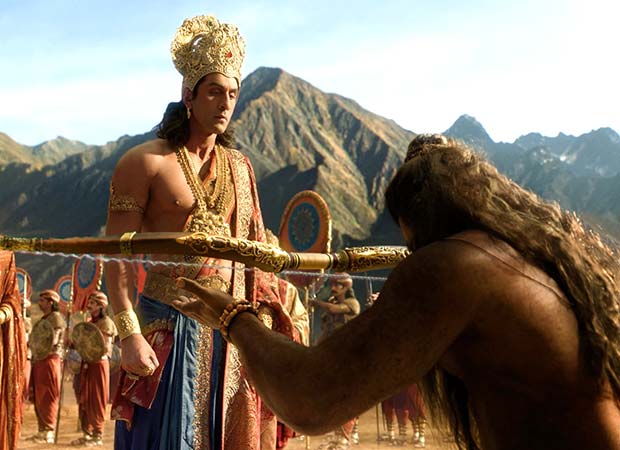
Nitesh Tiwari’s Ramayana is scheduled to release on November 5. The film faces a big challenge as it tries to satisfy three different audiences. While some viewers want a respectful religious portrayal, others seek nostalgia or a grand visual spectacle. Balancing these expectations is key to becoming a historic blockbuster.
A family walks into a cinema to watch Ramayana: Part One. The grandfather wants to see a respectful portrayal of Lord Rama. The parents hope to experience the story they grew up watching on television, this time on a spectacular big screen. Their teenage children are excited about the visual effects, action sequences and the prospect of watching Ranbir Kapoor and Yash in an epic confrontation. All four are buying tickets for the same film. But are they really buying the same experience?
Is Bollywood selling religion, nostalgia or spectacle? The three audiences Ramayana must satisfy to become a historic blockbuster
This is perhaps the most fascinating commercial challenge facing Nitesh Tiwari's Ramayana, which is scheduled to release on November 5.
The film is attempting to attract audiences whose reasons for watching may be fundamentally different. For some, the Ramayana is a sacred narrative. For others, it evokes powerful childhood memories. And for a younger generation accustomed to Hollywood spectacles and contemporary action blockbusters, it represents the possibility of experiencing Indian mythology on an unprecedented cinematic scale.
Religion, nostalgia and spectacle – three powerful motivations, but not always compatible expectations. If Ramayana can satisfy all three, it could achieve something extraordinary.
Audience one: Those who come for faith and tradition
For a significant section of Indian audiences, the Ramayana is not merely a story. It is deeply connected to religious beliefs, family traditions and cultural identity. These viewers may approach the film with expectations that differ from those associated with a conventional entertainer. They may place particular importance on the portrayal of Lord Rama, Sita, Hanuman and other revered figures. Dialogues, costumes, characterisation and the overall tone could matter as much as the visual spectacle.
For such audiences, technical excellence cannot compensate for a portrayal they consider emotionally or culturally unconvincing. The makers must ensure that their interpretation feels respectful and emotionally authentic without reducing the film to a purely devotional presentation. After all, a theatrical feature requires dramatic momentum, compelling performances and cinematic storytelling.
Finding that balance will be crucial.
Audience two: Those who come for nostalgia
The second major audience consists of viewers who grew up with the Ramayana through television, books, family storytelling and cultural traditions. For many Indians, Ramanand Sagar's television adaptation remains an important reference point.
The series became a shared viewing experience for families and helped establish enduring screen images of the characters.
A new cinematic adaptation inevitably invites comparisons with these memories. However, nostalgia is a double-edged sword. It can generate enormous anticipation because audiences want to revisit something they love. But it can also create expectations that are almost impossible to satisfy.
A viewer who has carried a particular image of Lord Rama or Ravana for decades may find it difficult to accept a significantly different interpretation. This is where casting, dialogue delivery, music and emotional tone become especially important.
Ranbir Kapoor, Sai Pallavi and Yash must make the characters their own while remaining convincing to audiences who already have deeply established expectations. The filmmakers cannot simply reproduce older adaptations. But they also cannot ignore the emotional connection viewers have with them.
Audience three: Those who come for spectacle
The third audience could be commercially decisive.
Younger moviegoers, particularly those accustomed to Hollywood franchises, superhero films, anime and contemporary Indian action spectacles, may approach Ramayana primarily as a cinematic event.
For them, the attraction could lie in the scale of the production, visual effects, elaborate battles, immersive environments and the star combination. These viewers may be familiar with the broad outline of the story without having the same attachment to earlier screen adaptations.
Their expectations are shaped by films such as Avatar, Avengers: Endgame, Baahubali and other large-scale spectacles. They will judge whether Ramayana delivers an experience worthy of the big screen.
But there is a potential conflict. A slower, emotionally detailed treatment may appeal to audiences seeking traditional storytelling while testing the patience of viewers expecting relentless action.
Conversely, an excessively action-oriented interpretation could alienate audiences who value the epic's emotional and spiritual dimensions. The challenge is not simply to include enough of everything. It is to make the different elements work together.
The international complication
The challenge becomes even more interesting outside India. For Indian-origin audiences overseas, Ramayana may represent a connection to cultural identity, childhood memories and family traditions.
For viewers unfamiliar with the epic, however, the film must work as an accessible piece of storytelling. They may not recognise the religious significance of particular characters or events.
The film must therefore establish its emotional conflicts clearly enough to engage people who have no prior knowledge of the source material. This creates a fascinating balancing act.
The filmmakers must preserve the story's cultural identity while making its dramatic themes understandable to an international audience. If they succeed, Ramayana could demonstrate that deeply Indian stories can appeal to global audiences without abandoning their roots.
The real commercial opportunity
From a box-office perspective, satisfying these different audiences could create a powerful combination.
Traditional family viewers may contribute to broad-based attendance. Nostalgia-driven audiences could generate strong initial interest. Younger spectacle-seekers may help sustain demand for premium formats and repeat viewing.
The overseas Indian diaspora could add another important layer, while positive word of mouth among non-Indian viewers would expand the film's reach. However, these are potential audience segments, not established findings about actual ticket buyers. The true composition of the audience will only become clearer through booking patterns, surveys and theatrical performance.
Ramayana is not simply attempting to sell a film.
It is attempting to deliver several experiences within one cinematic narrative.
The challenge for Nitesh Tiwari is to ensure that none of these audiences feels that the film has been made entirely for someone else. And perhaps that is where the greatest opportunity lies.
A truly successful adaptation would not force audiences to choose between devotion, nostalgia and spectacle. It would use the power of cinema to bring all three together.
The biggest victory for Ramayana may not be attracting three different audiences. It may be making all three applaud the same scene.