
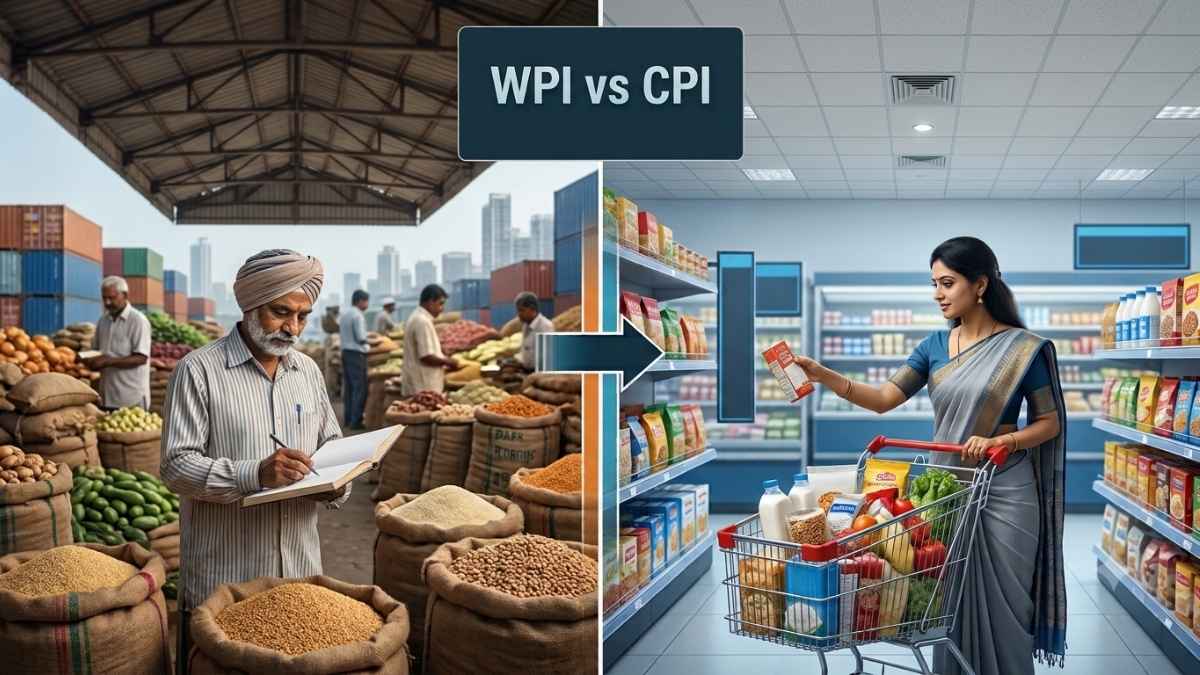
The year-on-year WPI inflation hit 11.39% in September 2026, more than double the year-on-year CPI inflation of 5.54%. These indices track different price levels, as WPI measures wholesale bulk sales while CPI tracks retail costs for households. Both indices use specific base years to show how prices changed over time.
l What do the two price indices — WPI & CPI —measure?
THE WHOLESALE PRICE Index (WPI) measures the average change in prices transacted in the wholesale market for bulk sale of goods.
The Consumer Price Index (CPI) measures changes in the general level of retail prices for select goods and services purchased by households for consumption.
The WPI is compiled by the Office of the Economic Adviser in the Department for Promotion of Industry and Internal Trade (DPIIT), whereas the National Statistics Office, under the Ministry of Statistics and Programme Implementation (MoSPI), compiles the CPI. Both the price indices use a base year as a reference point, with the index set to 100 to track prices over time. The latest revised base year for the WPI is 2022-23, and for the CPI, it is 2024.
The year-on-year WPI inflation hit 11.39% in September 2026, more than double the year-on-year CPI inflation of 5.54%. The WPI inflation was 9.92% in August 2026, whereas the CPI inflation was 4.83%.
l Why do the two indices diverge?
FIRST, THE TWO indices differ by design. The items in the WPI and CPI baskets of goods and services differ and are weighted differently. The total weighted items in the current All India CPI are 358, reflecting an increase in goods items by 49 and that in services items by 10. The WPI new series contains 957 items, compared to 697 in the series with the base year 2011-12. Secondly, WPI uses average prices at the first stage of the transaction, for instance, at the ex-factory level for manufactured goods and at the mandi level for agricultural goods. But CPI compilation uses prices that consumers pay at the retail level, which are collected from various markets.
l How do the weights of items differ?
THE CPI 2024 series’ updated item basket and weights are based on the Household Consumption Expenditure Survey 2023-24. To make India’s CPI globally comparable, the 2024 series has adopted the classification of Individual Consumption According to Purpose (COICOP), as per the UN Statistics Division. Thus, the new series has 12 divisions, 43 groups, 92 classes, and 162 sub-classes as per COICOPs 2018. In the combined CPI, the food and beverage weight declined from 42.61% in 2012 to 36.75 in 2024. The weight of housing, water, electricity, gas, and other fuels increased to 17.66% from 16.88%. Similarly, the other divisions with increased weights include health, transport, information and communication, paan, tobacco, and intoxicants, and personal care.
Now, the WPI weights are based on the gross value of output (GVO), emphasising domestic production, rather than the Net Traded Value used in the 2011-12 series. The Net Traded Value equals GVO plus imports minus exports. The two indices also diverge due to differences in the weights of food groups and major petroleum products in the two baskets. Further, services such as housing, education, recreation, and medical care form part of CPI but not of WPI.
l Global prices & their influence
ITEMS SUCH AS manufacturing inputs and intermediate goods, including minerals and basic metals, account for a large share of the WPI basket and are subject to global price influences. These are not consumed by households and do not form part of the CPI basket.
Therefore, a wholesale price shock “need not necessarily translate into CPI in the short run” since the rise or fall in wholesale prices is expected to reach retail prices only with a lag.
l So, is there a role of imported inflation in the divergence story?
THE RBI’S MONETARY Policy report, October 2026, analyses how, following the West Asia Conflict, imported inflation, i.e., the contribution of imported components to domestic inflation, increased as per the WPI 2022-23 series. Imported inflation increased until May 2026, with some respite thereafter. The CPI imported inflation also stayed high, but the sequential increase in CPI’s imported inflation was lower than that in WPI, “due to delayed and partial price increases in petroleum products at the retail level”, says the report.
For example, the RBI estimates show the CPI 2024-based retail imported inflation to be 11.7% (y-o-y) and the WPI 2022-23-based imported inflation to be 20.3% as of August 2026.