
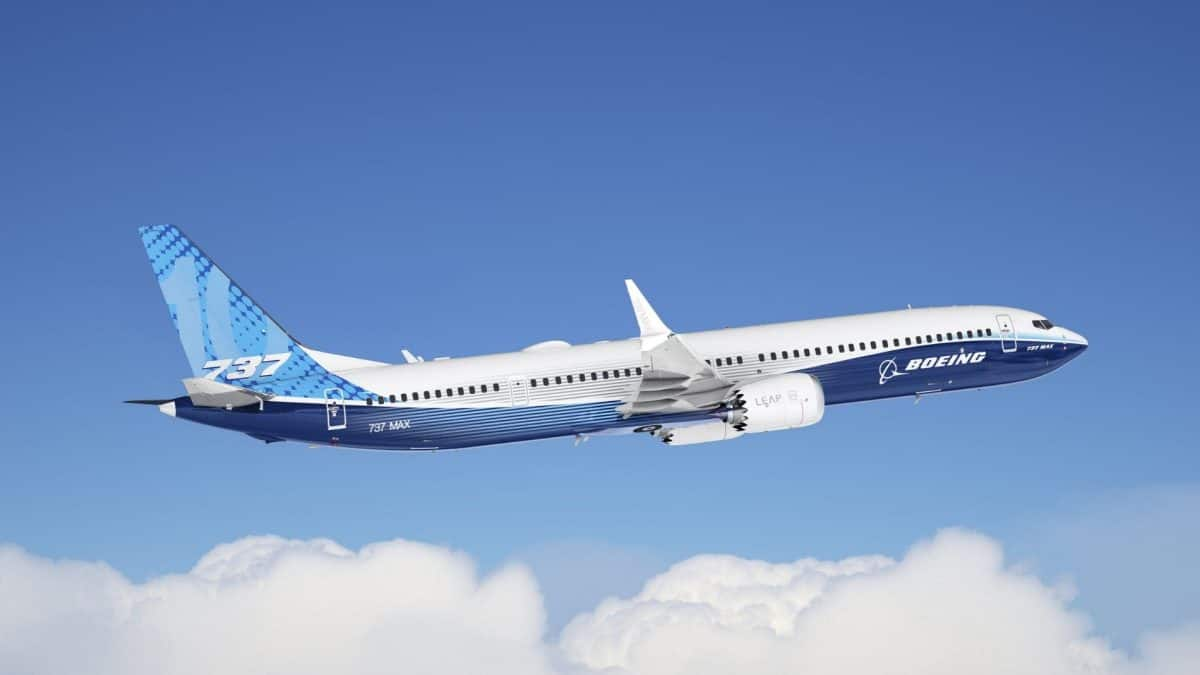
The US FAA certified the Boeing 737-10 last Tuesday, clearing the way for future deliveries. This move helps Akasa Air and Air India Express, as both carriers have this model on order. Indian regulators now use the FAA process to certify these planes, which carry up to 230 passengers each.
Last Tuesday, the US FAA (Federal Aviation Administration) certified the newest and the largest model of the MAX family, the MAX 10 or 737-10, as it is now branded. The certification marks the last of the MAX family aircraft being certified, which saw delays due to various reasons, including two deadly crashes leading to a worldwide grounding in 2019.
The certification now paves the way for deliveries to airline customers, with Canadian WestJet touted to be the launch customer of the type. Boeing has said that it would work with other regulators, including the European regulator EASA, for certification. The Indian regulator, the Directorate General of Civil Aviation, does not create a duplication of the process but relies on the FAA certification programme for Boeing planes (and EASA for Airbus), along with necessary documentation to certify the plane to operate in India. The process can now start in parallel, leading to the delivery of planes to Akasa Air and Air India Express, the two Indian carriers who have this type on order.
How is the 737-10 different?
The 737-10 is the longest in the MAX family with a length of 43.8 metres, while the wingspan remains the same across the family at 35.9 metres. The aircraft is also the heaviest in the family and has the capacity to serve up to 230 passengers in all economy configurations. The additional seating comes at the cost of range, where the type has the smallest of the range amongst the MAX family. However, the published range of over 5000 km is sufficient for all the routes in India on the domestic front and takes care of regional operations as well.
Airlines and lessors have placed orders for 7350 MAX aeroplanes, of which 2500 were delivered until last month, as per Boeing. The 737-10 order book is more than 30 per cent of the unfulfilled MAX orders as per the OEM, indicating that the order book has around 1555 737-10 aircraft.
Good days for Akasa Air and Air India Express?
Both Akasa Air and Air India have the MAX 10 on order. It remains unclear how many seats the airlines have opted for this aircraft type at the moment. A couple of airframes are in the final stages of readiness for the two airlines and could well make their way to India immediately after the DGCA paperwork and certification is complete.
With both airlines constrained on the deliveries front until last year, this is good news on multiple counts. With as many seats, the cost per seat goes down to the minimums amongst the fleet for these two airlines. With the entire domestic network within the range of the type, along with most of the international network as well, the aircraft could potentially be a new tool to take on market leader IndiGo with costs which help compete better.
As costs come under pressure due to a sliding rupee, higher oil prices and pressure on leisure travel, an aircraft with a cheaper cost per seat will help with the savings or lowering of losses. However, an aircraft with higher capacity comes with its own set of challenges, especially when not filled. The cost of the aircraft is typically higher than the others in the same family, and so is the trip cost. The economics work well when the commercial teams can push for more revenue at near-full or full flights, which would require the right deployment of the aircraft on the right routes.
In the Indian context, that could mean the metro routes. However, India also has the Route Dispersal Guidelines, wherein airlines have to mandate flying a certain percentage of the capacity deployed on Metro to Metro routes on routes which fly within North East, Jammu & Kashmir and Ladakh, and to these areas, which often can be non-profitable, especially during off-peak season. Requirements like these often complicate the deployment strategies for the airlines.
Tail Note
The certification of MAX 10 is a welcome relief for Boeing, which has had one of the most challenging times in its history while developing the MAX family. The process is now complete, and it can now focus on enhancements to the entire family, a continuous process for any OEM, and on taking on Airbus with a next-generation aircraft in the middle of the next decade. Boeing would also focus on expanding its production goals and adding more aircraft per month, where it lags drastically against Airbus. As for Akasa Air and Air India Express, the two airlines would be gearing up for the induction and hope that this helps save costs amidst the turbulent environment across the world.
Ameya Joshi is an aviation analyst.