
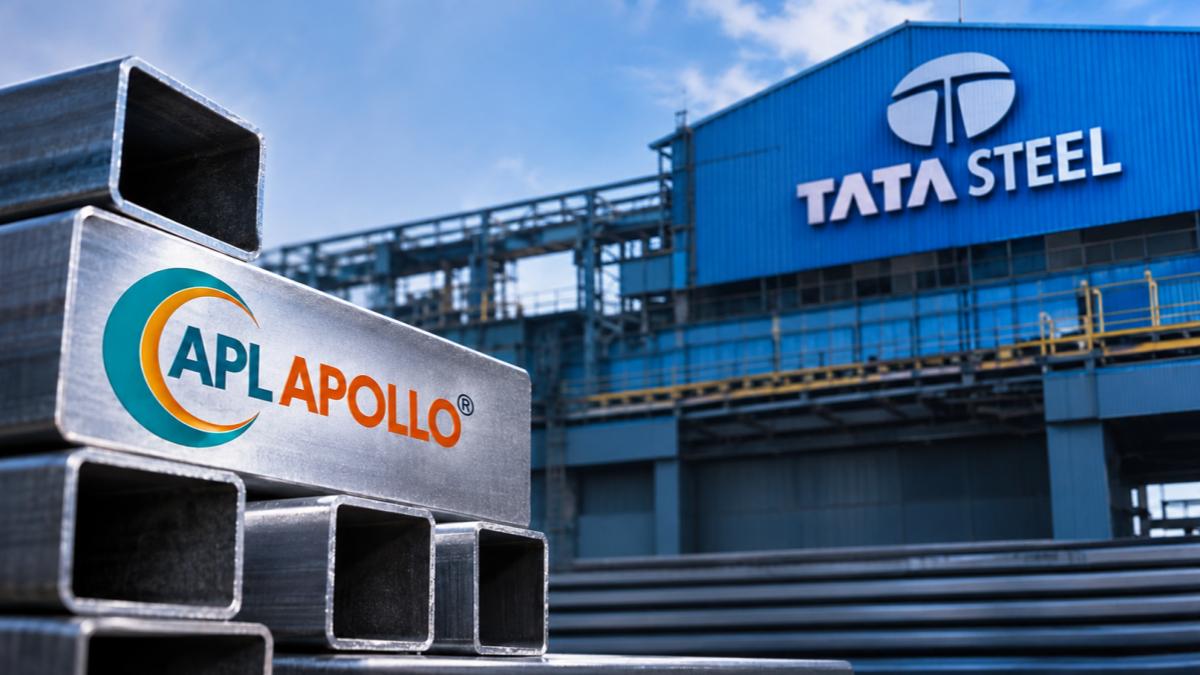
APL Apollo plunged over 21% and Tata Steel fell about 8% on Monday after their ₹28,000-crore deal sparked investor fears. Many questioned the high price tag and debt risks. Investor Vishal Gajwani asked, “What is the rationale for paying five times more than that?” Management said the brand adds value.
The market’s first verdict was bruising as APL Apollo plunged more than 21% and Tata Steel fell about 8% on Monday. Questions on APL’s investor call that evening showed why the Street remains apprehensive.
Investor Bharat Shah questioned the focus on scale. “Because we see that there are firms which may make 10,000 crore EBITDA, but will have a lower value than the firm which makes 5,000 crore EBITDA,” he said during the call.
Two transactions, different payoffs
According to Tata Steel’s announcement, it will buy the promoters’ 26.6% stake in APL for ₹15,510 crore at ₹2,100 a share, alongside an open offer for another 26% at ₹2,301.40. Separately, APL will pay ₹28,000 crore for Tata’s tubes and colour-coated businesses, initially using acquisition financing.
For continuing shareholders, the higher open-offer price offers only partial reassurance. The offer covers a limited number of shares; acceptance cannot be assumed for every share tendered. Shares retained remain exposed to the enlarged company’s financing and execution risks.
Tata investors also have a stake in APL’s borrowing: acquisition debt could enter Tata’s consolidated accounts, as analysts told Reuters.
Axis Capital’s Amit Murarka asked on the call why Tata could not transfer the businesses in exchange for newly issued APL shares. APL Apollo Tubes Chief Strategy Officer Anubhav Gupta responded, “So, Amit, we will take this offline. There are a lot of issues that I will explain to you after this call.”
That left the rationale for choosing this structure incompletely explained to the wider investor audience.
Tata Steel- APL Apollo deal: Price tag that needs defending
The ₹28,000-crore purchase comprises ₹11,700 crore for tubes and ₹16,300 crore for colour-coated operations. The latter prompted particularly pointed questions.
Asked what building comparable colour-coated capacity would cost, APL chairman Sanjay Gupta estimated ₹2,500-3,000 crore and two to three years. Investor Vishal Gajwani then asked, “What is the rationale for paying five times more than that?”
The management’s defence was that a functioning business brings more than machinery. Anubhav Gupta cited land, Tata’s brand, pricing power and an established distribution network, arguing that building capacity and establishing a successful business require different timelines.
The comparison, therefore, has limits: greenfield construction costs do not capture an established franchise’s full value. Even so, the premium needs to earn its keep.
Using management’s estimated annualised EBITDA of ₹1,150-1,200 crore for the acquired businesses, the purchase price works out to roughly 23-24 times operating earnings. That calculation makes delivery on promised growth and synergies particularly important.
Tata Steel- APL Apollo deal: Debt first, dilution details later
Apollo management outlined a plan to reduce acquisition debt by about ₹18,000 crore within 12 months, largely through equity infusion alongside operating cash flows and make APL debt-free within three years.
For shareholders, however, replacing borrowing with equity creates another question: at what price will new shares be issued and how much will existing ownership shrink?
During the analyst call, CLSA’s Indrajit Agarwal pressed management on whether a future equity issue would be priced at the prevailing valuation rather than the transaction price. Anubhav Gupta replied, “It will be friendly to minority shareholders.”
That assurance leaves the arithmetic open. A lower issue price would require more shares to raise the same amount. The eventual effect on earnings per share will depend on the issue’s terms and the acquired businesses’ performance.
Accounting also remains unsettled. Management estimated roughly ₹24,000 crore of goodwill but deferred a detailed answer when HDFC Securities’ Rajesh Ravi questioned its treatment. Investors still need clarity on the resulting balance sheet and return ratios.
Who drives the next chapter?
Investors also questioned whether Sanjay Gupta would continue running APL. Asked by Pictet’s Prashant Kothari about remaining CEO, Gupta said, “I am not managing the business”, while indicating he would help achieve its targets. His future designation remained unclear.
There is another relationship to assess. Tata’s announcement includes an arrangement with promoter-associated SG Tech Engineering to develop five million tonnes of colour-coated capacity through contract manufacturing. Investors will need to distinguish capacity owned by APL from outsourced production and understand how earnings are shared.
On the call, Bharat Shah challenged the emphasis on reaching ₹10,000 crore EBITDA and said, “But in reality, the existence of the company is for optimizing the value of the firm.”
That captures the hurdle facing management. A larger business can be attractive, but shareholders still need evidence that its financing, valuation and leadership will improve the value of each share.
Market veterans question Tata Steel- APL Apollo deal
Speaking on the payment and the way the deal was executed, Samir Arora, Founder and Fund Manager at Helios Capital Management pointed out on a post in social media platform X that, “Can a promoter commit his company to a significant transaction while simultaneously selling all his shares at the same time?
This way the promoter can get a better price for himself in return for committing his company to an unfavourable transaction.”
Another well-respected voice in the market, Deepal Shenoy posted on X that “Mergers are always complex, but man once in a while you find one that doesn’t seem to benefit anyone except an exiting promoter.”
N Jayakumar, MD & Group CEO, Prime Securities posted on X that, “After four decades of being in the investment banking space, am a seeing a deal that’s so universally panned and slaughtered like this apology of a governance package, called the Tata Steel APL deal! It’s so patently arbitrary and positively hostile to shareholder interest.”
Pointing to the sharp losses that the share price of both companies saw in Monday’s trade, he further pointed out in his X post that “both stocks got taken to the cleaners, an almost unthinkable outcome of corporate rejigging- valuations be damned, this deal lacks even a scintilla of common sense; clouded in complication and complexity, randomly valued assets and a debt-laden group.”
What lies ahead
Most brokerage houses stay cautious. As JM Financial highlighted “, the proposed change in ownership and potential exit of the existing promoters, whose execution capabilities have supported APL’s premium valuation, warrant a reassessment of its valuation multiple.”