
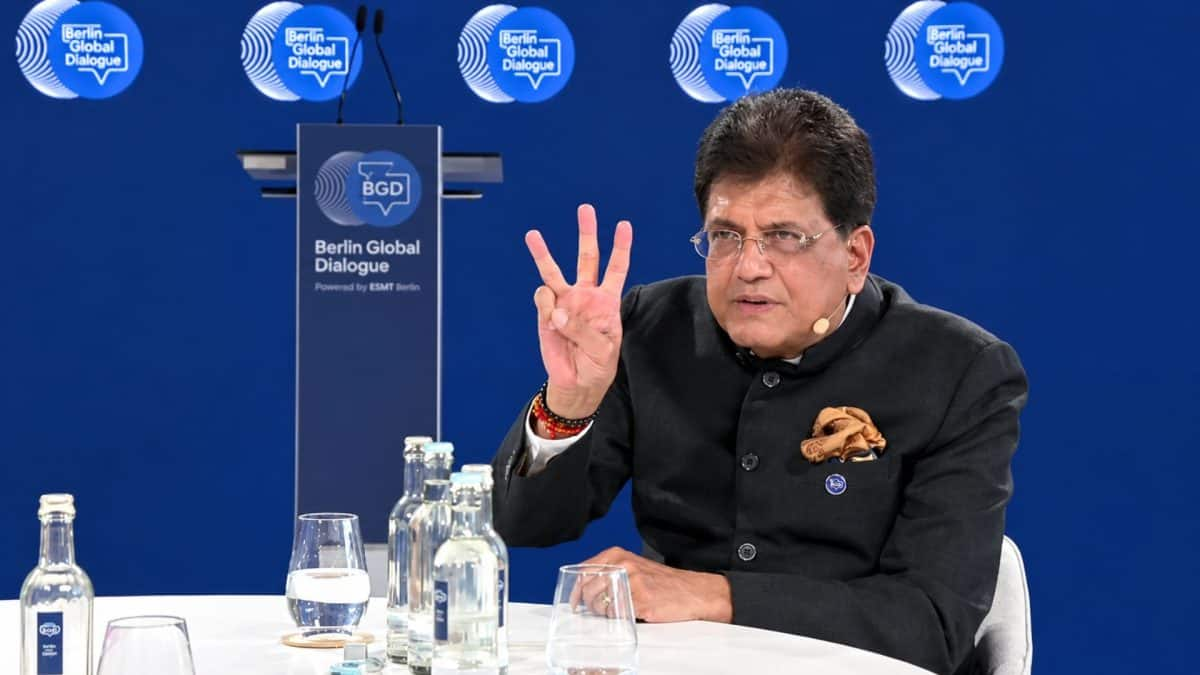
India’s Commerce and Industry Minister Piyush Goyal criticised developed nations for failing to provide climate finance. Speaking at the Berlin Global Dialogue, he said, “Eleven years later, we haven't seen a nickel or a dime of that. It's all promises.” He argued that wealthy countries must support developing economies more effectively.
India’s Commerce and Industry Minister Piyush Goyal has criticised developed countries for failing to deliver on their climate finance commitments, arguing that nations responsible for a larger share of historical carbon emissions must do more to help developing economies tackle climate change.
Speaking at the Berlin Global Dialogue, Goyal said wealthy nations had yet to provide adequate financial support and access to clean technology to developing countries, even as they continued to face pressure to reduce emissions while meeting the basic needs of their populations.
“Who's responsible for this mess in the first place? Where did the ozone layer get damaged? Who sent all that carbon into the atmosphere?” Goyal asked, pointing to the environmental impact of decades of industrialisation in developed economies.
Goyal questions unfulfilled climate finance promises
Goyal criticised developed countries for falling short of their commitment to provide $100 billion annually in climate finance to developing nations. The pledge was made in 2009 and reiterated in subsequent climate negotiations, including the 2015 Paris Climate Conference.
“Eleven years later, we haven't seen a nickel or a dime of that. It's all promises,” Goyal said, accusing wealthy nations of failing to provide the financial assistance and technology-sharing support needed to help developing economies transition to cleaner energy.
He argued that developing countries were being asked to shoulder a disproportionate share of the costs of addressing climate change while also working to reduce poverty, improve living standards and meet growing energy demand.
Goyal also criticised unilateral trade measures such as the European Union's Carbon Border Adjustment Mechanism (CBAM). The mechanism imposes a carbon-related cost on certain imports into the EU, with the stated aim of addressing emissions associated with carbon-intensive goods.
Goyal described such measures as protectionist, arguing that carbon-related trade restrictions do little to address the financial and technological challenges faced by developing countries as they move towards cleaner energy.
India’s emissions and development needs in focus
Goyal also spoke about the imbalance between India's contribution to historical emissions and the pressure it faces to address the climate crisis.
India accounts for roughly 17 per cent of the world's population but contributes less than 3 per cent of historical cumulative carbon emissions, he said.
By contrast, Goyal argued, European countries account for only a small share of the global population while their per-capita carbon emissions remain several times higher than India's.
He said India had to balance climate action with the need to provide energy, food and security for its large population.
“I have to meet their energy needs, their food needs, and ensure that my nation remains secure,” Goyal said. “Despite all of that, we have one of the world's fastest-growing clean energy programmes”.
Goyal argued that countries responsible for a larger share of historical emissions must do more to tackle climate change. He said developing nations should not have to sacrifice economic growth to fix a crisis largely driven by decades of industrialisation in wealthier countries.
He called on developed nations to back their climate promises with real money, investments and access to clean technology. Goyal also warned that carbon-related trade measures could raise costs for exporters in developing countries. He said climate action must be fair and ensure that emerging economies get the support they need to shift to cleaner energy without widening the gap between rich and poor nations.