
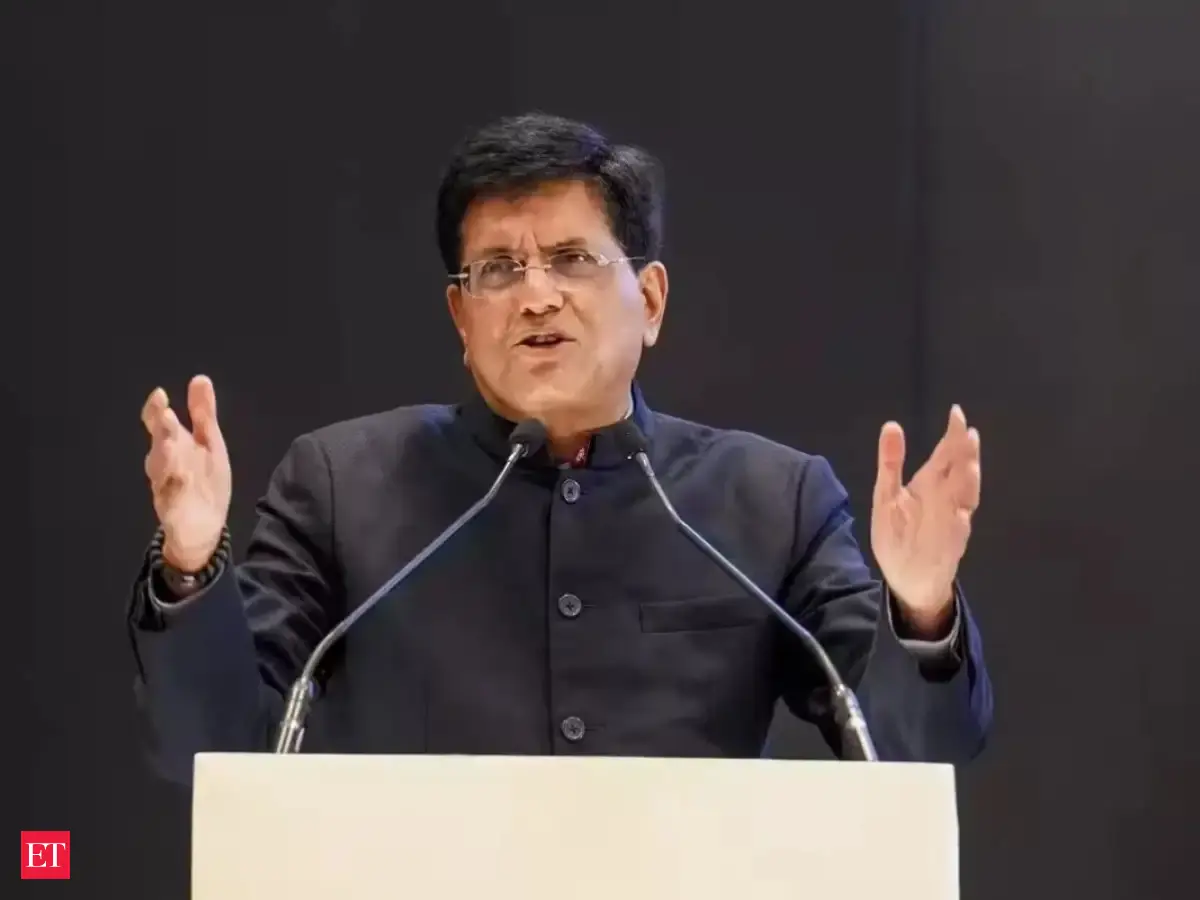
Commerce and Industry Minister Piyush Goyal said on Wednesday that India is working to develop relations with China once again. Bilateral trade reached USD 127.7 billion in 2025-26, but the trade deficit remains a concern. Goyal noted, "We are open to all countries as long as we get a fair deal."
Synopsis
Commerce and Industry Minister Piyush Goyal stated that India seeks to improve relations with China, ensuring fair deals. Bilateral trade between India and China reached USD 127.7 billion, which reflects significant growth in exports and imports. Furthermore, Goyal expressed concerns regarding the widening trade deficit and tightened FDI policies due to geopolitical tensions. India experienced supply chain vulnerabilities during Covid, leading to a focus on self-sufficiency.
New Delhi: Commerce and Industry Minister Piyush Goyal on Wednesday said India is working to rebuild its relations with China, but the last word has not yet been scripted on this journey.
He also said India is open for joint ventures with any country, provided it gets a fair deal.
"We are open to all countries around the world as long as we get a fair deal, as long as we ensure a continuity in the engagement, and as long as the geopolitical situation does not deteriorate. I think we had some concerns in the past. We are working to develop relations with China once again, but the last word has not yet been scripted on this journey," he said.
He was speaking at the Bloomberg New Economy event.
The remarks are important as China is India's second-largest trading partner. Bilateral trade between the two countries rose 7.9 per cent in 2025-26 to USD 127.7 billion from USD 118.39 billion in 2024-25.
Live Events
India's exports to China grew 36.62 per cent to USD 19.47 billion in 2025-26 from USD 14.25 billion a year ago. Imports, on the other hand, rose 16 per cent to USD 131.62 billion during the period. The trade deficit widened to USD 99.19 billion in the last fiscal from USD 85 billion in 2024-25. This is an area of concern for the country.
There are also issues related to investments from China as India has tightened its FDI policy for countries sharing land borders with it.
Prime Minister Narendra Modi met with Xi Jinping, President of China, on September 12, 2026, on the sidelines of the BRICS Summit here.
Talking about the current geopolitical challenges, Goyal said "Everybody has recognised the importance of friends, and that's going to be the most important critical element in the years to come".
Recalling the Covid period, the minister said India focused on self-sufficiency after a number of countries declined to supply essential items.
While India provided food grains and vaccines to over 100 countries during Covid, "we found that most countries let us down very badly," he said.
"During Covid, we really recognised the vulnerabilities that a nation like India, a large nation of 1.4 billion people, had to go through when supply chains were broken. We did not get adequate material for meeting our needs during Covid. Wherever we had placed orders for personal protective equipment or Covid kits or vaccines, we were let down miserably by all countries," he added.
Goyal further said, "When we needed Pfizer and Moderna vaccines, the West refused to give it to us... They even refused to make an application to get the vaccine into the Indian market, even though we were willing to waive all the conditions. So, it's a global phenomenon."
In response to that experience, Prime Minister Narendra Modi "gave the clarion call for Atmanirbhar Bharat (self-reliant India)," Goyal said.
Speaking at the Forum, Singapore's Deputy Prime Minister and Minister for Energy, Trade and Industry Gan Kim Yong said Singapore and India are in talks to strengthen the semi-conductor industry in India.
"We are also working on training and skilling of the Indian workforce so that we can support the growth of semiconductors," he added.
India and Singapore trade pact came into force in 2005.
(You can now subscribe to our Economic Times WhatsApp channel)
Onion inflation at 108%? Yes, but not really. What is different this time?
Curbing rupee bets: What the RBI’s new rules mean for the hedge-now-or-wait question
Brinjal, buffalo, bacteria: Inside India’s pay-for-nature system
Homebuyers wait as NCLT panel picks holes in unfinished Jaypee projects
The NBFC saga - Part 3: How one default in 2018 changed the way RBI reads risk
Four rules made HDFC Bank a compounder. All four have stopped. Can the new CEO rewrite them?