
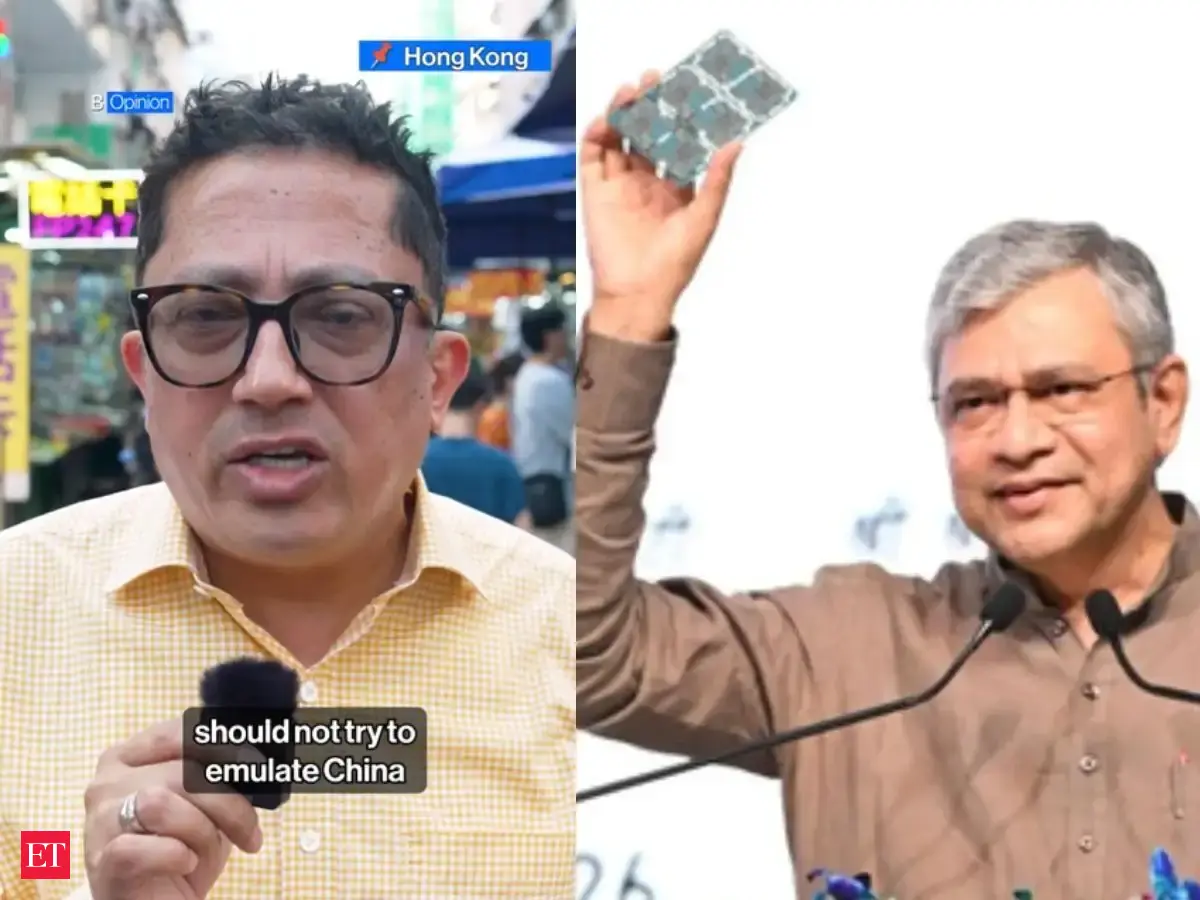
Union Minister Ashwini Vaishnaw defended India’s mobile manufacturing strategy against critics by citing strong economic returns. He noted the government paid Rs 19,000 crore in incentives but collected Rs 25,000 crore in direct taxes. With Rs 3 lakh crore in GST and 25 lakh jobs created, he told critics to "Cope harder."
Synopsis
Union Minister Ashwini Vaishnaw has hit back at criticism of India's mobile phone manufacturing strategy with a blunt “Cope harder” remark. Citing figures from the government's Production Linked Incentive (PLI) scheme, he said the government paid Rs 19,000 crore in incentives and collected Rs 25,000 crore in direct taxes, alongside Rs 3 lakh crore in GST. His response followed a Bloomberg Opinion video questioning India's iPhone manufacturing model, its dependence on imported components and the cost of government subsidies.
Union Electronics and IT Minister Ashwini Vaishnaw has hit back at critics questioning India's mobile manufacturing strategy, using government figures on tax collections and employment to defend the country's push to become a major electronics production hub. In a post on X, Vaishnaw cited the returns generated by the government's Production Linked Incentive (PLI) scheme for mobile manufacturing. He said the government had paid Rs 19,000 crore in incentives, while direct tax collections had reached Rs 25,000 crore. The sector has also generated Rs 3 lakh crore in GST collections, according to the figures shared in the post.
The minister ended his response with a sharp message for critics: "Cope harder!!"
His remarks came in response to a Bloomberg Opinion video that questioned the success of India's iPhone manufacturing push, including the country's dependence on imported components and the cost of government subsidies.
Ashwini Vaishnaw cites tax collections and jobs
Vaishnaw's response focused on two key outcomes of the manufacturing push: revenue for the government and employment. According to the minister, electronics manufacturing now employs 25 lakh people in India, with mobile phone manufacturing accounting for 12 lakh jobs.
Live Events
You Might Also Like:
Harsh Goenka says Indians' long working hours give country an edge over Europe, Ashneer Grover says it's 'majboori'
The figures form a key part of the government's argument that incentives for manufacturers can generate economic returns beyond the initial public expenditure. The direct tax collections cited by Vaishnaw alone exceed the Rs 19,000 crore paid out under the mobile PLI scheme.
India's growing role in iPhone manufacturing
India has emerged as an increasingly important production base for Apple and its manufacturing partners as companies look to diversify supply chains. The country has expanded its role in assembling iPhones for global markets, while electronics exports have increased significantly over the past decade. The government's incentive programmes have sought to attract manufacturers, encourage investment and create jobs in a sector long dominated by production hubs such as China.
But the debate over India's manufacturing success goes beyond the number of phones assembled in the country.
Critics have questioned how much value India retains when key components are imported from other countries. Assembly creates employment and supports exports, but producing more components locally could help Indian suppliers capture a larger share of the value generated by each device. That distinction is important as India attempts to move from being primarily an assembly destination to a more comprehensive electronics manufacturing ecosystem.
Government plans Rs 62,500 crore mobile manufacturing scheme
The government is preparing to continue its push through the Mobile Phone Manufacturing Scheme (MPMS), which received Cabinet approval in July with a budgetary outlay of Rs 62,500 crore.The scheme will run from financial year 2026-27 to 2030-31. It aims to increase production, deepen domestic value addition, strengthen supply chains and improve India's competitiveness in global markets.
The programme provides incentives ranging from 2.25% to 5% on eligible mobile phone sales. Manufacturers can also qualify for an additional incentive of up to 1.5% linked to domestic sourcing of key components and sub-assemblies. The scheme also seeks to support Indian mobile phone brands, including through incentives connected to design and research and development.
According to the Ministry of Electronics and Information Technology, cumulative mobile phone production during the scheme's tenure is projected to reach around Rs 39 lakh crore. The programme is also expected to generate approximately 60,000 direct jobs. The new initiative follows the end of the Production Linked Incentive Scheme for Large Scale Electronics Manufacturing on March 31, 2026.
Can India move beyond assembling phones?
Vaishnaw's post puts the government's tax and employment figures at the centre of the debate over manufacturing incentives. The numbers offer a strong argument for the scale of activity generated by the sector, particularly when direct tax collections are compared with incentive payments. The next challenge, however, is to build on that growth.
Increasing domestic production of components, bringing more suppliers into India and strengthening local research and design capabilities will be important if the country wants to capture a larger share of the global electronics supply chain.
For now, the government is betting that continued incentives will help India expand its manufacturing base. Whether that investment delivers lasting gains will depend not just on how many phones are made in the country, but also on how much of their value is created within India.
(Inputs from ANI)
(You can now subscribe to our Economic Times WhatsApp channel)
KYC and KYB: Inside Damani’s DMart, the retail chain for the middle class. And stock for the long term? – Part 2 of 3
Will it be a regulatory nightmare if an exchange lists on its own platform?
KYC and KYB: Inside Damani’s Avenue Supermarts that refuses to charge more – Part 1 of 3
Will oil turn into a lingering problem? Is the world economy, India, or the market prepared?
KYB and KYC: Business behind the wealth creator called ‘Divi’s Lab’ – Part 2, concluding