
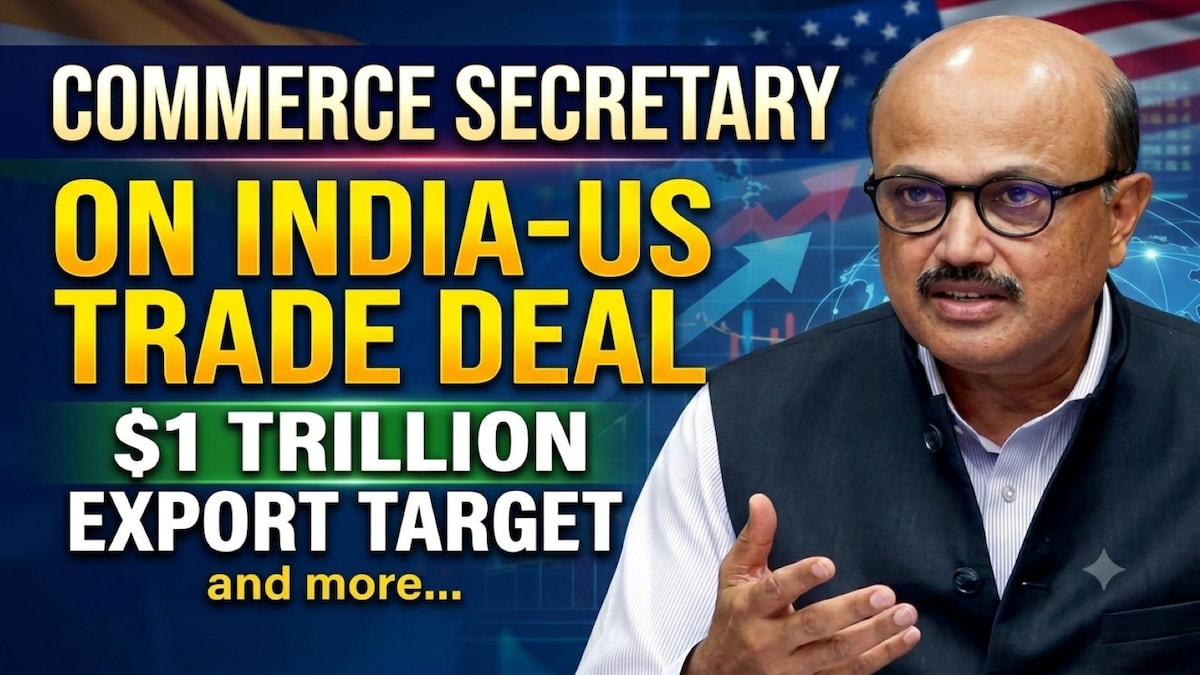
Commerce Secretary Rajesh Agrawal said on Wednesday that the India-US trade deal will take time to sign. Negotiations are nearing conclusion, but the US must first set its new tariff architecture. Agrawal noted, “Every aspect of the deal has been more or less finalised, and we will conclude soon.”
The signing of the India-US trade deal will take some time, but negotiations are nearing conclusion, with nearly every aspect of the agreement finalised, Commerce Secretary Rajesh Agrawal said on Wednesday. He indicated that the signing would depend on the United States putting its new tariff architecture in place and the ongoing Section 301 investigations reaching maturity.
Speaking at a panel discussion titled India’s Next Leap: Reforms, Competitiveness and Growth, Agrawal said the legal agreement was in its final stages, but uncertainty around the US tariff framework remained a key factor.
I think this is a deal which was announced in February. The contours of the framework deal have already been announced as part of the joint statement. The legal agreement has also been negotiated and is now in the final stages. It will be concluded soonHE SAID
Explaining why the signing could take longer, Agrawal said the deal had been announced against the backdrop of an executive tariff regime that has since been struck down by the US Supreme Court.
The United States is working on a new tariff architecture. Until that is in place, countries will not be able to sign the deal, as it will provide different kinds of comparative advantages to different countriesHE SAID
He also pointed to the ongoing Section 301 investigations, which are expected to come to the fore over the next few weeks or months.
There are certain Section 301 investigations already underway, which will come to the fore over the next few weeks or months. Every country would like to have a deal that provides certainty around these ongoing investigationsAGRAWAL ADDED
However, he reiterated that the negotiations themselves were close to completion.
“But as our minister has been saying, we are now very close to concluding the negotiations. Every aspect of the deal has been more or less finalised, and we will conclude the negotiations soon,” he said.
India on track to hit $1 trillion exports this year
On India's export performance, Agrawal said the country had continued to grow despite challenging global trade conditions, geopolitical tensions and slowing demand in some of its key markets.
Today we are growing by more than 16.6% in first seven months of this financial year, and our growth in terms of rupee is around 25%, which is phenomenalHE SAID
He added that India was seeing growth in newer markets, including Africa, Latin America and ASEAN, even as demand slowed in Europe and the US. Exports to ASEAN, he said, were growing by 50% this year.
Agrawal also said India was on track to achieve its target of $1 trillion in exports this financial year.
As our minister has pointed out, our target is to achieve $1 trillion in exports this year, and we are focused on it. I think we are on trackHE ADDED
India-EU FTA operationalisation targeted for first half of 2027
On the India-European Union free trade agreement, Agrawal said the government is aiming to operationalise the pact in the first half of the next calendar year, with the first quarter being the target.
We can't give a definite timeline, but I can assure you it will be in the first half of next calendar year, we are trying for the first quarter itselfHE SAID
He also expressed confidence that the agreements being negotiated and operationalised with countries that are major sources of foreign investment could help attract more capital into India.
“With these FTAs getting operationalised with EU or with UK, I see a lot of investment decisions being made from those companies,” he said.
Electronics exports could cross $60 billion
Agrawal described electronics as a major success story for India over the past decade, saying the country was already crossing $150 billion in electronic production.
He said the growth in exports was no longer limited to smartphones, with non-smartphone electronics exports also gaining traction.
This year the bigger growth has come in non-smartphone exports, and that is a big story because when you look at the non-smartphone portfolio, it is a much wider portfolioHE SAID
Agrawal added that the expansion of non-smartphone exports, including to FTA partner markets, pointed to greater value addition in domestic manufacturing.
“This year we are hoping to cross $60 billion dollars in exports itself from electronics,” he said.