
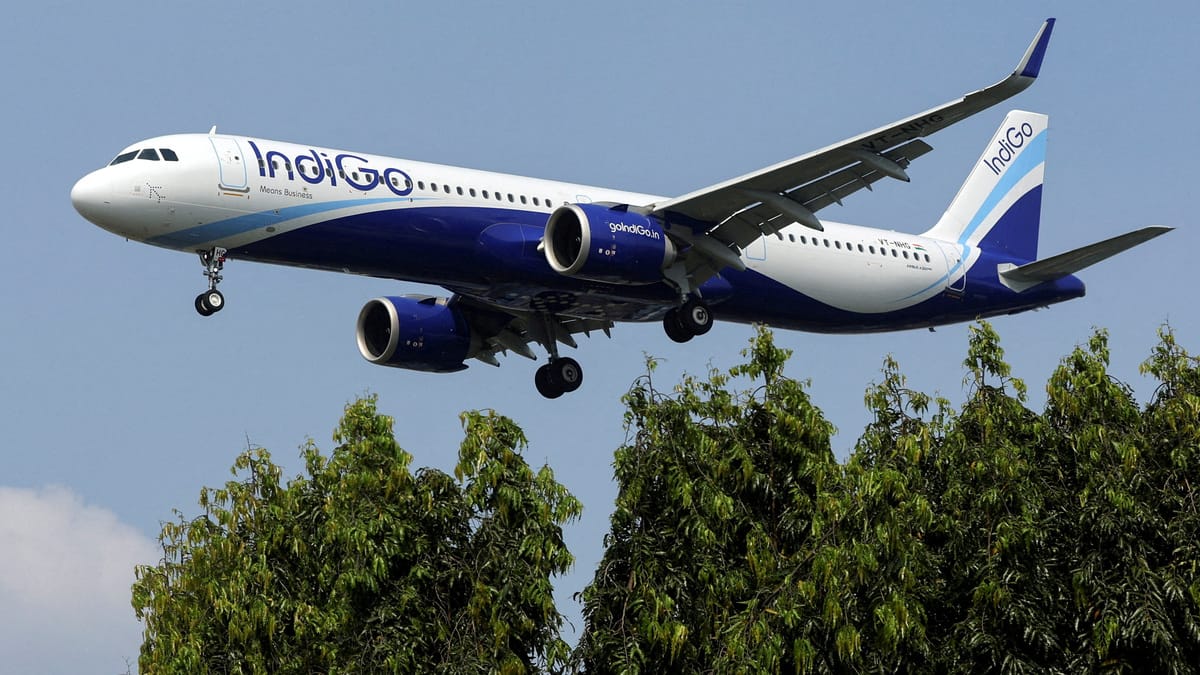
IndiGoStretch completed two years of operations over the weekend as the airline expanded its premium travel strategy. While the carrier initially planned to focus on domestic metro routes, it shifted focus and started deploying aircraft on international routes. Now, the product covers 36 international routes and many domestic leisure destinations.
IndiGoStretch turns two, expands international footprint as the airline sharpens its premium travel strategy.
IndiGoStretch, the business class product of the once low-cost carrier IndiGo, completed two years of operations over the weekend. Taking off between Delhi and Mumbai, the airline planned 45 planes with dual class to be inducted by the end of December last year and covering 12 metro routes within the country. The airline had a change of heart midway and started deploying the aircraft on international routes.
A detailed analysis of the network shows that the airline is deploying 488 weekly departures with dual-class operations on international routes, which includes the dual-class XLR aircraft, which are currently deployed to Amsterdam, Istanbul and Athens. The international deployment comprises 20.3 per cent of total departures, while 79.7 per cent, or 1911 weekly departures, are deployed on domestic routes.
The airline operates the Stretch product on 24 routes in India but hasn't covered all the metro routes. Instead, the airline has expanded to leisure routes like Delhi - Goa, serving both airports in Goa from Delhi with the Stretch product, while adding routes like Delhi - Pune to the list.
Amongst the metros, Delhi is connected to Mumbai, Bengaluru, Hyderabad, Chennai, Kolkata, Pune and the two airports in Goa. Mumbai is connected to Delhi, Kolkata, Hyderabad, Chennai and Bengaluru. The four metros, Bengaluru, Hyderabad, Chennai and Kolkata, are not connected to each other with the Stretch product but only to Delhi and Mumbai, the capital and financial capital of the country.
On the international side, the stretch is much bigger, literally and figuratively. IndiGoStretch is available across 36 routes, with Singapore offering 56 weekly flights, followed by Dubai offering 49 weekly flights to India with the dual-class product. Bangkok and Phuket follow with 42 and 28 weekly frequencies each. Istanbul, Amsterdam and Athens feature the XLR product as part of A321XLR deployment. The aircraft with Stretch offering have slightly different economy class seats as well, with charging ports available, unlike other IndiGo aircraft.
Are Indians paying more when on holiday?
IndiGo had its focus set on 12 domestic routes amongst the metro's for the Stretch product when it made the initial announcement. IndiGo's Stretch announcement came at a time when Vistara merged with Air India, and Air India converted its dual-class A320s to a three-class offering, similar to that of Vistara. IndiGo, on the other hand, went from mono class to dual class, introducing a small sub-fleet. At 65 planes, IndiGo would have about 14% of its fleet being dual class. The number is slightly higher when considering the operational planes since the airline continues to face groundings for some of its fleet.
The average length of routes on the international side where the Stretch product is available is more than twice that of the average length of routes on the domestic side where the Stretch product is available. It is possibly an indicator of the passengers finding more value from the business class product on longer routes, at not frequented airports, rather than on the domestic legs, though data specific to occupancy in cabin class remains private with the airline. The airline will add another route, that from Mumbai to Male starting in December, to the Stretch offering.
The internal routes see a mix of leisure and business traffic on most routes, unlike very specific business routes in the domestic markets. The availability of pre-set meals and not the pre-booked sandwiches as part of the Stretch offering could also play a part on the selection on the international routes.
Tail Note
IndiGoStretch is now offered on 15 per cent of flights, but as a capacity, it is still less than 1 per cent of the total seats on offer by IndiGo across its network. IndiGo, over the last few years, focused on adding interline and codeshare arrangements with multiple partners to carry traffic beyond the major airports to other airports in India. The mismatch in class of service could be an issue for some passengers who would want to travel to their final destination in the same class as what they flew in on a long-haul flight.
The arrival of Stretch+ is the most telling change in the product. The 2024 offer was all about the seat, the meal and priority. The 2026 offer adds what corporate travel desks actually care about, flexibility, baggage and lounge access. That is the classic fare-family approach of full-service carriers, applied to a two-cabin narrow-body. It shows that IndiGo has learned what makes a business traveller come back: the experience on the ground and the freedom to change plans matter as much as the seat.
Even the positioning has shifted. The early entry was about redefining business class in India. In 2026, it is about broadening the offering while staying true to affordability and reliability, with disruption giving way to consolidation. The airline has a strong balance sheet to absorb the initial cost needed to commoditise the offering. The airline offers 232 seats in all economy class A321neo, only 12 less than what it offers in the dual-class product. Essentially all it needs is a stretch seat to sell at double the average economy fare to justify the decision. When the fact that loads are never full is added in, the Stretch product suddenly looks like it is occupying a sweet spot for the airline.