
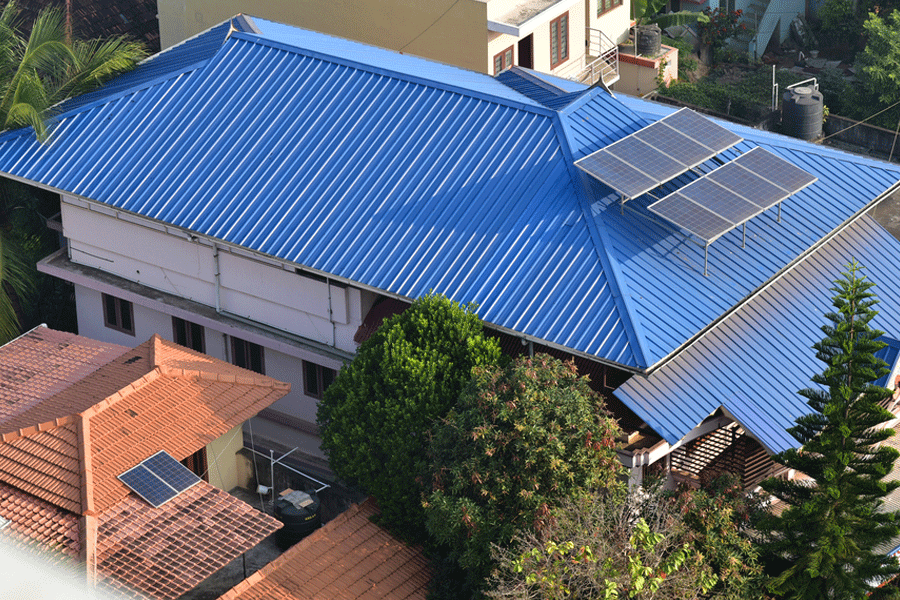
Tata Power plans Rs 2,500-crore solar investments in West Bengal, targeting 3 lakh homes over three years. CEO Praveer Sinha aims to boost rooftop solar adoption. Sanjay Banga said, "West Bengal should also come up with some state subsidy," to make these installations more affordable for many low-income households today.
Tata Power CEO Praveer Sinha says the company was targeting rooftop solar installations in 3 lakh homes in the state over the next three years, banking on higher adoption potential
Tata Power has urged the Bengal government to offer additional subsidies for rooftop solar installations to boost adoption under the Centre's PM Surya Ghar Muft Bijli Yojana, while exploring investments of around Rs 2,500 crore in solar projects across the state.
Sanjay Banga, CEO and managing director of Tata Power Renewable Energy Ltd, said a state incentive similar to those offered by Odisha, Bihar and Assam on top of the Centre's subsidy could make rooftop solar installations more affordable, particularly for low-income households.
Tata Power has installed around 6,000 rooftop solar systems in Bengal out of nearly 22,000 households covered under the programme in the state so far, according to company data.
"West Bengal should also come up with some state subsidy, similar to what is available in Odisha, Bihar and Assam, ranging from Rs 15,000 to Rs 25,000 per project, so that rooftop solar adoption in the state increases exponentially," Banga said at the launch of the company's Ghar Ghar Solar and storage battery solution in Kolkata ahead of the Durga Puja celebrations.
He said the upfront cost remained a major hurdle for households despite central assistance under the scheme.
For 1-kW rooftop solar installation, the Centre provides a subsidy of Rs 30,000, and it goes up to Rs 78000 for 3-kW, he said.
Banga suggested that the state consider additional incentives, particularly for smaller 1-2 kW rooftop solar systems, to bring more low-income households into the programme.
He added that rooftop solar adoption in the state remained among the lowest in the country.
Tata Power on Thursday also announced plans to promote aggressively the zero-down-payment scheme for residential solar projects in partnership with a panel of banks.
Meanwhile, Tata Power CEO and Managing Director Praveer Sinha said the company was targeting rooftop solar installations in 3 lakh homes in the state over the next three years, banking on higher adoption potential.
The company sees scope for a sharp rise in installations, citing the trend in Odisha, where rooftop solar installations have increased to around 30,000 per month, despite the state having a population of around 4.5 crore, while the population is more than 10 crore in West Bengal, he said.
Sinha said the company was exploring multiple solar power plant projects in the state with a combined capacity of around 500 MW, entailing an investment of around Rs 2,500 crore.
He said land availability remained a challenge in the state and that the company had approached the government for land. "The projects are at a very preliminary stage. We are identifying land. The state government has given us three-four locations. We have to go and see the viability of these locations," he told reporters.
The projects could be spread across multiple locations depending on land availability rather than being concentrated at a single site, he said.
Banga also suggested that the state identify non-agricultural land for solar parks, develop the required infrastructure and invite renewable energy developers to set up projects.
Under the proposed arrangement, the state government could develop the parks, while private companies install solar generation facilities and supply electricity to the West Bengal State Electricity Distribution Company Ltd (WBSEDCL) under long-term power purchase agreements.
Banga estimated that electricity generated by such projects could be supplied at around Rs 3 per unit, compared with WBSEDCL's current average power procurement cost of Rs 4-5 per unit.
He said Tata Power Renewable Energy would be keen to participate if the state provided suitable land and connectivity, citing similar approaches adopted by Rajasthan and Karnataka.