
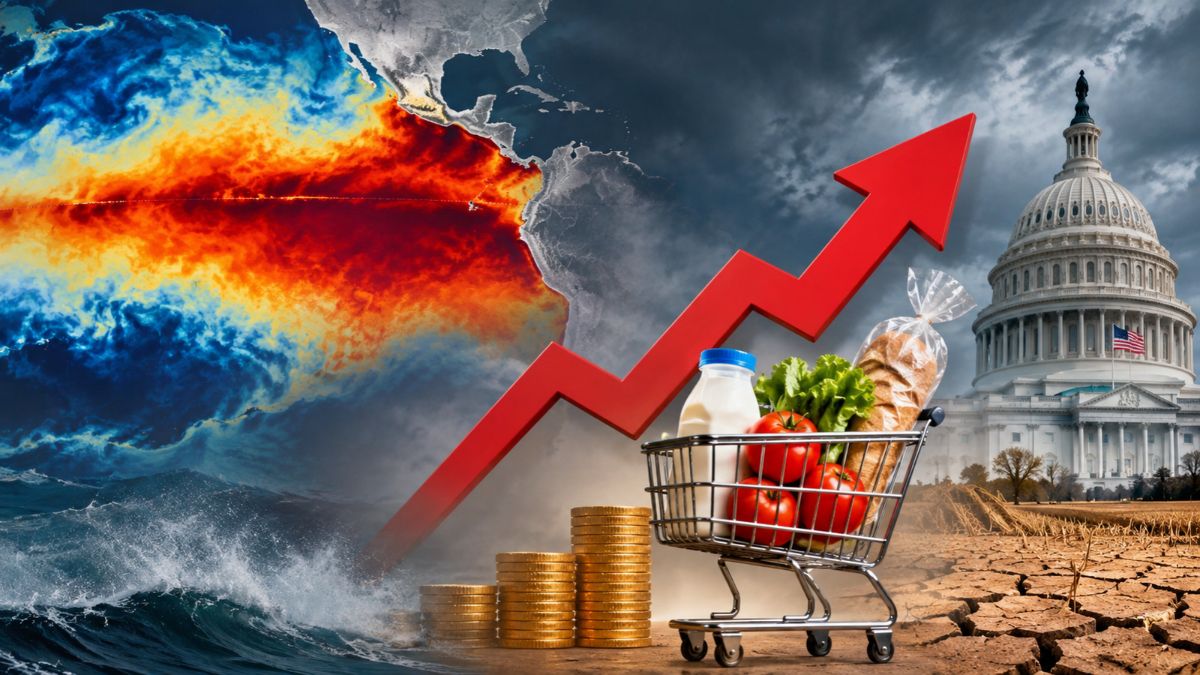
Researchers Molly Ardren, Toby Graf and Brigitte Roth Tran said the current El Nino poses a “meaningful risk” of higher inflation next year. The study showed that while jobs might get a boost, the weather pattern could push prices up. These findings depend on whether a La Nina follows later.
Researchers Molly Ardren, Toby Graf and Brigitte Roth Tran said the current episode poses a “meaningful risk” of higher inflation next year. However, they stressed that the estimates are not a definite forecast and depend partly on whether the current El Nino is followed by a La Nina weather pattern in 2027. The findings come at a time when the US Federal Reserve is dealing with inflation that has remained above its 2% target for more than five-and-a-half years, following several economic shocks.
How El Nino affects the US economy
El Nino is a weather phenomenon that occurs when trade winds over the Pacific Ocean weaken. These winds normally move warm water from the eastern Pacific towards the west. When they weaken, the eastern Pacific becomes warmer than usual, changing weather patterns across several parts of the world. In the US, El Nino years are generally associated with fewer hurricanes in the Atlantic, increased winter rainfall across the southern parts of the country and warmer winters in northern states.
Strong El Nino episodes usually reach their peak in late autumn or early winter. They are also followed by La Nina, a weather pattern in which Pacific trade winds strengthen and shift the jet stream north. The San Francisco Fed researchers said the current El Nino is a very strong episode, raising concerns about its potential impact on prices and economic activity.
The World Meteorological Organization had also projected that the current El Nino could become one of the strongest on record, potentially bringing drought to some regions, flooding to others and higher temperatures across several parts of the world.
Why inflation could rise in 2027
The Fed researchers examined historical economic and weather data to understand how previous El Nino episodes affected the US economy. Their analysis covered 22 El Nino events dating back to the 1950s. The study found that El Nino episodes have historically pushed prices up temporarily during the first summer of the weather event. This increase generally reverses by the following January.
Applying their historical estimates to the current episode, the researchers found that El Nino may have raised the US personal consumption expenditures (PCE) price index by around 0.3 percentage point between April and July 2026.
The PCE price index is an important measure of inflation used by the Federal Reserve when assessing price stability. The researchers said this initial increase is expected to reverse by the end of 2026. However, the pattern could be different in 2027. Their estimates suggest that the current El Niño could lead to a net increase of around 1 percentage point in PCE prices over the course of 2027.
The study identified core services and food prices as the main sources of these inflationary pressures. Energy prices also contributed to the initial increase in 2026. The researchers explained that weather conditions can affect several economic sectors. Warmer winters, for instance, can reduce demand for heating energy and improve productivity in construction and agriculture.
Higher rainfall, however, can slow construction activity or increase demand for certain goods and services because of flooding. Weather-related disruptions in other countries can also affect US prices through international trade and supply chains.
La Nina could determine the inflation impact
One of the important conditions behind the 2027 inflation estimate is the possibility of La Nina emerging after the current El Nino. The researchers said their statistical model expects a La Nina episode in 2027. This is based on historical patterns, as strong El Niño events are often followed by La Nina.
If La Nina develops next year, the model suggests that the current El Nino could contribute to a net 1 percentage point increase in PCE prices over 2027. However, if La Nina does not occur, the model expects no further net price effects in 2027.
The researchers cautioned that the development of La Nina remains uncertain. Some El Nino episodes last longer than a year, and their model is not designed to forecast the Relative Oceanic Nino Index, which is used to identify and measure these weather patterns. As a result, the study describes the projected increase as an inflation risk rather than a definite prediction.
El Nino could also boost US employment
The study also found that El Nino episodes have historically been associated with an increase in US employment in the year following the weather event. According to the researchers, total non-farm payroll employment generally remains unaffected during the first year of El Nino but rises in the following year. The current episode could therefore support employment growth in 2027.
Unlike the inflationary impact, the increase in employment has historically occurred regardless of whether El Nino is followed by La Nina. The researchers also found a similar pattern in unemployment data. Unemployment generally remained unchanged during the first year before improving in the following year.
They said warmer winters in northern parts of the US could be one of the factors behind the improvement in employment, although the exact reasons for the relationship require further consideration. The findings suggest that the current El Niño could create a mixed economic impact, adding to inflationary pressures while potentially supporting the labour market.
Why the Fed study comes with caveats
The researchers focused on several limitations in their analysis and said the estimates involve considerable uncertainty. First, although the study examined weather and economic data going back to the 1950s, it included only 22 El Nino events. Just four of these were classified as very strong episodes. This limits the amount of historical evidence available to estimate the impact of an exceptionally strong event.
Second, the current El Nino is projected to be stronger than any of the historical episodes included in the study. To estimate its economic impact, the researchers assumed that the effects of previous El Nino events increase in proportion to the strength of the weather pattern. However, this assumption may not hold in every situation.
For example, moderate rainfall in southern parts of the US could benefit some economic activities. Excessive rainfall, on the other hand, could cause widespread flooding and major economic damage. Third, uncertainty remains around the weather forecasts themselves, including the strength and duration of the current El Nino and the possibility of La Niña developing in 2027. The researchers also pointed to changes in the global economy that could make the current episode different from earlier events.
Weather forecasting has improved significantly since the 1950s, giving businesses, households and policymakers more time to prepare for extreme weather conditions. At the same time, greater integration of global markets could make the US economy more vulnerable to weather-related disruptions in other countries.
Inflation risks add to the Fed’s challenges
The possibility of another inflationary shock comes as the US Federal Reserve continues to deal with several sources of price pressure. Inflation has remained above the central bank’s 2% target for more than five-and-a-half years. The pandemic-era supply chain disruptions, a sharp increase in tariffs in 2025 and rising global oil prices since the war in Iran began earlier this year have added to inflationary pressures.
The Fed is also assessing the impact of growing demand for artificial intelligence-related goods and services, along with financial conditions that analysts have described as not particularly restrictive. Reuters reported that the central bank held interest rates steady last week but is widely expected to raise its policy rate in December and again next year to contain inflation.
The San Francisco Fed study adds weather-related risks to this already complicated economic outlook. The researchers concluded that the current El Nino could create upward pressure on US prices in 2027 while also supporting employment. However, they stressed that the findings should be viewed as an indication of potential risks rather than a firm economic forecast. The actual impact will depend on how the weather pattern develops, whether La Nina follows and how global supply chains and economic activity respond to the resulting disruptions.