
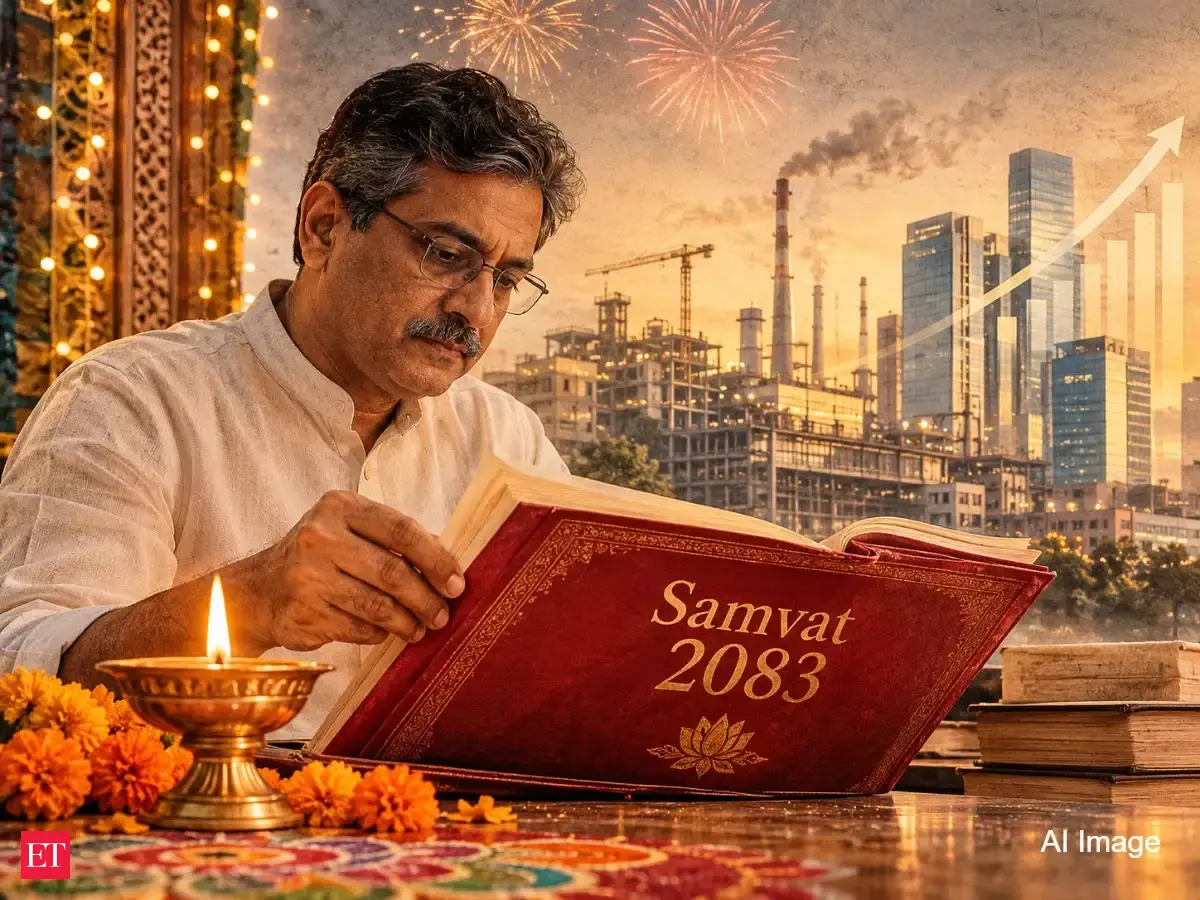
Samvat 2083 begins with Indian businesses feeling cautious optimism as the new year starts. Strong GST collections and festive demand showed economic resilience, but weak hiring and food inflation cloud the outlook. Sustained private investment and better corporate earnings will now determine if this growth finally creates more new jobs.
Synopsis
Samvat 2083 begins with Indian businesses entering the new year on a note of cautious optimism. Strong GST collections, festive demand and the RBI’s upgraded FY27 growth forecast point to economic resilience. But weak hiring, easing manufacturing momentum, food inflation and crude oil risks cloud the outlook. Sustained private investment and stronger corporate earnings will determine whether growth creates jobs.
Listen to this article in summarized format
Loading...
×
Diwali marks the beginning of Samvat 2083, the traditional Hindu New Year that has long held special significance for India's business community. For generations, traders and merchants have treated the occasion as the start of a fresh commercial cycle, opening new account books and seeking prosperity for the year ahead. The tradition continues in modern India through Chopda Pujan (ritual worship of account books) and the stock exchanges' annual Muhurat Trading session.
But the significance of a new Samvat extends well beyond Dalal Street. Since it is a new year for businesses, it also offers an occasion to assess the prospects of India's wider economy, its businesses and the forces likely to shape commercial activity in the coming year.
A resilient economy faces an uncertain global environment
The Indian economy enters Samvat 2083 with reasonably strong domestic fundamentals, although the external environment remains challenging. Recent economic indicators suggest that domestic demand continues to provide an important growth cushion.
India's services sector expanded at its fastest pace in four months in October, Reuters reported. Improved domestic demand supported new business, pointing to continued strength in the country's largest economic sector. However, subdued hiring and weaker international orders suggest that domestic momentum has yet to translate into equally strong external demand.
Live Events
You Might Also Like:
ET Graphics: Inside India’s factories — Jobs, pay, margins
Services have become a major driver of India's economic expansion, covering everything from financial services and technology to transport, hospitality and professional services. Sustaining growth will require businesses to convert demand into new investment and employment.
Festive demand provides an early signal
The festive season offers an encouraging starting point for the new Samvat. October's gross Goods and Services Tax (GST) collections rose 22.9% year-on-year to a record Rs 2.31 lakh crore. Net GST collections stood at Rs 2.03 lakh crore, up 25.6%. The increase points to substantial economic activity during the festive period, although GST receipts also reflect the timing of tax payments and business settlements.
The festive season has provided an encouraging indication of consumer demand as Samvat 2083 begins. Dhanteras gold sales improved despite domestic prices remaining significantly higher than a year ago, suggesting that consumers have not abandoned traditional festive purchases even in a high-price environment.
Gold sales on Dhanteras were estimated at around 52 tonnes, up 12% from 46 tonnes in the previous year, TOI reported. In value terms, sales were pegged at approximately Rs 70,000 crore. Silver sales were also expected to increase to around 300 tonnes from 250 tonnes. Jewellers saw gold sales volumes rise 8-10% while sales value increased 18-20% year-on-year, as per an ET report. Senco Gold reported a growth of more than 25% in sales value.
A correction in gold prices just before Dhanteras helped revive buying interest. Wedding-related demand and advance bookings provided further support.
The trend offers a useful insight into India's consumption economy. Even when prices are elevated, culturally significant occasions can sustain spending, although consumers may adjust the size and composition of their purchases. The strong response across smaller cities is particularly encouraging for organised retail. The bigger question is whether this festive momentum will extend into the post-Diwali period and translate into sustained demand for automobiles, consumer durables and other discretionary products.
For retailers, automobile manufacturers, consumer goods companies and jewellery businesses, the sustainability of festive demand will be more important than the initial sales numbers. The real test is whether spending remains strong after the festival season.
Manufacturing needs to regain momentum
The manufacturing sector enters Samvat 2083 with a mixed set of indicators. India's HSBC Manufacturing Purchasing Managers' Index slipped to 54.7 in October from 55.1 in September. A reading above 50 indicates expansion, so factory activity remains in growth territory. However, the moderation in new orders and domestic demand suggests that the pace is losing some momentum.
There is a positive signal from overseas markets. Export orders grew at their fastest pace in six months, helping manufacturers offset softer domestic demand. Input-cost inflation also fell to its lowest level since February, while selling-price increases were the weakest in nearly four years. This could offer some relief to businesses facing pressure on margins. However, factory employment growth slowed and business confidence remained below its long-term average. Manufacturers also increased inventories, partly as a precaution against possible supply disruptions.
The challenge for the coming year will be to turn export demand into sustained production growth. Capacity expansion will depend on how confident businesses are about future orders rather than short-term inventory accumulation.
The employment question cannot be ignored
A recurring concern in the latest business surveys is the weak response of hiring to improving economic activity. Employment has remained subdued even as new business improved. The October composite PMI had similarly shown that hiring had almost stalled despite stronger private-sector activity.
This raises an important question about the quality of economic growth. Businesses appear capable of handling higher workloads without proportionately increasing their workforce. That may reflect productivity improvements, cautious expansion plans or uncertainty about the durability of demand. For India's economy, however, sustained employment creation is essential to broaden consumption beyond households that already have relatively strong purchasing power.
The coming Samvat will therefore need to be judged not merely by GDP growth but also by whether businesses begin translating stronger orders into more jobs.
Food inflation and rural demand remain vulnerable
The inflation outlook could prove particularly important for consumer-facing businesses. India runs the risk of prolonged food inflation with pressure extending across grains, chicken and milk. Food accounts for a substantial share of household expenditure, particularly in lower-income households.
Persistent food inflation can squeeze disposable incomes and leave consumers with less money for discretionary purchases. It can also raise operating costs for food processors, restaurants and other businesses. The impact could be more pronounced in rural India, where household purchasing power is closely linked to agricultural income and food prices.
Agricultural output and rural demand will consequently be important variables to watch. A favourable rural income environment could support sales of two-wheelers, consumer durables and fast-moving consumer goods. Conversely, higher food bills could limit the recovery in these categories.
External risks
India's dependence on imported energy makes crude oil prices a critical variable for Samvat 2083. The West Asia conflict has already exposed the vulnerability of global energy supply chains. Brent crude recently raced towards $120 a barrel amid concerns about disruptions to supplies through the Strait of Hormuz before dipping below $100.
Since India imports more than 88% of its crude oil requirements, a prolonged increase in international prices would raise the import bill and could put pressure on the rupee. It would also increase costs for airlines, transport operators, petrochemical companies and energy-intensive manufacturers. Higher fuel and transportation costs could eventually feed into consumer inflation.
The situation is not entirely negative. Reuters reported in October that India's West Asian crude imports had recovered to pre-war levels in September, reaching approximately 2.8 million barrels per day. This accounted for 54% of total crude purchases. Russian oil imports, meanwhile, declined 14% month-on-month to 1.8 million barrels per day. The changing import mix reflects India's efforts to secure supplies in a volatile global energy market.
For businesses, the important consideration will be the duration of energy price volatility. A temporary spike can be absorbed more easily than a prolonged period of elevated input costs.
Investment and corporate earnings need to pick up
India's growth outlook continues to receive support from domestic consumption and investment. The Reserve Bank of India raised its FY27GDP growth projection to 7.1% in October, from 6.7% earlier. The revision reflected stronger-than-expected economic activity, including 7.8% GDP growth in the April-June quarter. The central bank also pointed to resilient consumption and investment.
However, private investment, which has ticked up recently, needs to become a more consistent growth driver. Government infrastructure expenditure can create demand for steel, cement, construction equipment and logistics services but sustained economic expansion will require private companies to commit capital towards new factories, technology and capacity expansion.
The outlook for corporate profitability is also important. Market analysts expect an improvement in earnings growth during FY27 after a relatively weak FY26. The larger expectation is that more reasonable valuations and stronger corporate earnings could support an improvement in investor sentiment.
The underlying point extends beyond the stock market. Stronger earnings give companies greater room to invest, hire and expand their businesses.
A new year of opportunities, but execution will matter
Samvat 2083 begins with a relatively encouraging domestic economic backdrop. Festive consumption has been strong, services activity has improved and manufacturing continues to expand while private investment is ticking up. The RBI's growth projection also suggests confidence in India's underlying economic resilience.
But the emerging weaknesses cannot be overlooked. Hiring remains subdued despite stronger business activity. Manufacturing growth has moderated and food inflation could constrain household spending. Energy prices and geopolitical uncertainty remain outside India's control.
For India's traders, manufacturers, retailers and entrepreneurs, the coming year will be about converting economic resilience into actual business growth. The extent to which domestic demand sustains itself after the festive season will be an important indicator. Equally significant will be the willingness of companies to invest in fresh capacity and create employment.
The traditional opening of new account books on Diwali carries a commercial significance that remains relevant even in a modern economy. As Samvat 2083 begins, the larger expectation is that the year brings more than favourable market returns. It should translate into stronger business activity, greater investment and wider economic opportunity.
(You can now subscribe to our Economic Times WhatsApp channel)
Seoul halts trading, Nifty has its best week since 2021: Money leaving the AI trade – will it land in India?
Junk bonds are cracking at the bottom. Will the noise get loud enough to make ‘junk bond’ a household term again?
PNG connections rise half a million, but how many use piped gas for cooking?
Some elections matter more than you know: No crop changed in the fields, yet sugar, coffee and soya got cheaper in a day
You can buy a walkie-talkie online. But can you legally use it?
KYB and KYC: Quick commerce, the Damani premium and what DMart must deliver – 3rd and concluding part