
Russian oil refinery shutdowns caused an 18% drop in output during the third quarter. Strikes damaged port infrastructure, hurting exports and slowing GDP growth. Sberbank’s Taras Skvortsov said, “The negative impact of a period of high rates and high real interest rates continues to accumulate; it is putting increasing pressure.”
Shutdowns at oil refineries drove an 18% year-on-year decline in refining output in the third quarter, the steepest drop in comparable quarterly figures going back to 2020, according to data from the Federal Statistics Service. Lower fuel production deepened a contraction in mining while pushing wholesale trade into negative territory, the data show.
Strikes have also damaged loading terminals and port infrastructure, weighing on exports.
“I also want to emphasize here the role of the war escalation in the Azov and Black Sea basin on growth,” said Tatiana Orlova of Oxford Economics. “This new crisis is largely responsible for the drop in the volume of crude exported via the Black Sea which is not affected by the refinery strikes.”
Lower crude and oil-product exports cut about 3.75 percentage points from year-on-year growth in total exports in the third quarter and reduced GDP growth by around 0.7 percentage point, Orlova estimates.
Outside military production, consumer demand remains the only source of growth, but it’s also slowed sharply to 4.2% year-on-year in the third quarter, down from 7.2% in the previous three months. At the same time, prices have risen, wage growth has eased, and businesses continue to face rising costs and high borrowing rates.
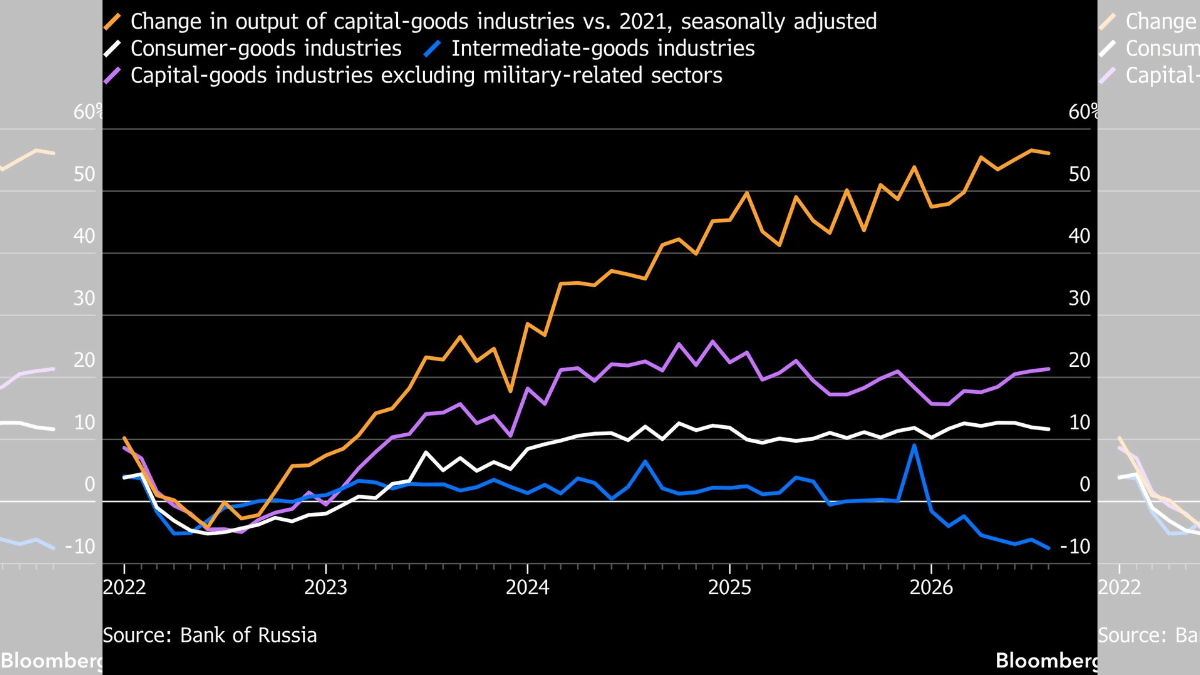
Output across a range of consumer-goods industries also contracted.
A growing number of industries are “not doing particularly well,” Sberbank Chief Financial Officer Taras Skvortsov said on an investor call in October. Russia’s biggest lender sees corporate loan quality as a growing concern.
“The negative impact of a period of high rates and high real interest rates continues to accumulate; it is putting increasing pressure on clients” he said. “All of this adds to our pessimism.”
The loss of production capacity in the third quarter pushed Russia’s economy into what the central bank calls a “positive output gap,” in which supply falls short of demand.
Manufacturing continues to expand, led by double-digit growth in industries catering to state demand with military spending set to reach a record this year. The gap between war-related industries and the rest of the economy has continued to widen.
Weak demand, a shortage of working capital and late payments by counterparties were Russian companies’ main constraints in the third quarter, according to a survey by the Russian Union of Industrialists and Entrepreneurs.
Limited access to borrowing and a rising debt burden ranked as the next most pressing concerns, with each cited by about 20% of respondents — the highest share on record for the latter, according to the report.
The Bank of Russia now expects monetary policy to remain moderately tight for longer, with less room to ease as it grapples with the inflationary impact of the drone attacks.
Higher fuel prices have raised the cost of a range of goods, pushing inflation further from the central bank’s 4% target, which Russia is set to miss for the seventh consecutive year.
Annual inflation is expected to accelerate to 7.07% in October from 6.35% a month earlier, according to the median estimate in a Bloomberg survey.
Official forecasts for 1.4% growth next year and 1.9% in 2028 are “overoptimistic,” she said.