
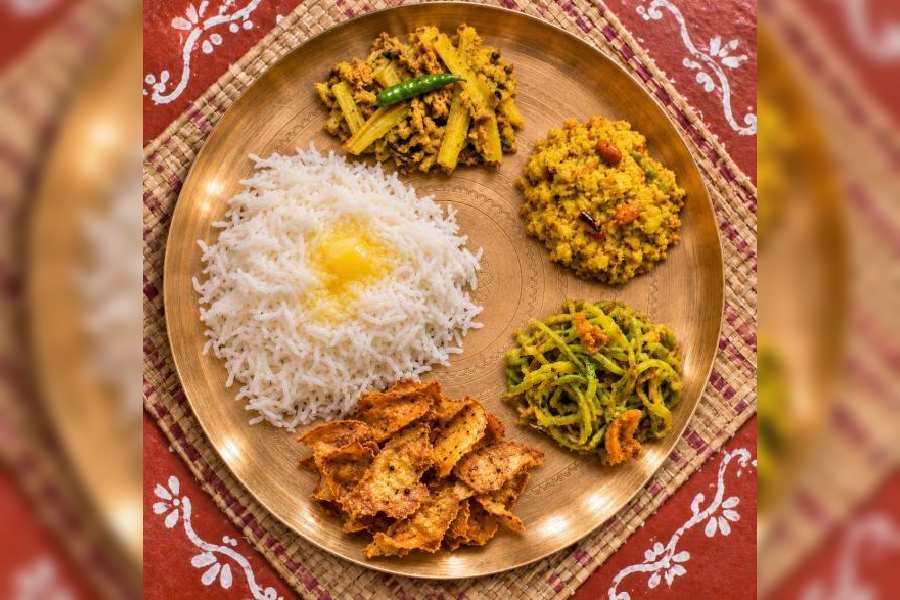
Bengali cuisine often uses stalks and peels to stretch food budgets, a habit sharpened by colonial rule. The 1943 famine showed that hunger is not just about supply. Amartya Sen called it "entitlement failure," noting that three million people died because their claim on food collapsed, not because it vanished.
Every cuisine has a history. Bengali cuisine has a history and a receipt.
A plate of food can look ordinary when it arrives on the table, particularly to someone who has never had to calculate whether there will be another. As a child in Jamshedpur, I would throw a tantrum when phulkopir dnata chorchori, a mustard-sharp jumble built around the stalk of the cauliflower, appeared at lunch. I did not want the softness or the faintly bitter aftertaste. I wanted something else. At that age, I could not understand why anyone would cook the stalk at all. The answer, I learnt much later, lay in two centuries of household arithmetic.
Food writers now celebrate root-to-stem cooking as a modern virtue. Restaurant menus in Calcutta place thor and khosha bhaja as timeless Bengali heritage. Both readings flatter the kitchen and miss part of its history. Bengali cooks did not learn to use stalks, leaves, peels and stems from scarcity alone; ecology, regional exchange, faith and plain taste all had a hand in it. But long periods of compressed purchasing power under colonial rule sharpened these habits into something closer to a principle: make a purchased vegetable go as far as it can and discard nothing that could feed someone. What is sold today as tradition was often also a way of stretching a household's food budget.
The famine of 1943 offers the sharpest evidence of this, although it is better read as the collapse of a chronic condition than as a bolt from nowhere. Rice supplied three quarters or more of the daily Bengali diet; this left almost no margin when prices moved. Wartime disruption, procurement and hoarding roughly quadrupled the wholesale price of rice in Calcutta between the middle of 1942 and the middle of 1943 and agricultural wages did not follow. A labourer's earnings simply stopped commanding food. Amartya Sen's reconstruction put per capita food-grain availability in 1943 at roughly 9% above 1941, a year without famine. The figure has since been contested by historians, although the insight it carried has held: three million people did not die because food ran out but because their claim on it collapsed. Sen called it "entitlement failure", and the term has not been improved upon. Food is never merely a matter of supply; it is a matter of means, of the wages or assets through which people command what is already there.
The colonial State had, in fact, already experimented with the diet it would later starve. Company ledgers from 1797, now held in the India Office Records at the British Library, record agents in Bengal distributing free potato seed to peasants, and an 1800 Bengal Revenue Commission report said the tuber would help "alleviate the Miseries" of failed rice crops. Adam Smith had given the potato several admiring paragraphs in The Wealth of Nations, predicting that the same land would feed many more people. This is the supply-side idea of hunger: grow more per acre and the hungry will eat. The idea measures the seed and stays silent on why a peasant needed a subsidised tuber in the first place. A crop inserted under duress became indispensable, so much so that Bengali cooking without the potato is now nearly unimaginable.
Honesty requires two concessions. The dish I refused cannot itself remember 1770: cauliflower reached India only in 1822, imported by a Kew botanist named Jemson to the Company's gardens at Saharanpur, so phulkopir dnata chorchori is at most two centuries old, and it may well have begun as urban thrift rather than rural survival. The historian, Utsa Ray, has traced how the Bengali Hindu middle class, under colonial conditions, fashioned its very idea of a Bengali cuisine, which is reason enough to be careful with the word, tradition. Nor was scarcity the kitchen's only teacher; ritual restriction decided much of what could be cooked: this is also, after all, a cuisine of hilsa, mutton and mishti. Neither concession rescues the romantic reading. A household that feasts during the Pujas and eats stalks on an ordinary Tuesday is making one set of decisions across one year, and a cuisine with two registers is evidence of a budget. The habit of total use is the constant running beneath both.
The economics of the stalk is plain enough. It did not require a second purchase and it made a vegetable feed more people. My tantrum was possible only because someone before me had already paid for the right to refuse; what I mistook for preference was slack in a budget that earlier generations of the same kitchen may never have known. The stranger fact is what happened afterwards. As incomes rose, these dishes did not quietly disappear the way an economist might expect. They climbed the income curve and turned into nostalgia, cooked now by choice and priced on restaurant menus as memory. The constraint fell away and the recipe stayed.
The best comparison is a kitchen that answers to a rule instead of a budget. At the Jagannath temple in Puri, food is offered to the deity six times a day, and the kitchen keeps out vegetables of foreign origin, among them the potato and the cauliflower, the two crops that meet in an ordinary Bengali pan. The food writer, Nina Mukerjee Furstenau, notes that the temple has cooked this way for roughly five hundred years; the potato is simply too new to be served. The temple kitchen answers to a rule, the household kitchen to a budget, and only one of them took the potato.
The dish reached my childhood plate in Jamshedpur, a steel town outside Bengal, because kitchens carry their training wherever the household goes. Nobody in my family called it economics; it was simply how a kitchen behaved. I still would not choose phulkopir dnata chorchori over almost anything else on the table. But I no longer ask why anyone would cook the stalk. For two hundred years, the better question was how anyone could afford not to.